| Author |
 Replies: 9 / Views: 2,592 Replies: 9 / Views: 2,592 |
|
|
New Member
United States
5 Posts |
Hey~ Hope everyone is enjoying life. My wife and I were at my brothers house down by the beach. Little woman told me to pick that up. We were walking in the surf. Submitted for your approval. One paper thin "thing" looks to be hammer stamped on both sides. Have gone to a language site and so far it has stirred a little controversy. As that the Arabic language has changed over the years and Arabic is a strange language to begin with. Some symbols are for holding your breath then exhaling to make a sound. So as the years went on some symbols were dropped. Here are two pictures of the coin "thing" it is approximately 5/8 inch wide 13 centimeters. About as thick as a magazine cover. So far the thought pattern is "Minted in ? 122 Feel free to jump in the mix. I have talked to a handful of people from Belgium to Wales to points unknown. 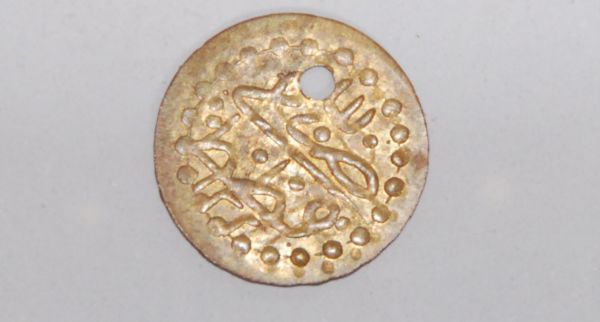 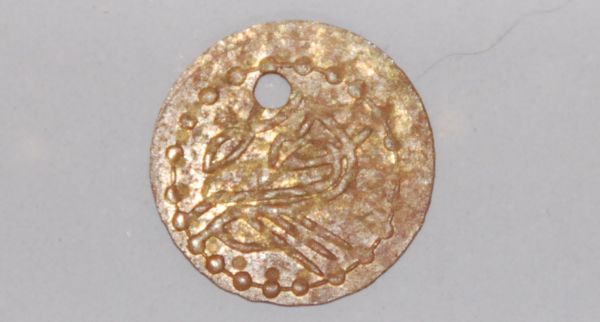 *** Moved by Staff to a more appropriate forum. *** *** Moved by Staff to a more appropriate forum. *** |
|
|
|
Moderator
 Australia
17005 Posts |
Hello and welcome.  Sorry to tell you, but what you've got is not an actual coin. it's a somewhat crude imitation of an Ottoman Empire coin, specifically a Turkish gold coin. The Arabic inscription on the reverse (top pic) is somewhat garbled but seems to be trying to say zuriba fi Qutanta - "struck in Qutanta", with "Qutanta" being a garbled rendition of "Qustantiniya" - Constantinople, the Ottoman capital (not Istanbul). The "date" is also garbled; the coin it was copied from was likely dated 1223 or 1255. The bottom pic is a crudely rendered toughra, the Ottoman sultan's signature. Do a forum search for "imitation Ottoman" and you'll find many more such coins. Some are very close and realistic imitations, others are just a garbled mess. Yours is somewhere in between. These "jewellery copies" are used for decorative purposes, at weddings and other celebrations. Think "belly-dancer coin", if that helps you imagine what they're used for. Don't say "infinitely" when you mean "very"; otherwise, you'll have no word left when you want to talk about something really infinite. - C. S. Lewis
|
|
New Member
 United States
5 Posts |
Hey~
Never said it was a coin. Being as thin as it is I thought exactly what you put forth.
But if you don't mind can you tell me how you arrive at the "zuriba fi Qutanta" Struck in Qutanta. As opposed to "Minted in" or "Made in"
Also Copper or Brass perhaps a mix there of?
I did a search on Fake Otterman coins to begin with that's what brought me to this site.
As for the Toughra have also been told it could be a symbol representing an animal.
So no way to date it even if it is a belly dancer bobble.
And if you don't mind me probing your mind. How did you get to the last two digits being a 23 or a 55? And not a 22
|
|
Pillar of the Community
Egypt
3470 Posts |
First  to CC forum and I agree with what Sap said Quote:
These "jewellery copies" are used for decorative purposes, at weddings and other celebrations. Think "belly-dancer coin", if that helps you imagine what they're used for. This is exactly what it is and it is still used in Egypt for the same purpose |
|
New Member
United States
5 Posts |
So no one knows how we arrived at "zuriba"? Curious as to what language you are using to get that. Since the ones I have been using begin with a "ba"
I have no problem with it being a belly dancer bobble. Belly dancers have been around for a long time.
Does anyone have an idea as to how old this "bobble" may be? Yes I have looked up current belly dancer bobbles which so far are very neatly stamped. Rounded edges and with more detail. Where as this one is crude and the stampings are off you can see the roll in the metal from the dies not lining up. So would that date it or is that info not available? If you have a site that shows similar bobbles I would love to see it. I have looked at a few and they all remind me of shiny tokens.
Again, what metal do you think it is made of? i.e. is there a scratch test I can do to see if it is Bronze, copper or some other alloy?
|
|
Pillar of the Community
Egypt
3470 Posts |
Quote:
So no one knows how we arrived at "zuriba"? Curious as to what language you are using to get that. Since the ones I have been using begin with a "ba" I dont really understand what you mean by your question, but I know that it is spelled and pronounced as "Duriba" and not "Zuriba" meaning struck or mint. |
|
Pillar of the Community
Egypt
3470 Posts |
Quote:
Again, what metal do you think it is made of? i.e. is there a scratch test I can do to see if it is Bronze, copper or some other alloy? That will be hard to say from the pics. As far as I know they were made of many metals starting from gold and silver down to copper and bras. I think may be a jeweler can help you more than I can. |
|
New Member
United States
5 Posts |
Thank you~
I have thought this to be something that would have been sewn into a garment. From the moment I picked it up.
I would like to try and date it though. The only way I know of doing that would be to find another on the internet. And see what story that person had. I have been looking in books,current stores, and old photos.
The reason that the spelling is important, in part is to help date it. At least ball park it. Currently there is some disagreement on the spelling. That is coming from a site with people who are fluent in Arabic. It is a complicated language. That has had changes over the years.
Again
Thank You.
|
|
Moderator
Australia
17005 Posts |
Quote:
But if you don't mind can you tell me how you arrive at the "zuriba fi Qutanta" Struck in Qutanta. As opposed to "Minted in" or "Made in"...
So no one knows how we arrived at "zuriba"? Curious as to what language you are using to get that. Since the ones I have been using begin with a "ba"Unlike EgCollector, I don;t live in an Arabic-speaking country. But I have a book, "Arabic coins and how to read them" by Richard Plant. In the introduction to the book, the author explains that he won't teach you how to speak conversational Arabic, but will try to teach you how to read the writing on Arabic coins. Plant gives the word at the top of the reverse as "zuriba" - perhaps using "z" to distinguish it from the other letters pronounced with a "d" or "b" sound. The speaker on Google Translate pronounces the same word with a "b" sound; I suspect different regions and dialects in the Arab word pronounce some letters slightly differently. This word "zuriba" is derived from the root word meaning "to hit", hence "struck" is a more literal translation. Quote:
The reason that the spelling is important, in part is to help date it. At least ball park it. Currently there is some disagreement on the spelling. The problem is, the maker of this piece was not trying to write legible, sensible Arabic; they were trying to make a piece of jewellery that looked at first glance like a coin. The "date" which appears on it is meaningless, because it was slavishly and roughly copied from a much older coin. It's impossible to date it, except to say that it was made sometime after the coin it was copied off, which dated from sometime in the mid-1800s. But they are still making such pieces today. Don't say "infinitely" when you mean "very"; otherwise, you'll have no word left when you want to talk about something really infinite. - C. S. Lewis
|
|
New Member
United States
5 Posts |
Would like to find a site with similar "tokens" on it.
Site I was talking to people didn't think it was a coin either but had wondered if it was a stamp i.e. like a dog license or for proof of taxes paid.
No one thought it was a date on the bottom. Only 2 maybe 3 digits.
Main reason I have been looking for a similar stamping. Only thing I found was a para coin in silver which was just as thin.
The belly dancer tokens look better are thicker, have rounded edges and tend to have a wreath going around the rim.
Thanks for clearing up the Za or Ba thing. That makes total sense since I have been researching this. Will look for a copy of this book.
Found this "token" in the town of Lewes Delaware which has a very rich history of being a big port in its day. No longer a port but a beach resort small town, where on any given evening you will see people with their Metal Detectors scouring the water for gold doubloons. During the 1800's in a two year period over 80 ships sunk in the bay from bad storms. So hundreds have sunk since the town began in 1600. And a lot of tourist lose their rings also. A lot of the town is built on fill from the inlet. Stuff pops up from time to time.
My brother found a very old pad lock while planting a bush the other day. Looks to be from mid 1800s.
Every time a barge goes up the river it stirs the waters. Always opportunity.
AS for you think some dialects pronounce things differently. Brother you have no idea. A dot next to a symbol can be decorative or an accent to the word, highlighting the word. i.e. Ohio O-hi-o.
Either way Thank you for your input. Much appreciated.
|
| |
Replies: 9 / Views: 2,592 |
|








 Posted 06/16/2011 10:37 am


