Coin Community Family of Web Sites Join Thousands of Coin, Bullion, & Money Collectors
Vancouvers #1 Coin and Paper Money Dealer 300,000 items to help build your collection! Coin, Banknote and Medal Collectors's Online Mall Join Thousands of Coin, Bullion, & Money Collectors Specializing in Modern Numismatics Royal Estate Auctions - $1 Coin AuctionsRoyal Canadian Mint products, Canadian, Polish, American, and world coins and banknotes.


Username:
Password:
Save Password
Forgot your Password?


This page may contain links that result in small commissions to keep this free site up and running.

Welcome Guest! Registering and/or logging in will remove the anchor (bottom) ads. It's Free!

NGC AU-50 1840 Goa Rupia

To participate in the forum you must log in or register.
Author Previous TopicReplies: 20 / Views: 5,412Next Topic
Page: of 2
Pillar of the Community
swamperbob's Avatar
United States
5362 Posts
 Posted 07/02/2011  5:59 pm  Show Profile   Bookmark this reply Add swamperbob to your friends list Get a Link to this Reply
There is one other item I would like to point about this coin that is actually a serious anomaly.

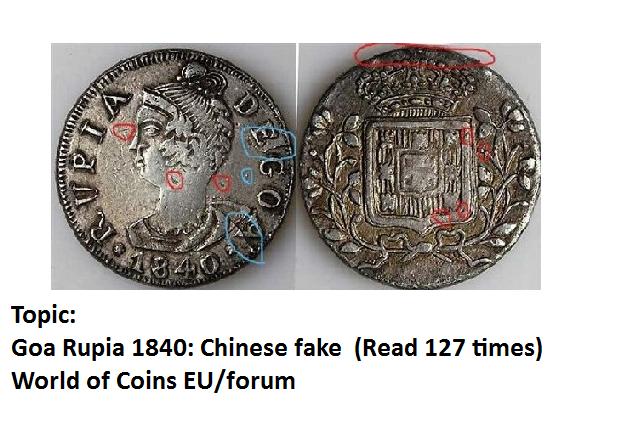
It is one of the dots which was shown previously circled in blue to the left of the letter G. See picture below from the World Coin EU Forum.

NGC--AU-50-1840-Goa-Rupia

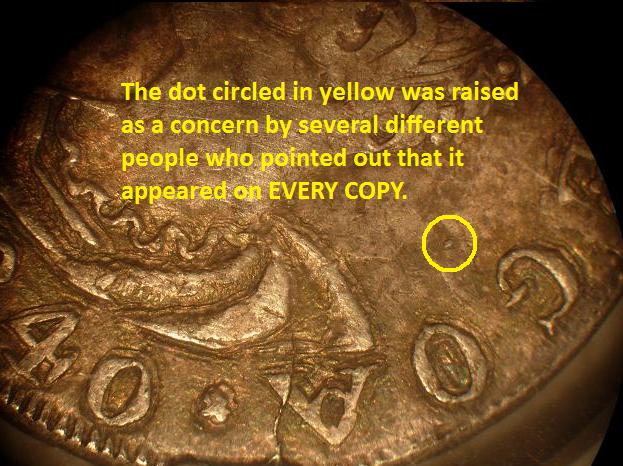
The same dot appears on my earlier photo that shows the crack. Here it is circled in yellow. It looks like a simple die ding that fills with metal.

NGC--AU-50-1840-Goa-Rupia

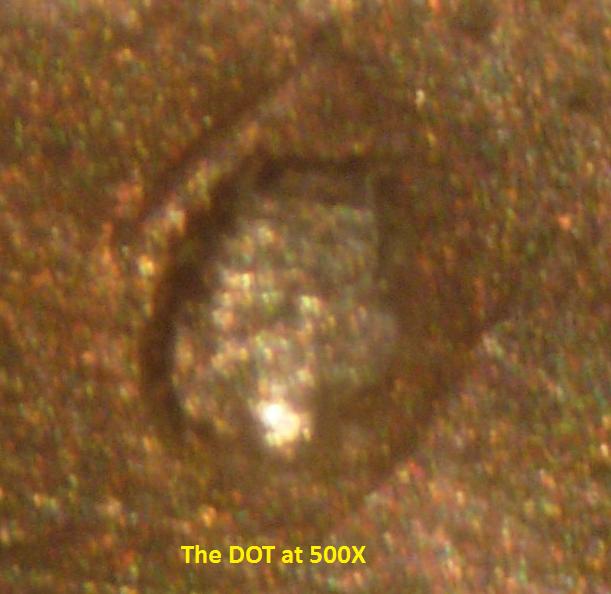
But here is that same area (rotated 30 degrees counterclockwise and viewed at 500X.

NGC--AU-50-1840-Goa-Rupia

If you notice there is now a very curious thing visible. The dot is clearly raised above the average level of the field of the coin (the die surface) but there is an INCUSE square area around the base of the dot. This incuse area is depressed BELOW the field level and would have to be a raised square on the actual die.

That is a very ODD FEATURE.

Another proof of forgery.
Pillar of the Community
Czech Republic
803 Posts
 Posted 07/02/2011  6:28 pm  Show Profile   Bookmark this reply Add TwoKopeiki to your friends list Get a Link to this Reply
I've always liked Goa issues because of the hand-cut elements of the dies. Great detective work, Bob! What's with "ghosting" around most elements? Almost as if every letter was recut on the die?
Pillar of the Community
swamperbob's Avatar
United States
5362 Posts
 Posted 07/02/2011  6:55 pm  Show Profile   Bookmark this reply Add swamperbob to your friends list Get a Link to this Reply
TwoKopeiki Ghosting is definitely present as well as some doubling from the original strike or strikes. Both features were copied onto the counterfeit dies used to strike this coin. When thinking about this coin we must clearly think in terms of two dies and two strikes. What happened to make the original coin look like it did and what happened in the counterfeit strike.

The ghosting in my opinion is a feature of the host coin which the forgers copied when making this die. There may also be some added erosion of the counterfeit die making it a bit more confusing. But which ever die is involved GHOSTING is present.

Ghosting occurs as a result of the way a die wears. It happens around sharply defined features that were cut or punched into the original die. Many of these early dies were made with small punch tools that gouged lines into the die face or which actual punches that exerted significant impact force to a small area of the metal. This impact force can harden the metal just slightly more that the surrounding metal.

In addition, the method used for hardening of the die after it is finished can be effected by any sharp features, so that the die just a slight bit harder right at the die feature than a fraction of a mm away. The theory of ghosting presumes that the result is a differential in the rate of wear right near any sharp die feature. This creates erosion in the die surface next to the feature more quickly than in the adjacent field. This depression in the die translates to a ghost image on the die.

I hope that is clearer than mud.

This is a much discussed topic and you can find experts with different explanations for the mechanism that causes ghosting. BUt it is most often seen on well used dies near the end of their useful life.

It is confusing but die wear rates are clearly involved.
Pillar of the Community
Czech Republic
803 Posts
 Posted 07/02/2011  7:28 pm  Show Profile   Bookmark this reply Add TwoKopeiki to your friends list Get a Link to this Reply
Thank you for a great explanation, Bob!
Bedrock of the Community
DVCollector's Avatar
United States
10045 Posts
 Posted 07/02/2011  9:15 pm  Show Profile   Bookmark this reply Add DVCollector to your friends list Get a Link to this Reply

Quote:
The die had a crack.
The coin was struck by the die twice (or more).
The crack appears - ONCE
THAT IS IMPOSSIBLE
Sure, that's totally clear and logical--once explained. It's akin to hearing Sherlock Holmes' explaining his train of logic--it seems simple in retrospect.
  Previous TopicReplies: 20 / Views: 5,412Next Topic
Page: of 2

To participate in the forum you must log in or register.


Disclaimer: While a tremendous amount of effort goes into ensuring the accuracy of the information contained in this site, Coin Community assumes no liability for errors. Copyright 2005 - 2026 Coin Community Family- all rights reserved worldwide. Use of any images or content on this website without prior written permission of Coin Community or the original lender is strictly prohibited.
Contact Us  |  Advertise Here  |  Privacy Policy / Terms of Use

Coin Community Forum © 2005 - 2026 Coin Community Forums
It took 0.22 seconds to rattle this change. Forums