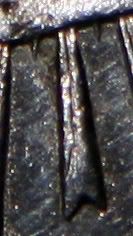
Dragon teeth is an anti-counterfeit feature on standardized dies and looks like two tiny teeth, one on each side of the bottom middle ray.
And here's what mr Swamperbob had to say about "dragon teeth" in one of his e-mails to me back in 2006:
Quote:The dragon's teeth were first added as an Anti-counterfeiting measure to the Mexico City dies in 1867 when they adopted what Dunigan refers to as the 1867 to 1897 die style. I split that style down because the Standardized hubs were not produced until about 1870-75 at Mexico City and they made minor variations after that date until 1887. The change in the snake's head is the final major change that identifies the final Standard die type (at least for me). But there are quite a few old dies used in the transition and some old snakes heads show up on later dated coins.
The Standardized dies were introduced to the branch mints in different years. All were supposed to be converted by 1887. The last converted was Potosi - so there are actually Non-standard 1887 8Rs but only for Potosi.
To understand Standardized dies you have to avoid thinking like a modern US coin collector. US hub designs change but not as often as Mexican dies did. A Standardized die was one made in the die shop at Mexico City. They made new hubs periodically (annually or less) so there are minor variations of a type not seen on
US coins. The branch mints especially Zacatecas tried to mimic the Mo design before 1887 perhaps to keep their die sinking jobs - who knows. The Zs dies before 1887 are VERY similar to Mo produced dies. But the real standard dies were the ones made at Mexico City. Some mints used Mexico City master (King) punches and added their own details for some time - Chihuahua and Hermosillo for example. But ALL branch mints were brought under central control in about 1887. That is about the time Mexico started taxing overseas bullion coins and took production control away from the mine owners and mint leasees.
I know this can get complex and I always get a bit confused on this transition - because no sooner do I think I have it down pat than I find an 8R made from a die that causes a date to change.
Here is a quick list of approximate dates: (approximate because of carry over die usage and the issues I addressed quickly above)
Alamos 1887
Chihuahua 1868 (Although not mentioned by Dunigan some dies with Dragon's Teeth)
there are both kinds in 1868. The Standardized hubs of the Mo style are used
continually after 1870 with minor detail changes until the end of the series. The Ca mint
seems to have started using Mo made dies VERY Early on.
Culiacan 1887
Durango 1887
Guadalajara 1887
Guanajuato 1887
Hermosillo 1881 (Mexico City style using local lettering until 1887) Full Standardization
begins in 1887
Oaxaca 1881 starts using Mo dies with teeth - minor variations seen until 1884.
San Luis Potosi 1887 is a transitional year - the 1887 NON-STANDARD Pi coins are the
last ones of the kind issued. They are SCARCE - try to find one!
Zacatecas 1882 is the first time the teeth appear on SOME of the full J types. The 1882-1887
Zs issues are close copies of the Mo style but they were not made from Mo produced
dies until 1887.
The 1882 Zs transition produce some of odd types. There are two Js - straight and Full. But the ones with the Full J come in two mint styles Zs (as expected) and Go. There are at least two dies in the Go style with Zs lettering (borrowed dies?) and there are mules of the styles. Some are considered RARE. I have been cherry picking 1882 Zs coins for years.




 First Page


 Posted 07/24/2011 1:47 pm




 ... but I'm sure there will be others out there


 Time travel


