










 Posted 07/19/2011 9:19 pm


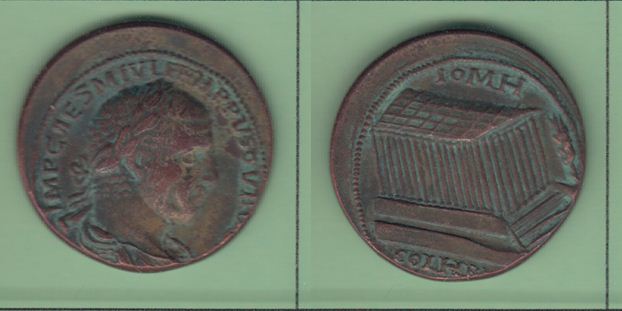
Yes. It's a very famous coin type from the colony of Heliopolis, in the province of Syria. Now known as Baalbek, Lebanon. The site is one of the best-preserved Roman colonial ruins in the Middle East. The Temple of Jupiter, depicted on the coin, is famous for having in its foundation the Trilithon, some of the largest stone blocks ever used in architecture. This Philip I example on WIldwinds is in terrible shape; this example of emperor Caracalla illustrates the reverse much better. The type was issued under several emperors from Septimus Severus to Philip I; there are several more examples on the Wildwinds page for this city.
The coins are significant, because not only do they show what the now-ruined temple looked like in all its glory, but they demonstrate that the ancient Romans knew perfectly well how to draw an orthographic 3-D projection, something often regarded as a Renaissance invention. This, coupled with the fact that architectural types (especially for well-known famous ruined buildings)means that these coins are highly sought after.
It's a scarce coin from a scarce emperor. Unfortunately, I believe your coin is not genuine. The bright-red-and-verdigris-green patina is typical of a "tourist fake", probably originally acquired in Baalbek itself. The design, with Philip I obverse, is listed on the FORVM fakes database. The slightly skewed design on the temple roof of your coin and the one on FORVM is an exact match. Sorry.
The coins are significant, because not only do they show what the now-ruined temple looked like in all its glory, but they demonstrate that the ancient Romans knew perfectly well how to draw an orthographic 3-D projection, something often regarded as a Renaissance invention. This, coupled with the fact that architectural types (especially for well-known famous ruined buildings)means that these coins are highly sought after.
It's a scarce coin from a scarce emperor. Unfortunately, I believe your coin is not genuine. The bright-red-and-verdigris-green patina is typical of a "tourist fake", probably originally acquired in Baalbek itself. The design, with Philip I obverse, is listed on the FORVM fakes database. The slightly skewed design on the temple roof of your coin and the one on FORVM is an exact match. Sorry.
Don't say "infinitely" when you mean "very"; otherwise, you'll have no word left when you want to talk about something really infinite. - C. S. Lewis


