|
This page may contain links that result in small commissions to keep this free site up and running.

Welcome Guest! Registering and/or logging in will remove the anchor (bottom) ads and the security checks. It's Free!
To participate in the forum you must log in or register. | Author |
 Replies: 19 / Views: 5,887 Replies: 19 / Views: 5,887 |
|
Pillar of the Community
United States
731 Posts |

Historically, numismatic researchers such as Rulau, Brunk, and others have attributed the VOTE THE LAND / FREE token to the Free Soil Party, which was a proponent for admitting new states into the Union under the condition that all people should be free, and slavery would not be allowed within the "soil" of each new state.
David Bowers, however, pursued research into these counterstamped coins, and has shed doubt as to this accepted theory of the stamps. Rather, Bowers proposes that the National Reform Association, a political movement involved in the 1844 presidential election, was the genesis of these curious tokens.
Given the era, and the various political movements of the time, Bowers theorizes that the National Reform Association was a better candidate as the source for the tokens, as the counterstamp better fits the slogans used by this movement. Bowers further hypothesizes that the counterstamp coins were probably struck in the springtime of 1844, shortly after the convening of the Association's March conference.

In 1844 George Henry Evans, a radical activist, established the National Reform Association. Formed in New York City, Evans and other activists focused their organization on labor movements and land reform.
In Evan's view, capitalist speculators had acquired most of the desirable frontier lands in the expanding western United States, and resultantly, had left very little for the average citizen to acquire. Upset with the belief that there was a growing disparity between the wealthy and the average working American, Evans and other activists sought to reignite old Jeffersonian ideas of self-sufficiency and self-determination through agrarianism. Society, they reckoned, would be better if farm ownership was made more easily attainable to the average American.
To that effort, Evans printed numerous newspapers and pamphlets devoted to the organization's causes. Titles of his periodicals included "Working Man's Advocate," "The Radical," "The People's Rights," and "Young America!" All were quite controversial for their time.
By mid-1844 the popularity of the Evans' efforts waned. Despite the organization's efforts, the United States never transitioned back to the utopian agrarian society that Evans' envisioned.
That said, Evans' efforts were not in vain. Whereby when Evans began his crusade, he had only the support of a few New York friends and a handful of city newspapers. But by 1850, the number of newspapers in the U.S. had grown to over 2,000, and as many as one-third had grown to support aspects of Evans' land reform movement.
In 1862, a homestead law was enacted by Congress. It enabled all citizens, either the head of a family or twenty-one years of age, the ability to acquire a tract of federal public land. As a condition for acquiring title, the tract could be no more than 160 acres, and the land had to be settled and worked for no less than 14 months.

Given the era, and the various political movements of the time, Bowers theorizes that the National Reform Association is a better candidate as the source for the tokens, as the counterstamp better fits the slogans used by this movement. Bowers further hypothesizes that the counterstamps were probably struck in the springtime of 1844, shortly after the convening of the Association's March conference.
In conducting his research, Bowers assembled a census of known and listed VOTE THE LAND / FREE tokens. The outcome of his census is the illustrated in the following:

After compiling the census, Bowers contacted Rulau and Brunk. He discovered that neither Brunk or Rulau had actually seen first hand or photographs of any post-1844 specimens.
Yet the Free Soil Party movement was active in the 1848 and 1852 presidential elections. If indeed the tokens had been struck for this movement rather than Evans', many more coins dated 1845 and later would be encountered, and thus included in the census. But they aren't.
Given the census and distribution of known and verified specimens, I'm inclined to agree with Bower's theory. Pursuant to the waning popularity of Evans' campaign in 1844, it is clear why the highest population of specimens are dated 1844 and earlier.
Bowers finally speculates that if indeed there are specimens which exist that are dated later than 1844, they were struck casually, and are not pursuant to the National Reform Association's efforts. I'm also inclined to agree.
Below is a VOTE THE LAND / FREE counterstamped large cent. The specimen is listed as HT-833 with a rarity of R-5 (31-75 known specimens.)
Its counterstamp grade is at least Very Fine.

Thanks,
Cheetah
__________________________
Sources and Images:
1. David Bowers, The E-Sylum: Volume 4, Number 16, April 15, 2001, Article 7
2. Standard Catalog of United States Tokens 1700-1900 4th Edition, Russell Rulau, Krause Publications, 2004
3. Americans and Their Land: The Deep Roots of Property and Liberty, Will Sarvis, Contemporary Review, 2008
4. Kansas Historical Society and Kansas Historical Foundation, Exhibit 'VOTE THE LAND / FREE Stamp"
5. Young America!: Principles and objects of the National Reform Association, or Agrarian League / by a member, 1845
6. History of the Labor Movement in the United States: From Colonial Times to the Founding of the American Federation of Labor, Philip Foner, International Publishers Co, 1979, pg.228
7. George Henry Evans & The Origins Of American Individualist-Anarchism, Kenneth R. Gregg, Jr. Edited by CheetahCats
08/03/2011 03:27 am
|
|
|
|
Pillar of the Community
Australia
2830 Posts |
very interesting story.
Reminds me, a bit, of the English Conders of 1790~1811.
|
|
Pillar of the Community
United States
4432 Posts |
Yet another fine and most informative post, Cheetah.
Personally, I'd venture that every advanced collection of Hard Times tokens should contain a specimen of this counterstamp; especially so, given its historical significance. These counterstamps, to my experience, tend to trade in the $75-$150 range, nowadays. Collectors need to exercise caution as there have been modern replicas struck on older, damaged large cents. The alignment of the lettering on the replicas is different, making comparison to published photos of original specimens, like the one you've posted, mandatory.
|
|
Pillar of the Community
 United States
731 Posts |
Quote:
Yet another fine and most informative post, Cheetah.
Personally, I'd venture that every advanced collection of Hard Times tokens should contain a specimen of this counterstamp; especially so, given its historical significance. These counterstamps, to my experience, tend to trade in the $75-$150 range, nowadays. Collectors need to exercise caution as there have been modern replicas struck on older, damaged large cents. The alignment of the lettering on the replicas is different, making comparison to published photos of original specimens, like the one you've posted, mandatory. Thanks!
I concur with your sentiments regarding counterstamps, and the need to exercise thorough due-diligence to ensure a specimen isn't counterfeit. Caution should be undertaken when considering purchase of most, if not all, counterstamped tokens for such possibility.
As is standard protocol for all specimens that I consider purchasing, below please find an animated comparison between the specimen featured above, and an authentic specimen that sold at Heritage.
To enhance the comparison, the featured specimen was photographed using axial lighting to better elicit the details of its counterstamp.

Thanks,
- Cheetah |
|
Pillar of the Community
United States
1147 Posts |
Great post Cheetah. Suprising to see the date census so evenly distributed.
|
|
Pillar of the Community
 Canada
9903 Posts |
|
|
Pillar of the Community
United States
1147 Posts |
Thought I would pull out and share the example I have. There is a modest amount of verdigris hidden in the hair and hairlines as well. I am quite suprised at the even distribution of large cent dates listed. Cheetah would you elaborate on the idea that pieces might have been struck following 1844? 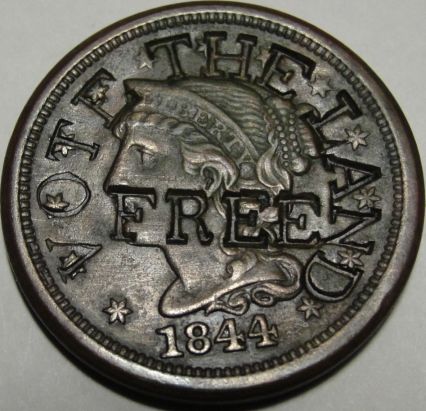 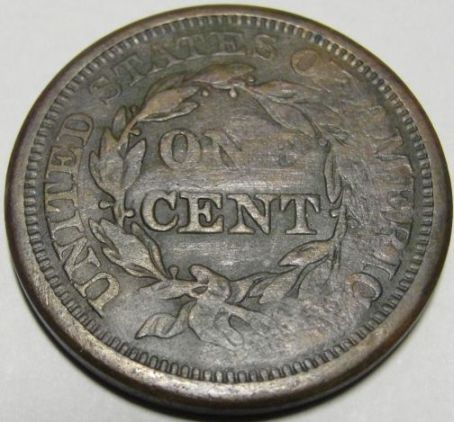 |
|
Pillar of the Community
United States
731 Posts |
Quote:
Thought I would pull out and share the example I have. There is a modest amount of verdigris hidden in the hair and hairlines as well. I am quite suprised at the even distribution of large cent dates listed. Cheetah would you elaborate on the idea that pieces might have been struck following 1844? Bowers avers that there were two organizations which could have been potential candidates for the VOTE THE LAND/FREE counterstamp. The first was the Free Soil Party. The second was the National Reform Association. The National Reform Association and its initiatives took place up to the 1844 Presidential election. Among the various beliefs of the organization was that every American should have the right to own land. The Free Soil Party, in contrast, had a tenet which believed that as a condition for new states to join the Union, the state had to agree that under no circumstances would slavery be permitted within the state. The belief from either organization fits nicely into the VOTE THE LAND / FREE counterstamp. Given both potentialities, Bowers proposed that a better way to narrow down which organization was responsible for the counterstamp was to look at the population of known specimens and their associative dates. Had the Free Soil Party been responsible for the VOTE THE LAND / FREE counterstamp, there would be many more post-1844 specimens with the counterstamp. However, pursuant to his census, very few (about 5%) date older. Thus, it would stand to reason that for whatever purpose of the counterstamps, it would have to be something different than the Free Soil Party. And given that the majority of the counterstamp specimens exist prior to 1844, it would stand to reason that it would be more probable that it was for the National Reform Association. Such a probability is heightened by the fact that a spike in the number of counterstamped large cents occurs in the years just prior to the 1844 election, and dwindles to a steady number therebefore -- which would be in line with the various dates of large cents in general circulation.  Those dated later would have been struck whimsically. Edited by CheetahCats
08/20/2011 11:31 pm
|
|
Pillar of the Community
United States
1147 Posts |
They were struck in such small quantities and almost every year is represented. Its not like they were striking random dates from what was available in ones pocket change of the time. You would think if they were going to advertise something that much higher amounts would be struck in total. So that has me wondering if they were for used in some manner such as an award/reward for such an association. The near even amounts represented would support this threory. Its interesting they are considered Hard Times when they clearly span earlier than that.
|
|
Pillar of the Community
United States
731 Posts |
Quote:
They were struck in such small quantities and almost every year is represented. Its not like they were striking random dates from what was available in ones pocket change of the time. You would think if they were going to advertise something that much higher amounts would be struck in total. So that has me wondering if they were for used in some manner such as an award/reward for such an association. The near even amounts represented would support this threory. Its interesting they are considered Hard Times when they clearly span earlier than that. The Hard Times Era was from 1833 through 1844. The tokens were struck/counterstamped in the early 1840s up to the 1844 election. That would qualify them as being from the Hard Times Era. Please clarify why these strikes wouldn't be random from pocket change. Up to specimens dated in the 1830s, there is an even distribution. Thereafter, the numbers increase -- as could be expected since newer coinages would be most prevalent in pocket change. The numbers cited in the census are those which survive -- Not total struck. In the late 1850s, as the U.S. began to emit small cents, there was a concerted effort by the mint to pull large cents out of circulation given their high copper content. It would stand to reason that the majority of large cents, including those counterstamped, would have been pulled and melted. Am I misunderstanding what you're saying? Thanks, Cheetah |
|
Pillar of the Community
United States
1147 Posts |
I would assume there are more pieces than the census lists including ones that were eventually melted, lost, or not accounted for. What the census shows to me is a very even distribution and one could even argue that the dates not represented might not be accounted for. If one went to the bank in 1844 and purchased 75 large cents (a guess) I would expect an very uneven date mix. So you can either believe they were struck at one time and that by chance the date mix is quite even which could have happend. If earlier examples show greater wear on the host coins then I would accept that idea. I would imagine these didn't see much circulation and were kept as mementos or pocket pieces. Your example is holed as to be worn on a chain or sewn onto a piece of clothing which was common. Had I not seen the census I would assume they were struck at once or over a year or two. But the idea comes to mind that possibly they were struck over time in small amounts. If earlier examples show little wear on the host coin that would support this idea. Since we are not even sure who struck these and for what purpose its all guess work. What I meant about pocket change is its unlikely to have such an even date mix when when randomly pulling coins from ones pocket. When I look at mintage numbers of large cents versus the census I dont see any correlation and that is most likely because 56 examples is too small to reflect that. You would need to know who struck them in order to know the timeframe in which they were struck.
|
|
Pillar of the Community
United States
1147 Posts |
|
|
Pillar of the Community
United States
1147 Posts |
Having read that I would be inclined to believe it was the National Reform Association.
|
|
Pillar of the Community
United States
731 Posts |
Quote:http://www.kansasmemory.org/item/212514Having read that I would be inclined to believe it was the National Reform Association. That is in the sources as per the original post. Quote:
Sources and Images:
1. David Bowers, The E-Sylum: Volume 4, Number 16, April 15, 2001, Article 7
2. Standard Catalog of United States Tokens 1700-1900 4th Edition, Russell Rulau, Krause Publications, 2004
3. Americans and Their Land: The Deep Roots of Property and Liberty, Will Sarvis, Contemporary Review, 2008
4. Kansas Historical Society and Kansas Historical Foundation, Exhibit 'VOTE THE LAND / FREE Stamp"
5. Young America!: Principles and objects of the National Reform Association, or Agrarian League / by a member, 1845
6. History of the Labor Movement in the United States: From Colonial Times to the Founding of the American Federation of Labor, Philip Foner, International Publishers Co, 1979, pg.228
7. George Henry Evans & The Origins Of American Individualist-Anarchism, Kenneth R. Gregg, Jr. |
|
Pillar of the Community
United States
1147 Posts |
I did see it in your references but I did not see this unitl after I had posted so I put the link up.
The donor, Ellis Smalley was a blacksmith, political activist, and former probate judge near Council Grove. Smalley was a delegate from Plainfield, New Jersey, at the first convention held in October of 1845, and was elected Secretary of the National Reform Association
|
|
Pillar of the Community
United States
4432 Posts |
Enjoying the informative exchange on the sidelines, I am!  While the NRA is the likely issuer of this counterstamp, the Kansas website states: "In 1848, NRA was absorbed into other political movements, like the Free Soil and Abolitionists." Is it not possible then that some abolitionist participants in the NRA adopted the slogan beyond 1844? This would account for the later dated specimens. My own collection includes three pre-1844 dated coins with this counterstamp. One, a Coronet type, has no date. I've seen others, where the date was worn or absent, too. One just sold on ebay for $99. I strongly suspect that there are a few hundred examples of this counterstamp extant. In the realm of counterstamped coins, there are examples of stamps having been used after the original issuer had passed. Silversmith, John Aitken, is one such example as I recall. Perhaps, a successor, a son or other member of Aitken's family wanted a keepsake or was simply curious how the stamp would look on a coin? IMHO, if this dual scenario is true, there's really no means of positive attribution for a given piece, regardless of the date. The NRA would be the default issuer, but who's to say that an abolitionist wouldn't have been proud to share the sentiment ... VOTE THE LAND FREE. Regardless, a great slogan, that; and, a slogan which certainly has present-day implications! From my perspective, this all adds to the mystique of this issue. |
| |
Replies: 19 / Views: 5,887 |
To participate in the forum you must log in or register.
Disclaimer: While a tremendous amount of effort goes into ensuring the accuracy of the information contained in this site, Coin Community assumes no liability for errors. Copyright 2005 - 2026 Coin Community Family- all rights reserved worldwide. Use of any images or content on this website without prior written permission of Coin Community or the original lender is strictly prohibited.
Contact Us | Advertise Here | Privacy Policy / Terms of Use
|
| Coin Community Forum |
© 2005 - 2026 Coin Community Forums |
| It took 0.47 seconds to rattle this change. |
 |
|
| |
| |







 Posted 08/05/2011 9:14 pm


