Coin Community Family of Web Sites Join Thousands of Coin, Bullion, & Money Collectors
Royal Canadian Mint products, Canadian, Polish, American, and world coins and banknotes. Coin, Banknote and Medal Collectors's Online Mall Royal Estate Auctions - $1 Coin AuctionsJoin Thousands of Coin, Bullion, & Money Collectors Specializing in Modern Numismatics 300,000 items to help build your collection! Vancouvers #1 Coin and Paper Money Dealer


Username:
Password:
Save Password
Forgot your Password?


This page may contain links that result in small commissions to keep this free site up and running.

Welcome Guest! Registering and/or logging in will remove the anchor (bottom) ads. It's Free!

Meaning Behind Constantine Issue Field Marks?

To participate in the forum you must log in or register.
Author Previous TopicReplies: 6 / Views: 3,610Next Topic  
Pillar of the Community
bobbyhelmet's Avatar
United Kingdom
2838 Posts
 Posted 08/29/2011  10:15 pm Show Profile   Bookmark this topic Add bobbyhelmet to your friends list Get a Link to this Message Number of Subscribers
This is a new thread concerning the meanings (if any) behind the field and mint marks of Constantine the Greats SOLI INVICTO COMITI issues.

It is a follow-on from a question I asked jamesicus in the below thread but hopefully others can join in:

https://goccf.com/t/95782

The basic background is that I couldn't get my head around some of the Roman mint and field marks so decided to study the coin type I had the most of, Constantine SOLs.

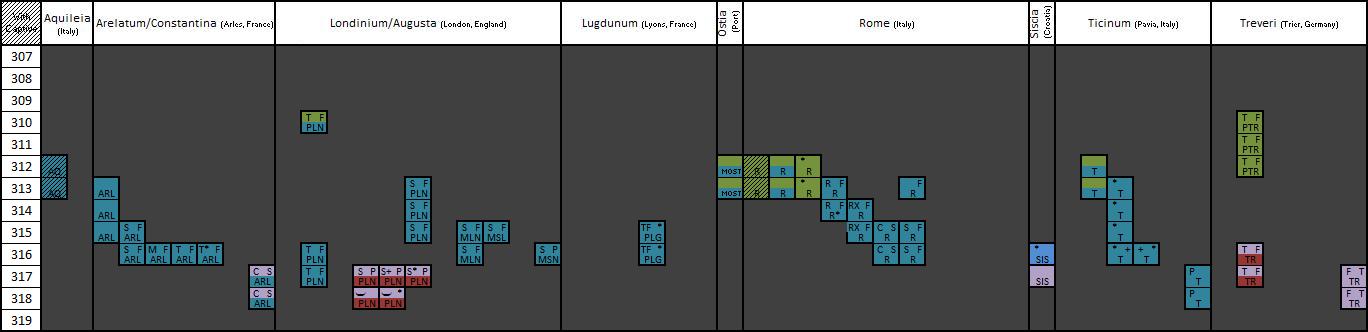
Below is my attempt to visualise the issues chronologically:
Meaning-Behind-Constantine-Issue-Field-Marks?

Issue years are on the left and mints across the top - the shaded out boxes are Sol issues that have captives in the main image and not in a field or mint mark. The other boxes show all known field and mint variations excluding officinae marks.

Below are observations and theories I have either read or have suggested to try and explain the marks, let me know if any of them sound likely or just plain fantasy!

None of the field marks show any officinae or officinae style control except perhaps the 'A S' and 'B S' issues from Trier in 317 and 318.

I believe the field and mint changes are there first and foremost for management and accountability but also feel they must have some other meaning as they dont follow a set sequence.

Main image captive issues appear in Aquileia and Rome in 312 and in 313 in Ticinum, 313 also sees a captive in a field mark issue from Treveri. (it looks like 'Tr' as I cant track an example down and draw a font, sorry). The above coincides with the Battle of Milvan Bridge (late 312) and later the taking of Rome from Maxentius.

We again see captive issues introduced at Arelatum in 318 (left and right seated types) when Constantine takes Raetia and Pannonia from Licinius in 317. We also see a Laurel wreath issue in Rome around the same time.

We see crescent issues in Arelatum and Londinium in 318 - the crescent symbol has links to fertility and these issues coincide with the birth of Constantius II born in Sirmium, Pannonia (Serbia) 317 (August 7th).

We also see a crescent issue in Rome in 316 coinciding with the birth of Constantine II born in Arelatum (France) 316 (August?).

In 310 we see a '*T *F' issue appear from Londinium, stars have been know to be used to represent the Emperor. We have 2 stars on this coin, it was in 310 that Galerius begins referring to both Constantine and Maxentius as joint Augusti in the West. In 312 and 313 we see a single star on issues from multiple mints, again this is around the battle of Milvan Bridge and Constantines defeat of Maxentius. Is he proclaiming that he is now sole emperor, at least in the West.

Think I'll leave it there for now as checking my dates etc is time consuming, I'll add some other bits and bobs later, I'm not sure I believe any of the above but there seems to have been little study in this area, perhaps little study is the wrong word and I mean little results.

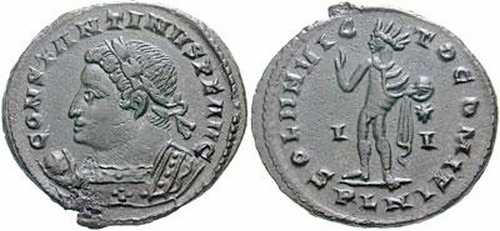
Edited to add a basic coin of the type so people can see exactly which one I mean.
Meaning-Behind-Constantine-Issue-Field-Marks?

btw - all dates etc are taken from multiple sources but mainly RIC and Helveticas tables which I assume are mainly based on RIC.


Edited by bobbyhelmet
08/29/2011 10:19 pm
Pillar of the Community
bobbyhelmet's Avatar
United Kingdom
2838 Posts
 Posted 08/29/2011  11:49 pm  Show Profile   Bookmark this reply Add bobbyhelmet to your friends list Get a Link to this Reply
In 316 in Ticinum we see '* +' and '+ *' issues, the '+' has obvious links to Christianity - could this (with the '*') be a statement of the Emperors links to the religion? I know other coins of Constantine start showing these themes as early as 314, shortly after the Edict of Milan (312) proclaiming religious tolerance.

Thats most of the symbols meanings guessed at but what about the letters in the fields.

'I *I' Londinium sometime between 310 and 312, only 2 examples are known. It is theorised that 'I *I' stands for 'IMAGO IMPERATORI' (Vision of the Emperor) and it was minted in 310. This is way off the romantic notion of a 'vision' just before the battle of Milvian Bridge in 312 but some accounts of the 'vision' state it as taking place a long time before that particular battle.

'T F / F T' The earliest known field marks appearing in Londinium, Trier and Lugdunum at about the same time (309/310). This was only a few years after Constantine assumed an uneasy control of parts of the western Empire. TEMPORVM FELICITAS? (Times of Prosperity) was a well known phrase and used on earlier coins - could it be an attempt to spread propaganda by an unsure Constantine.

'S F' appears in 313 in Londinium and Lugdunum and later in Arelatum and Rome. SAECVLI FELICITAS? (Age of Prosperity), again a well known phrase and used on earlier coins, its another kind of 'everythings great' statement.

The above issues cover the civil war between Constantine and Licinius and also the uneasy truce that followed.

316 sees many new and different field marks across the mints, this was just before the Battle of Mardia, is Constantine using the coins to send new messages such as 'S P' SECVRITAS PVBLICA? (Security of the People), 'R S' RESTITVTOR SECVRITAS? (Restorer of Security) and 'T S' TEMPORVM SECVRITAS? (Times of Security).

In Londiniums case it issues 'S+ P' and 'S* P', is this Security of the People with Christ and the Emperor?

In short is Constantine using the coins to reassure the public as he goes through induction, civil wars, and uneasy truces.


What do people think? - I'm not pushing or defending any of these theories but interested in what opinions others have.
Valued Member
jamesicus's Avatar
United States
167 Posts
 Posted 08/30/2011  02:24 am  Show Profile   Bookmark this reply Add jamesicus to your friends list Get a Link to this Reply
Have you checked out This PDF of Victor Clark, bobbyhelmet?

James
Pillar of the Community
bobbyhelmet's Avatar
United Kingdom
2838 Posts
 Posted 08/30/2011  02:43 am  Show Profile   Bookmark this reply Add bobbyhelmet to your friends list Get a Link to this Reply
Yes - I have http://www.constantinethegreatcoins.com saved as a favourite so must have been there at some point! Will re-read it now as must admit I cant remember much.
Pillar of the Community
bobbyhelmet's Avatar
United Kingdom
2838 Posts
 Posted 08/30/2011  04:58 am  Show Profile   Bookmark this reply Add bobbyhelmet to your friends list Get a Link to this Reply
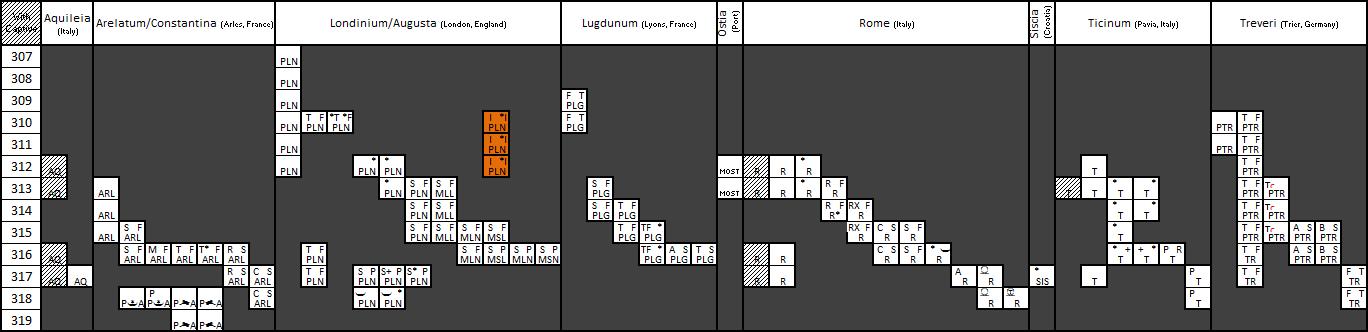
Thought I would produce the same chart as above but showing the Sol coins produced in the various mints under other peoples names.

CONSTANTINE II CRISPUS LICINIUS MAXIMINUS II

Meaning-Behind-Constantine-Issue-Field-Marks?

Its interesting to see how certain mark combinations were not used for certain emperors.
Valued Member
jamesicus's Avatar
United States
167 Posts
 Posted 08/30/2011  1:20 pm  Show Profile   Bookmark this reply Add jamesicus to your friends list Get a Link to this Reply
bobbyhelmet:

I haven't collected or researched Constantinian coins beyond AD 305 for some time now and so I will have to do some memory refreshing in order to be able to offer you any meaningful comments on your research. I have always found Victor Clark's web site very helpful. I still have my ROMAN COINS OF THE LONDON MINT: 296-325 AD As cataloged in RIC, Volumes VI and VII online, but it is in bad need of refining and updating (that will probably never happen now).

You may find some of the RIC Volume VII information and the search facility of some use in your project however.

James

Edited by jamesicus
08/30/2011 1:24 pm
Moderator
Learn More...
echizento's Avatar
United States
23731 Posts
 Posted 08/30/2011  3:24 pm  Show Profile   Bookmark this reply Add echizento to your friends list Get a Link to this Reply
Interesting subjec. One that I haven't done much research on, but I see now that I need to spend some time on. Thanks for this thread.
  Previous TopicReplies: 6 / Views: 3,610Next Topic  

To participate in the forum you must log in or register.


Disclaimer: While a tremendous amount of effort goes into ensuring the accuracy of the information contained in this site, Coin Community assumes no liability for errors. Copyright 2005 - 2026 Coin Community Family- all rights reserved worldwide. Use of any images or content on this website without prior written permission of Coin Community or the original lender is strictly prohibited.
Contact Us  |  Advertise Here  |  Privacy Policy / Terms of Use

Coin Community Forum © 2005 - 2026 Coin Community Forums
It took 0.27 seconds to rattle this change. Forums