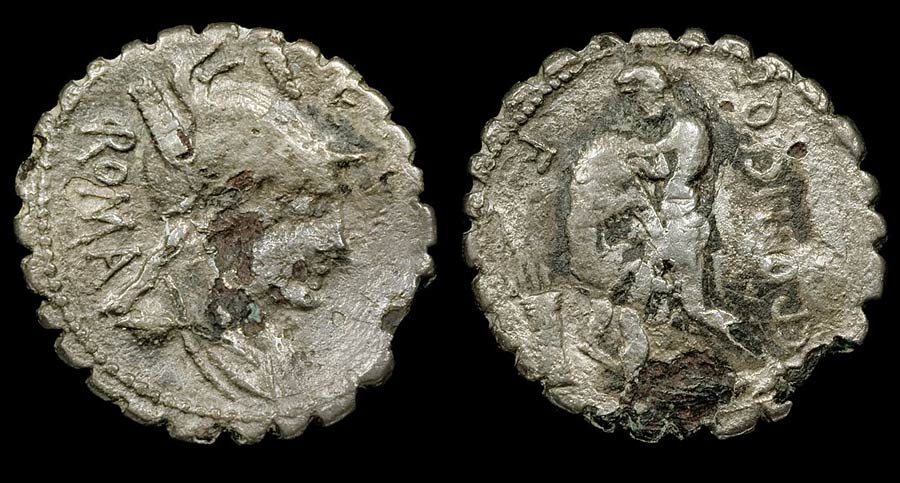
I saw this, and it got me curious. Does this Denarius look like contemporary damage to pilfer silver--or done later? Would a coin with these cuts be accepted during Roman times?
This coin is a "denarius serratus", or serrated denarius. It was actually made that way, by laboriously carving little notches into the blank before the coin was struck. A very early and primitive form of edge protection, and an attempt to demonstrate the authenticity of the coin by showing that it is solid silver all the way through.
The existence of contemporary counterfeit serrated denarii demonstrate that, as an anti-counterfeiting device, it was futile. Nevertheless, some of Rome's trade partners, particularly the unconquered parts of Gaul and Germany, preferred their coins to be serrated.
Don't say "infinitely" when you mean "very"; otherwise, you'll have no word left when you want to talk about something really infinite. - C. S. Lewis
There are many examples of serrated coins, and I too find them fascinating. However, over the years I have never acquired any of this type. Some day......
Futile as Sap said! You can find fourree (silver plated over copper) ancient counterfeits of serrate coins. Most collectors avoid plated coins but these have a special interest reminding us that it is hard to stay a step ahead of those who would cheat you.
Disclaimer: While a tremendous amount of effort goes into ensuring the accuracy of the information contained in this site, Coin Community assumes no liability for errors. Copyright 2005 - 2026 Coin Community Family- all rights reserved worldwide. Use of any images or content on this website without prior written permission of Coin Community or the original lender is strictly prohibited. Contact Us | Advertise Here | Privacy Policy / Terms of Use










 Posted 09/26/2011 02:37 am


 This is the first example I've seen.