| Author |
 Replies: 18 / Views: 2,944 Replies: 18 / Views: 2,944 |
Page 2 of 2
|
|
|
|
Moderator
 United States
23731 Posts |
Sel I guess that possible, but why would they use an official die on a reduced flan for a provincial coin?
|
|
Bedrock of the Community
Australia
21792 Posts |
I was looking through the Wildwinds listings for Hadrian, and noted that there were far more aureus types than semis types. Sear lists only one semis type (S 1146) for Hadrian.
It seems that by the time of Hadrian, the ravages of inflation had progressed far enough for the semis to be a rather scarce denomination. I notice that the semis disappears from Sear's listings after the time of Hadrian.
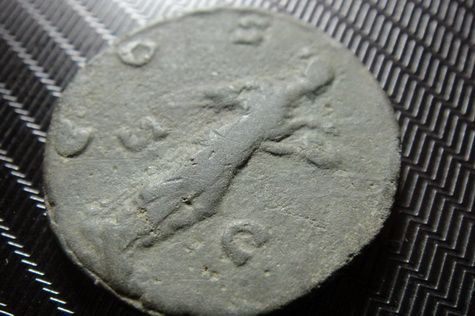
That would have made it somewhat morally easier for a lazy die cutter to use an already existing AS die, to produce a semis denomination, to answer a small but immediate need for them. That is my reasoning for an Imperial die being used for an Imperial semis denomination, and also explaining the weight of coin pictured here.
That makes me support your original comment about die and flan size being miss matched.
Edited by sel_69l
02/21/2014 8:43 pm
|
|
Moderator
United States
23731 Posts |
|
|
Valued Member
 200 Posts |
Thank you! Very interesting!
This remark is from an another forum:
"It looks like an ancient cast fake, these are usually light."
What do you think this is also an option?
|
|
Bedrock of the Community
Australia
21792 Posts |
I do NOT think this is a contemporary (ancient) cast fake, for two reasons:
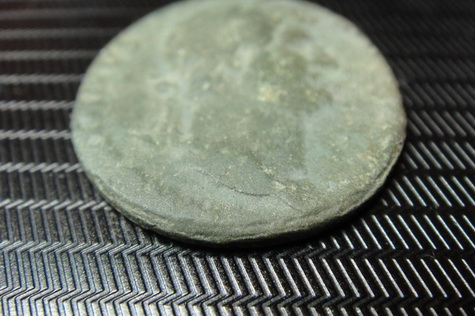
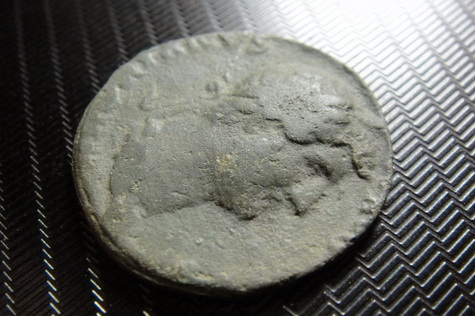
1. There are small flat areas in the fields which indicate that it was struck. The rougher areas exhibit some porosity, that is indicative of corrosion caused by burial.
2. If it was an ancient strike, it would show inferior die cutting, and thus look barbarous. That is not the case here.
It would be of advantage to closely examine the edge for evidence of casting. From the pictures presented here, casting evidence of the edges, although it may be difficult to see, is certainly not obvious.
It is certainly better to have the coin 'in hand' when looking for signs of it being a fake.
|
|
Pillar of the Community
United Kingdom
946 Posts |
Edited by Masis
02/22/2014 1:41 pm
|
|
Pillar of the Community
United States
549 Posts |
I think it may be an ancient "limesfalsa"; a cast from the Roman border region. Now imitation denarii are commonly seen, but the original meaning of "limesfalsa" was for coins just like this, also called "lightweights." You can see some on my page: http://esty.ancients.info/imit/Limes-falsa.html -- Warren |
|
Moderator
United States
23731 Posts |
That's very interesting, I've not heard of this type.
|
|
Pillar of the Community
Australia
1015 Posts |
I brought a coin from Forvm Ancient Coins many years ago that was a cast fake and yes I brought it as such,the description was "Agrippa Ancient Cast Counterfeit" copper AS.
gF,8.128g,31.1mm,195*,illegal mint,ancient cast coin of RIC Caligula 58,S 556 (official Rome mint,38 AD)and then obv and rev leg and go's on to say why it was a fake,I did post a photo on this site 5 or 6 years ago thinking it was a frontiers coin and yes thinking I picked up a bargain because the cast lugs were still on the coin but now I believe I'm wrong and the coin is what it is.
I just want to say those people at F.A.C. know there stuff and you can't go wrong with anything you run passed them,
I also think the people here know there stuff too.
Edited by nuggethill
02/22/2014 10:55 pm
|
|
Valued Member
200 Posts |
|
|
Moderator
United States
23731 Posts |
From the edges it looks cast.
|
|
Bedrock of the Community
Australia
21792 Posts |
Upon now seeing those edges, I have no problem at all in agreeing with echizento.
|
|
Valued Member
200 Posts |
Thank you all of you! :)
So this is a "limes-falsa" from Pannonia! :)
|
|
Pillar of the Community
United States
3497 Posts |
It has been a long time since I played with fire and made castings of some of my coins (for a metals class I was attending and not for any nefarious purpose !) I seem to recall that copper did not cast well and alloy (bronze or brass) was the material of choice. Further the subject of 'shrinkage' was relevant to my project. Gold shrinks a smaller amount than silver (about 10%) and if memory serves bronze shrinks even more. Probably in the area of 15%. If the original flan were 28mm a cast copy might be around 25mm. The weight could go from close to 10 grams (or so) down to 8 grams. Add a bit of wear and you might be closer to 7.
Castings will always be somewhat 'light'. Which is why having a nice cheap digital pocket scale is sooo nice to have.
|
|
Valued Member
200 Posts |
Totally! :D I had this coin a few years ago, but only last week bought a pocket scale! :D
|
|
Page 2 of 2
|
Replies: 18 / Views: 2,944 |
Page 2 of 2
|








 First Page


 Posted 02/21/2014 8:39 pm