PCGS - The
Barber half dollar series isn't necessarily known for boasting any budget-busting key dates, like its
Barber quarter kin, which has several series stoppers. However, the lowest-mintage business strike for the
Barber halves is most certainly scarce but is by no means financially formidable for series enthusiasts who wish to tackle a run of the entire run. We're talking about the 1914
Barber half dollar, which saw a mintage of less than 125,000 and was produced at the Philadelphia Mint.
 Check out 1914 Barber Halves on ebay
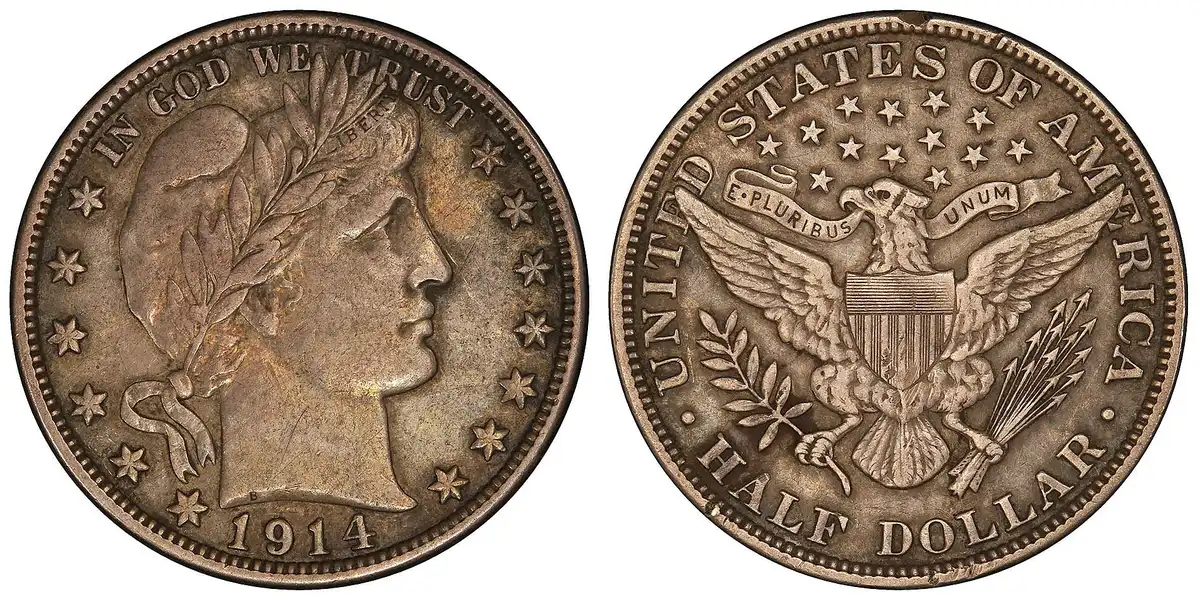
The 1914
Barber half dollar came along at a time when lower-mintage outputs proliferated as the series wound down. The penultimate issue of the series, the 1914, was among a triplet of low-mintage Philadelphia-struck
Barber half dollars that consecutively closed out the coin's production run. The 1914
Barber half dollar had a mintage of only 124,230 pieces, following suit with the 1913 and its anemic 188,000 coins and the last Philly
Barber half dollar with its squad of 138,000 representatives. To be fair, the branch-mint issues of 1913, 1914, and 1915 also saw smaller numbers than was typical for the
Barber half dollar, but nowhere nearly as small as those posted by Philly during the last three years of the coin's run.
So, why isn't the 1914
Barber half dollar considered a true "key" date? The answer might be more subjective than objective. There's no hard-and-fast rule about what makes a key date a key date, as surely a "lowest-mintage" issue could qualify a coin for that status. However, if we look at the whole of the
Barber half dollar series, which is often measured more in terms of conditional rarity than absolute rarity, you might see how the 1896-O or 1904-S (with mintages of 924,000 and 553,038, respectively) might be more difficult coins. While the 1914
Barber half dollar runs for $1,200 in XF40 according to the PCGS Price Guide, the 1896-O exceeds $3,200 at that grade and the 1904-S garners $3,500.
While the 1914
Barber half dollar can be purchased for a much more affordable $135 in G4, collectors routinely pay over $3,000 for one of the relatively few Mint State examples out there. PCGS estimates there are about 300 specimens in grades of MS60 or higher, with only 40 survivors likely in MS65 or higher. The all-time price record for this coin was hammered in 2010, when a PCGS MS66 example took $37,375 at auction.
Check out 1914 Barber Halves on ebay Check out Books on Barber Coinage on Amazon






 Posted 07/13/2026 11:00 am





