| Author |
 Replies: 18 / Views: 3,804 Replies: 18 / Views: 3,804 |
Page 2 of 2
|
|
|
|
Pillar of the Community
 Canada
9904 Posts |
It looks like a split planchet. Why does it still weigh more than 2.5 grams? Why did extra metal push up between the collar and die?
"Dipping" is not considered cleaning...
-from PCGS website
|
|
Valued Member
 United States
462 Posts |
I thought that too at first but coin weighs normal so can't be split.
|
|
Valued Member
United States
462 Posts |
Finning is from extra pressure caused by whatever was on the planchet when it was struck.
|
|
Pillar of the Community
Canada
872 Posts |
https://goccf.com/t/165314Hi. Not trying to hijack your thread but SPP ottawa commented on my split planchet penny a few months ago and this is what he said: "A split planchet indeed. Split prior to the strike, and then struck underneath a regular blank planchet (obverse is the anvil die). Somewhere out there, is the other coin with only the reverse (probably a regular sized planchet)..." thought maybe the 2 are related as SPP states. nice coin by the way. cheers.
|
|
Valued Member
United States
462 Posts |
As I already stated a few times, my coin weighs correct weight as normal cent so it can't be a split planchet. Yours clearly is thinner and weighs less than normal planchet. Not the same as mine.
|
|
Pillar of the Community
Canada
872 Posts |
I am not saying that yours is a split planchet but that it was struck underneath a split planchet like mine. read the quote from SPP and picture your coin as the regular planchet struck under my coin.
|
|
Valued Member
United States
462 Posts |
I stated early on that my coin may have been struck through a striated split planchet. I already understand how that error type occurs. It was not struck under a regular blank planchet and itself is not a split planchet.
|
|
Moderator
 Canada
10477 Posts |
You are assuming the original planchet weight was correct to begin with... perhaps it was not... (i.e., why could this not be a 3.1 gram bronze planchet (Barbados, which was of equal diameter, 19.05 mm) that was split after the strike? DBM already pointed out the extra metal on the Rim Fin... "Discovery follows discovery, each both raising and answering questions, each ending a long search, and each providing the new instruments for a new search." -- J. Robert OppenheimerContent of this post is licensed under a Creative Commons Attribution-NonCommercial 3.0 Unported License. See: http://creativecommons.org/licenses...0/deed.en_USMy eBay store
|
|
Moderator
United States
56855 Posts |
Could it be struck through cloth? John1  |
|
Valued Member
United States
462 Posts |
SPP-Ottawa....I would think that in your 1st response that you would have mentioned that the split planchet would have to have been on a foreign planchet, which is highly unlikely. What is likely is that it's on the intended normal planchet of a 1984 cent, since it is of almost exact specifications and that there would be no likely reason to consider anything else. It's merely struck through a normal planchet, the question remains what was it struck through. The finning doesn't add weight to the planchet, it's metal flow that is the result of excessive pressure from whatever got between the die and my planchet. My guess continues to be struck through a striated split planchet.
|
|
Valued Member
United States
462 Posts |
Also, my coin has the mushy appearance of being struck through something thin. A split planchet after strike would have a more jagged and sharper appearance.
|
|
Moderator
Canada
10477 Posts |
All other things aside, regardless of planchet likelihood being Canadian or not, form analogy is what I was based my interpretation on. I have about dozen 1-cent coins, all split after the strike, with striations usually parallel to rolling marks, of various depths. That surface looks exactly like one of my post-strike split planchets. I also have coins (both bronze and nickel) that were struck through cloth and tape - Your coin looks nothing of a strike-through, especially one that goes all the way to the rim (collar), especially one that would yet retain an image of the Queen. If it is a strike-through, then explain that surface. A split foreign planchet, while unlikely, is quite plausible. The RCM minted more than 5 million bronze cents for Barbados in 1984... "Discovery follows discovery, each both raising and answering questions, each ending a long search, and each providing the new instruments for a new search." -- J. Robert OppenheimerContent of this post is licensed under a Creative Commons Attribution-NonCommercial 3.0 Unported License. See: http://creativecommons.org/licenses...0/deed.en_USMy eBay store
Edited by SPP-Ottawa
03/04/2014 10:29 am
|
|
Valued Member
United States
462 Posts |
I'm sorry but I have to disagree with you. A struck through cent planchet can have an image of the queen if the object being struck through is thin enough. Coins struck through thin die caps that show the image of the die design is a perfect example. See below mage. 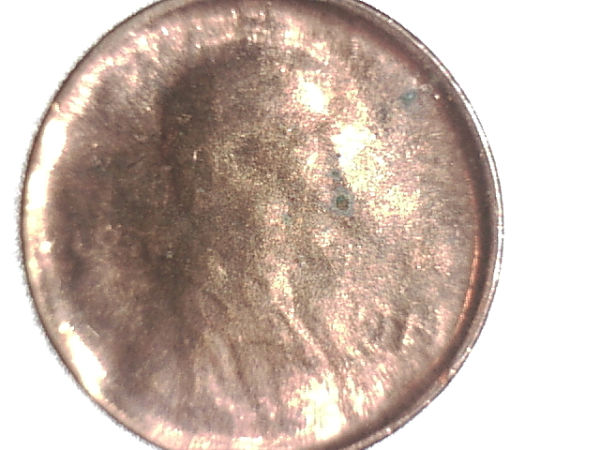 This is the normal reverse of the capped die. 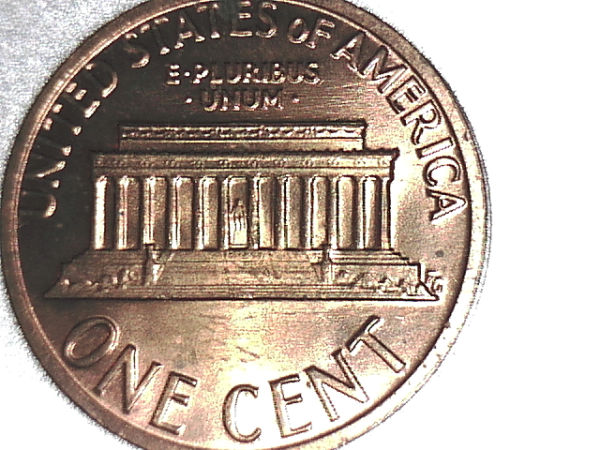 I have also attached an image of a Loon Dollar that was struck through a washer that allowed the die image to transfer through to the blank 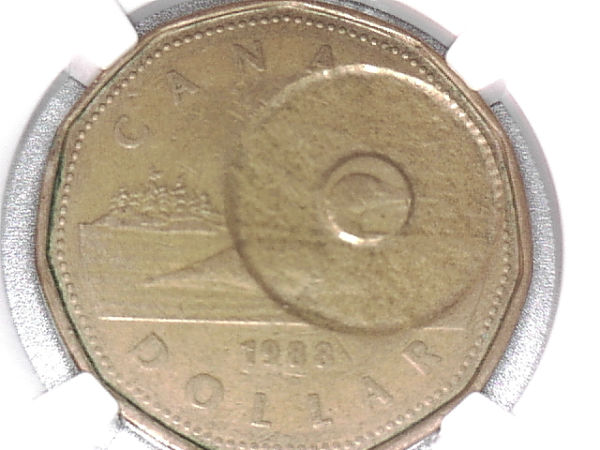 So I am not sure why you think an image of the queen can't show from a strike through. I also can't figure why you think a strike through can't affect the rim area. The entire face of the planchet is struck by the die. Anything that is laying on a planchet can be struck into the planchet anywhere on the face of the planchet including up to the edge of the planchet. Can you tell me why there is finning on the reverse, which is normally caused by excessive die pressure caused by something being struck into my coin? I have several planchets split after strike as well. The split side of all my examples show a more jagged appearance and weigh much less than a normal planchet. Hanging your hat on the premise that my coin was struck on a split foreign planchet is far fetched although I wish I had one. |
|
Pillar of the Community
United States
2752 Posts |
I agree with Zimmy that this cent is a normal planchet that was struck against a split planchet. What you're seeing on the obverse face is the impression of the striations on the split planchet.
Error coin writer and researcher.
|
|
Moderator
Canada
10477 Posts |
Ah, so the best of both possible end members (split planchet versus strike through). Struck through a split planchet, hence the striations on that face. That is a first for me, in Canadian coins...
Thanks Mike.
"Discovery follows discovery, each both raising and answering questions, each ending a long search, and each providing the new instruments for a new search." -- J. Robert OppenheimerContent of this post is licensed under a Creative Commons Attribution-NonCommercial 3.0 Unported License. See: http://creativecommons.org/licenses...0/deed.en_USMy eBay store
Edited by SPP-Ottawa
03/05/2014 04:02 am
|
|
Page 2 of 2
|
Replies: 18 / Views: 3,804 |
Page 2 of 2
|







 First Page

 Posted 03/02/2014 10:01 pm





