| Author |
 Replies: 25 / Views: 5,424 Replies: 25 / Views: 5,424 |
Page 2 of 2
|
|
|
|
Bedrock of the Community
United States
17884 Posts |
Quote:
I thought that they were a result of the reaction of chemicals in the production process and are there from the beginning. In other words, milk spots don't develop over time inside a slab. Is that incorrect? They are thought to be caused by incomplete rinsing of the chemicals used to clean the planchets, and they can show up on raw coins. But stories seem to indicate that they really start showing up AFTER slabbing. After all there are a lot of MS and PF 70 and 69 ASE's out there with milkspots and the TPG's would not have graded them that high if the spots had been present at the time of grading. So they must have developed over time in the slab. Having to pay off under their grade guarantee is the reason they first dropped coverage of the ASE's for milkspotting and eventually today's exception that eliminates coverage for any coin that turns/goes bad in the holder after slabbing. |
|
Rest in Peace
United States
7075 Posts |
Jeepers -- I was recently considering 'investing' in some ASE MS70's -- figuring they would/might do all right by me in the future. Now.....well, I just won't buy anything that isn't at least four years old and still raw. |
|
Valued Member
United States
90 Posts |
The TPG say milk spots have no effect on grading. There seems to be multiple answers on this. When I called pcgs they told me spots don't effect grading it's how the coin was struck and need a magnifier to see it. |
|
Pillar of the Community
United States
2543 Posts |
Quote: I was recently considering 'investing' in some ASE MS70's -- figuring they would/might do all right by me in the future Not much of an investment, for the 2014 MS70, PCGS has a population of 54,600 plus another 64,421 (W) and (S) slabs. So only you and 119,020 of your like minded friends would possess this investment coin. And that's not including NGC and ANACS MS70's. Or you could get a MS70 Girl Scout or Civil Rights Silver Dollar and only 84 other people would possess this coin.  |
|
Pillar of the Community
United States
1247 Posts |
HSN is preselling them at 200.00 a pop... All I can say is wow... that is way over priced.
I like watching HSN and Art & Coin show, so I can laugh at what they sell that stuff for.
|
|
Pillar of the Community
United States
2543 Posts |
Quote:
HSN is preselling them at 200.00 a pop... All I can say is wow... that is way over priced. *SPOILERS* Now you spoiled it, I have their New Years extravaganza recording on the DVR while I watch Miss St and Ga. Tech in the Orange Bowl.  Edited by denco7
12/31/2014 9:27 pm
|
|
Pillar of the Community
United States
4901 Posts |
A few comments: This thread started with a question about proof 70 ASE's and went to MS70 bullion and back to proof so I have no clue which comments refer to what item. I will continue with this confusion  The stats on the MS70 bullion prove the fact of how common they are...one 2014 sold for $43 yesterday with free shipping. Re: 2014 PF70's...NGC graded around 39k and 29k of those were 70's..not a rare grade and appropriate since it is a collector coin. 2014 NGC70 pf's sell for around $80-90 so HSN markup is a tad over the top but normal for them. Milk spots most definitely affect grading and NO coin submitted with them will ever grade 70. PCGS and NGC had their grade guarantee I had many coins with spots get bought back or exchanged by NGC because they no longer were grade appropriate... Milk spots do NOT need any kind of magnification unless you are getting to the molecular level and trying to see them before they become obvious. The TPG's have no clue what is causing the spotting and at one time had offered $50k for ANYONE who could give them an answer...no one did..and they dropped their grade guarantee. All the reasons given are theories.. Here's my 2006 20th Anniversary reverse proof (not a cheap coin)...get out your magnifiers (coin angled to better image spots): 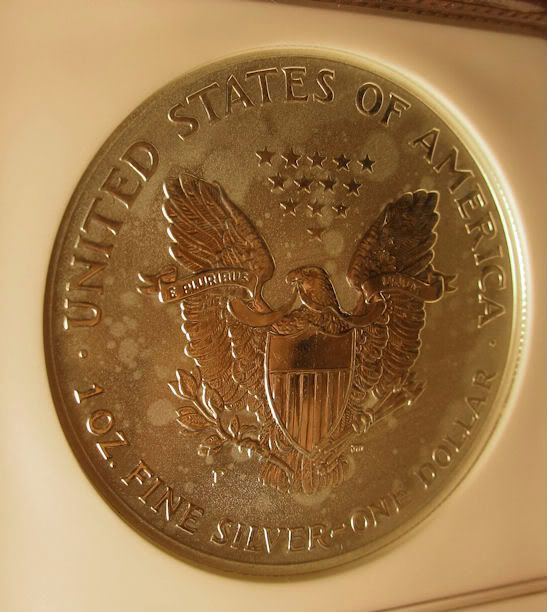 Edited by Foxwoods Man
01/01/2015 08:14 am
|
|
Moderator
 United States
23522 Posts |
No need for magnification. What kind of arrogance does it take to sell something as "collectible" when you know there's a chance your chosen procedure will make that coin non-colectible down the road? The Mint has known about this for years and I refuse to believe there's only *one* wash formulation that works.
|
|
Rest in Peace
United States
7075 Posts |
Gees, it's a shame about that coin.
What happens when the milk spots get really old...like 10 or 20 years old? Do they change at all or continue to 'grow'?
It kind of makes me want to crack mine out of their mint cases and rinse them off -- but I won't.
|
|
Moderator
United States
23522 Posts |
Wouldn't matter - you'd have to "rinse" with acid. Once spotted, such a coin is done for good.
|
|
Pillar of the Community
United States
1393 Posts |
So acetone wouldn't do anything?
|
|
Pillar of the Community
United States
4901 Posts |
Acetone won't do anything after the fact but there are some who believe that it would help if used prior to grading.
No evidence to back it up but it wouldn't hurt....
I have never figured out why the huge 5 once silver bullion pucks do not have huge reports of milk spots...there must be something different done with the process of both and it should be an obvious fix
|
|
Pillar of the Community
United States
1247 Posts |
denco7.. well, no spoiler, because I got the price wrong... the true spoiler is they were selling them in PF70 ANACS for 94.99
|
|
Pillar of the Community
 United States
588 Posts |
Quote:
Milk spots most definitely affect grading and NO coin submitted with them will ever grade 70. PCGS and NGC had their grade guarantee I had many coins with spots get bought back or exchanged by NGC because they no longer were grade appropriate... Dont know too much about grading but this is what happens when a coin no longer matches the grade? They are bought back? |
|
Bedrock of the Community
United States
17884 Posts |
Quote:
What happens when the milk spots get really old...like 10 or 20 years old? They become cheese spots.  Quote:
Dont know too much about grading but this is what happens when a coin no longer matches the grade? They are bought back? Used to, but now coins that have gone bad in the holder after grading (developed spots, stains etc) are no longer covered by the grade guarantees. So you are stuck with them. Quote:
I have never figured out why the huge 5 once silver bullion pucks do not have huge reports of milk spots...there must be something different done with the process of both and it should be an obvious fix If the cause is actually improper rinsing of the wash solution then it might be as simple as the 5 oz pieces get a more through careful rinsing. They can do that because the number of 5 oz coins is much smaller than the number of ASE's. Might also be a difference in the care provided in the production of the planchets for the 1 oz and 5 oz pieces depending on whether or not both of them are produced by the same manufacturer. (I don't know if they are or not.) |
|
Page 2 of 2
|
Replies: 25 / Views: 5,424 |
Page 2 of 2
|





 First Page


 Posted 12/31/2014 12:57 pm


