| Author |
 Replies: 17 / Views: 3,662 Replies: 17 / Views: 3,662 |
Page 2 of 2
|
|
|
|
Valued Member
Spain
239 Posts |
Great answer but remember that things such as die chips, die clashes/cracks etc. will be present on more than one example. It will be progessive but for a short while many will be the same.
|
|
Valued Member
United States
415 Posts |
An error typically occurs during the minting process, while a variety tends to be an irregularity on the master hub......Errors tend to be unique or few of a kind, varieties tend to have multiples quantities........(UNLESS THE VARIETY IS A MINT INTENDED CHANGE LIKE TYPE 1 AND 2 Buffalo nickels), ALL VARIETIES ARE ERRORS, NOT ALL ERRORS ARE VARIETIES |
|
Pillar of the Community
United States
5825 Posts |
Errors are unintentional. Varieties are intentional. Some errors are changed to varieties by a Mint decision. Classic Case: 1955 DDO. Mint approved the error rather than toss out 1000's of cents. |
|
Pillar of the Community
United States
4897 Posts |
|
|
Valued Member
Spain
239 Posts |
Wow, what a read. Nice link.
|
|
Moderator
 United States
196572 Posts |
Amida beat me to it.  |
|
Pillar of the Community
 United States
1191 Posts |
Thank you for the link. That answered my question.
|
|
Bedrock of the Community
United States
17884 Posts |
In the linked thread many times they refer to a "die error". This can be the source of a lot of the confusion. Something that results from a "die error" is neither an error or a variety, it results in a die stage (Die stage is the proper term but you will often see it called a die state. Calling it a die state is incorrect.) Die stages are discrete steps of changes in the life of a die. A crack appears, the crack extends to a new spot, a chip appears, a clash appears, etc. Something where it wasn't there on the previous coin but it is on the next one, a discrete change. Die state refers to the amount of wear that a die has received and it is a continuous process. You can say this is a early stage and this is a late stage but you can't point to a specific coin and say "This is were it changed from early to mid state, it's always a range.
Something such as the 37 D three leg nickel is neither an error or a variety, it is a die stage. That reverse die wasonce sharp and new and it produced coins with four legs. As it wore it changed from an early to a mid, to a late, and finally a very late state and as it did the images it produced were less and lees sharp and clear, but they all had four legs. but then the die was severely polished removing part of the right foreleg. This created a die stage. The last coin struck before the polishing had four legs, the first coin struck, and all the coins after that, had three.
So in general a variety is present on all the coins of a given die, a discrete change in the appearance of the die creating that variety is a die stage, a gradual change in the condition of the die results in die states. A unique one of a kind occurrence is an error.
Edited by Conder101
12/17/2015 1:33 pm
|
|
Pillar of the Community
United States
1812 Posts |
This is both a error & die variety ( type 2 - wide. AM). 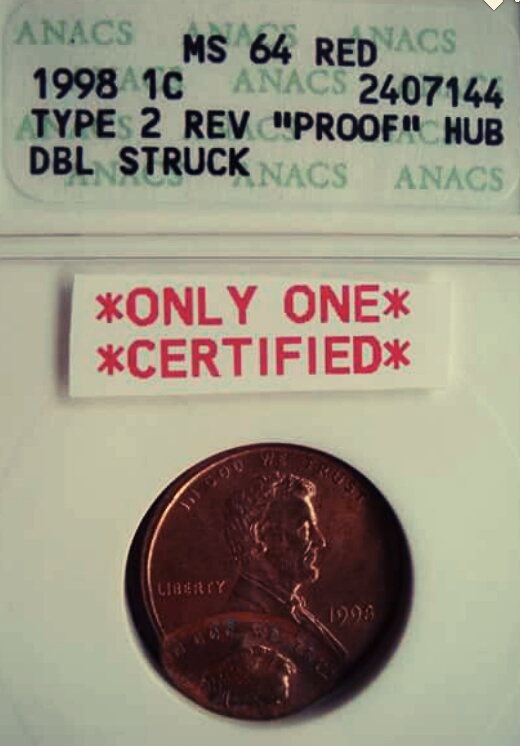 |
|
Moderator
United States
16697 Posts |
Errors are not manipulated.. Supposedly.
Varieties are.
swcoin.ecrater.com
|
|
Bedrock of the Community
Australia
21792 Posts |
Varieties are the result of differences in dies, deliberately cut the way they are.
Errors are the result of a fault in the minting process, which may include die damage.
How each category is derived is quite distinct, one from the other.
|
|
Bedrock of the Community
United States
20753 Posts |
HOWEVER, what do you call an error coin that was made purposely by the Mint? And if made continuous, wouldn't that be a variety?  |
|
Bedrock of the Community
United States
17884 Posts |
Well since an error is a one of a kind item, the mint couldn't be making them continuously. If they did deliberately make an error coin, the term would be a piece de caprice. (Think dime struck on nail.)
|
|
Bedrock of the Community
Australia
21792 Posts |
There has indeed been instances of error coins being made deliberately. That happened as a protest in 1970, when employees at The Royal Mint in London were not prepared to go with the transfer of their jobs (and their families) to Llanstrisant in Wales. They deliberately made all sorts of error coins, and just chucked them over the perimeter wall of the London mint by the handful, to be picked up by passers - by, who were waiting for them out in the surrounding streets !Almost all Americans are aware of the 1913 liberty Head Nickel made clandestinesly by Mint employees. I believe five of them exist. It becomes a matter of choice on how you decide if coins in this class of manufacture are errors or varieties or even if indeed, they are legally happen to be coins at all. |
|
New Member
United States
8 Posts |
Varieties are certain coins that have 2 or more made of the same year. Errors are mess ups in the production itself.
|
|
Page 2 of 2
|
Replies: 17 / Views: 3,662 |
Page 2 of 2
|








 First Page


 Posted 12/17/2015 08:06 am


