OK, here's what you're looking at. Canon entry-level dSLR's, the Rebel series, evolved like this:
300D/Rebel, 6MP, 2003
350D/Rebel XT, 8MP, 2005
400D/Rebel XTi, 10MP, 2006
450D/Rebel XSi, 12MP, 2008
500D/Rebel T1i, 15MP, 2008
550D/Rebel T2i, 18MP, 2010
600D/Rebel T3i, 18MP, 2011
There are two slightly-downmarket models. The 100D/Rebel XS, 10MP, 2008 - this is the model you'll currently find Bobby131313 posting stupid-good images from on the forum - and the 12MP 1100D/Rebel T3 of 2011. They differ only from their big brothers in the range of adjustments/capabilities, not in sensor quality or anything relevant to shooting coins, or even normal photography to someone who isn't a pro or shooting sports.
I've owned a 350D and 450D; some of my best shots were with the 350D. This is probably your target. You should be able to find a 350D for less than $300 used. If lucky, that will include the stock 18-55 kit zoom lens.
Canon has 3 Macro lens models, 50mm, 60mm and 100mm. The "longer" the lens (bigger numerically), the farther you can be from the coin to get a given-size image. It is my opinion that the 50mm Macro will not return results much better than the 18-55; it is somewhat superior optically, but probably not sufficient to justify its' $300 price ($200+ on
ebay). The larger macro models will definitely cost more than the camera itself; if you can get into a 100mm Macro for $400, you're doing well indeed. In fact, the 60mm is tough to find at that price.
The 18-55 is capable of taking decent coin images. I did this with the 450D/18-55:
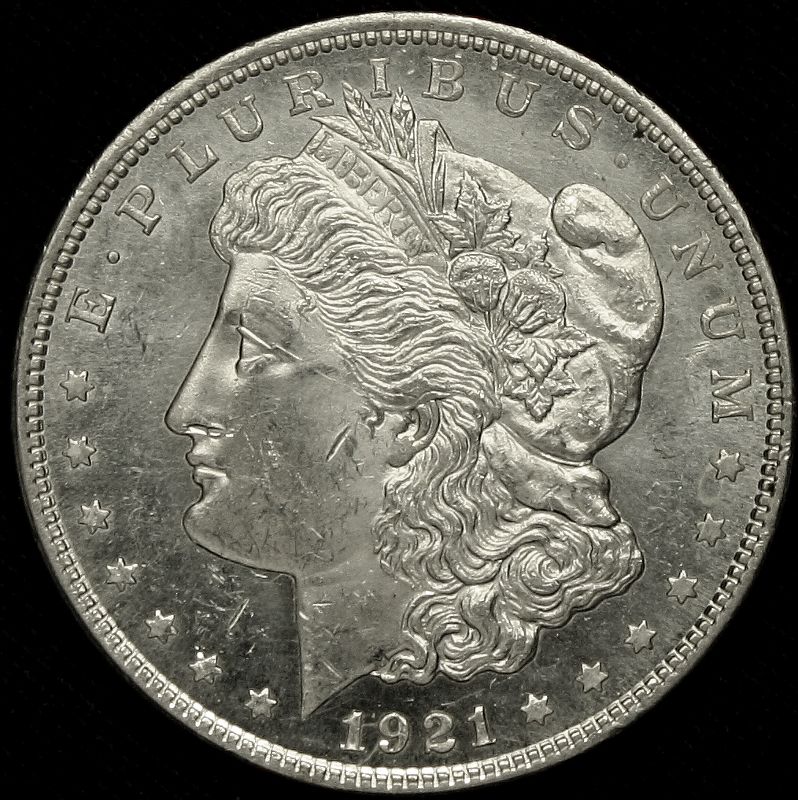
The original image was about 1100 pixels in diameter (as always, I refer to the coin only), where the 100mm Macro will return the same image at 2200-2300 pixels in diameter. I also had to postprocess it for sharpness.
The 18-55 is more difficult to use, being more exacting in the setup required to find its' "sweet spot" and less-forgiving than the dedicated Macro lenses. It's all a tradeoff - more money buys you more leeway for setup and bigger pics.
Were it mine to do, I would encourage everyone going the dSLR route to buy the camera with the stock lens, and learn to shoot coins with it before graduating to the 60 or 100mm. This forces one to actually learn about photography - the dedicated Macro lenses are such a slam-dunk improvement that one can produce superior images with them 10 minutes out of the box and with only the most basic of knowledge.
Whereas, using the kit lens will make the whole dSLR package much more useful to you in regular photography. Then you'll understand why people are willing to carry those big, bulky cameras around sightseeing rather than a convenient, pocketable point-and-shoot. Even a cheap dSLR with a cheap lens is an order of magnitude better than any P&S. And if you're gonna drop that kind of coin on a camera, you might as well learn how to maximize its' value to you.
OK, that should give you a feel for the minimum money required to get into a dSLR. Please feel free to ask for any clarification you need.




 First Page


 Posted 04/02/2011 6:24 pm




 but I use a somewhat different approach. I download photos from my camera using the EOS Utility, also provided by Canon with EOS cameras. EOS utility downloads my pics and puts them directly into my Graphics Editor (Paint Shop Pro X2) The EOS Utility also enables me to tether my camera to my PC and control it from there. I do have Zoombrowser but never use it because, for me, my way is easier and faster.