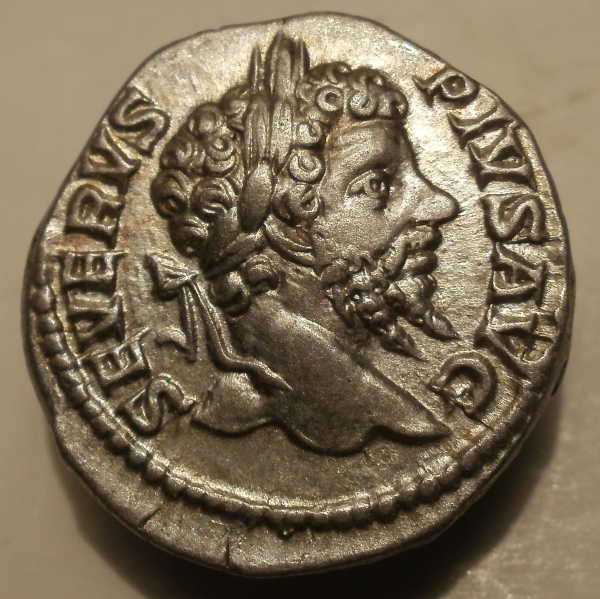
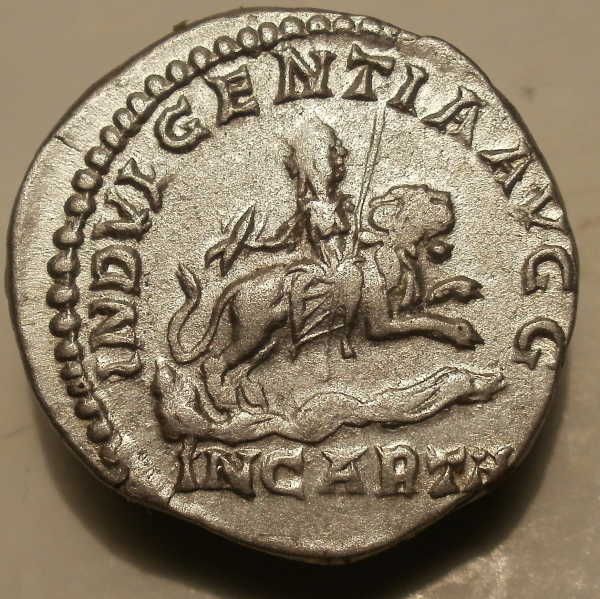
Like Doug, I choose not to go stand in line all night, but instead treated myself to a little more expensive coin for this Black Friday. It was sold by a Spanish Dealer I buy from on a regular basis. It is attributed as Septimius Severus RIC IV 266:
OBV: SEVERVS PIVS AVG, laureate head right
REV: INDVLGENTIA AVGG, IN CARTH in ex, Dea Caelestis in elaborate headdress riding right on lion, holding thunderbolt & scepter; below, water gushing from rocks left
According to a footnote in Sears, this type records some special mark of favor to Carthage, the capitol of Severus' native province. It appears to be connected to the city's water supply (perhaps a new aqueduct), but the details are not known. The principal female deity of Carthage was known to the Romans as Dea Caelestis, the "Celestial Goddess"
I have no other reason for buying this coin then I like the reverse. The INDVLGENTIA type of Septimius is one of the most picturesque and also one of the most common (in silver) of the period. Most people do not realize, however, that there are four distinct reverse types: 1) Dea Caelestis, looking front, riding a lion leaping to the right, holding a thunderbolt and scepter; 2) Dea Caelestis, looking right, riding a lion leaping to the right, holding a thunderbolt and scepter; 3) Dea Caelestis, looking front, riding a lion leaping to the right, holding a drum and scepter; 4) Dea Caelestis, looking front, riding a lion leaping to the right, holding a drum, no scepter. The first two varieties are the most common. The third variety is very rare. The last variety is extremely rare. Interestingly, the direction of the deity's head appears to have a chronological significance. Examples with the facing deity were struck late in 203, while those with the right facing deity were struck early in 204 (information obtained from CNG Electronic Auction 184 (19.03.2008).







 Posted 11/25/2011 5:48 pm