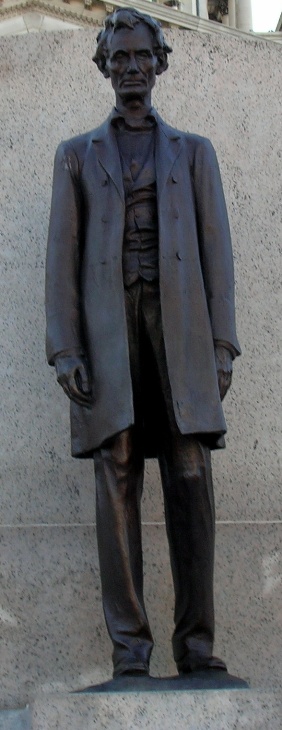
As Illinois prepared to celebrate the centennial of Abraham Lincoln's birth in 1909, there were calls to erect a permanent memorial to the 16th President. The people of Illinois staged a grand celebration of Lincoln in 1909, but no statue or other monument was erected. A few years later, in 1913, the Illinois General Assembly (GA) passed legislation to correct this "oversight."
The GA appropriated funds for the creation of individual statues of Abraham Lincoln and Stephen A. Douglas â€" two men forever linked in US history through their debates staged during the 1858 campaign for one of Illinois' US Senate seats. Though Lincoln was unsuccessful in his Senate bid, the debates raised the public's awareness of him and helped put him in a position to successfully run for the US presidency just a few short years later.
The GA's appropriation put the Illinois State Art Commission in charge of securing the statues; the Commission organized a contest to select the artists who would create them. Andrew O'Connor, a noted sculptor from Massachusetts, was chosen to create the Lincoln statue; Gilbert Riswold of Chicago was selected to create the Douglas statue. The two statues were dedicated on October 5, 1918 during a ceremony that was part of the Illinois Centennial celebration. The statutes are both on the grounds of the Illinois State Capitol.
The O'Connor statue, known as "The Lincoln of the Farewell Address," is said to depict Lincoln as he stood at the back of a train in Springfield, IL on February 11, 1861 saying goodbye to his friends and others who had gathered to see him off as he left for Washington, DC to become the 16th President of the United States.
Lincoln wears a saddened expression in O'Connor's depiction, he also appears clean shaven. No doubt, a bit of "artistic license" was taken on this last point. While it is true that Lincoln was "beardless" during his presidential campaign, by the time he boarded the train to Washington as the President-elect he had the full beard for which he would forevermore be known. It would appear that O'Connor chose to depict Lincoln as he appeared for nearly all of his time in Illinois rather than as he actually appeared at the time of the scene depicted.
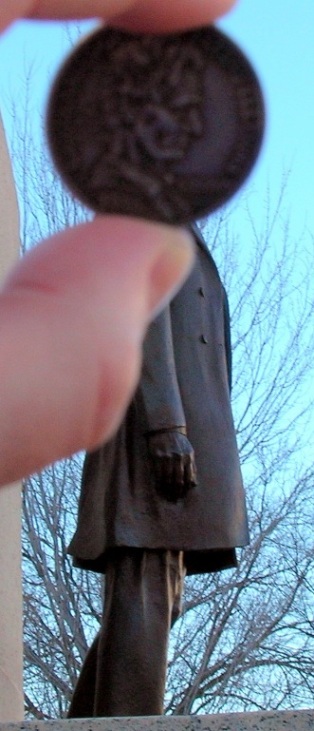
As George Morgan used the O'Connor statue as the basis for his design of the obverse of the Illinois Centennial half-dollar, it isn't surprising to find that it features a beardless Lincoln. Such a portrait works well for the coin, as it was meant to present Lincoln as he appeared during almost all of the time he spent in Illinois. The same design approach was used for the 2009 "Professional Life"
Lincoln Cent. For the statue, however, I think it works less well as it inaccurately presents an important event in Lincoln's life. I believe that such a lasting memorial, seen by many thousands each year, should have been a bit more factual in its depiction.
Below, I've shown my example of the Illinois Statehood Centennial half-dollar.
Here's a link to view the O'Connor statue of Lincoln:
http://www.presidentsusa.net/lincol...ngfield.htmlPS Ever wonder why Lincoln decided to grow his beard?Amazingly, it appears that a letter from an 11-year-old girl from Westfield, New York who wrote to Lincoln in October of 1860 was the catalyst. The girl's name was Grace Bedell, and she urged Lincoln to grow a beard, telling him, among other things, that he "would look a great deal better for your face is so thin." The truth can definitely surprise you sometimes!
1918 Illinois Statehood Centennial Half-Dollar - Obverse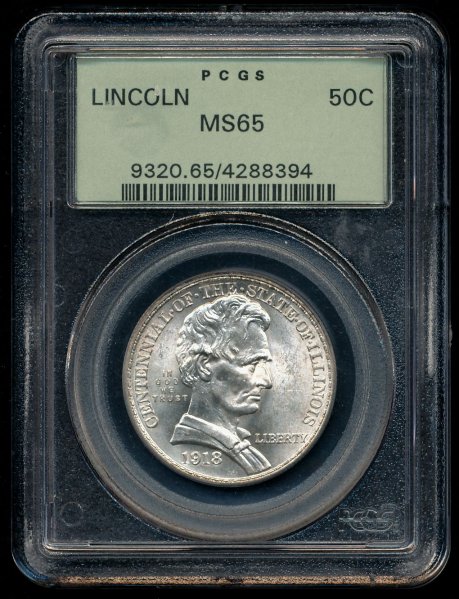 1918 Illinois Statehood Centennial Half-Dollar - Reverse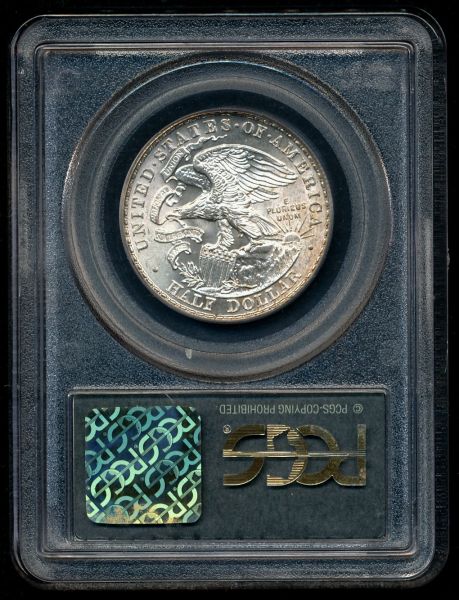










 Posted 11/01/2013 8:17 pm