During the first session of the 80th US Congress (1947), Representative Thomas Bahnson Stanley (D-VA) introduced a bill that would have authorized 50-cent pieces "to commemorate the patriotic services of Patrick Henry and to perpetuate his home as a historic site."
Henry was certainly among the more prominent figures in the American Revolution, being equally well known for his outspoken stand against British imperialism in the American colonies as he was for his oratorical skills. Henry was a leading statesmen in Virginia's colonial government and was a key figure in the First Continental Congress that met in Philadelphia in 1774; he also attended the Second Continental Congress in 1775 but did not figure as prominently.
At home in Virginia, Henry argued in support of being militarily prepared to face the increasingly likely British threat against American freedom. As a member of the Virginia Convention in March 1775, he presented his position via his now famous speech that ended with "Give me liberty, or give me death!"
The coin bill specified that up to 300,000 silver 50-cent pieces could be produced, and that the coins were to be provided to the Patrick Henry Memorial Foundation. The Foundation was to use the profits they made from the sales of the coins to support education about Henry and his patriotic services, as well as to support the preservation of Henry's "home and last resting place in Red Hill, Virginia, forever as a national patriotic shrine."
The bill was initially reported out of the House Committee on Banking and Currency with a recommendation for approval. Shortly afterward, however, Congress received letters from the White House (President Truman) and Treasury Department which stated their opposition (once again!) to the continued issuance of commemorative coins.
The Patrick Henry bill, along with several others, was reconsidered and ultimately had its support withdrawn. At the same time, the Senate proposed a bill that would authorize medals not coins for such commemorative purposes; the bill did not become law.
Fortunately, the Patrick Henry Memorial Foundation did not need the commemorative coin to pursue its objectives. Henry's home and burial plot at Red Hill is today a well-preserved national memorial supported by the Foundation. You can read more about it here:
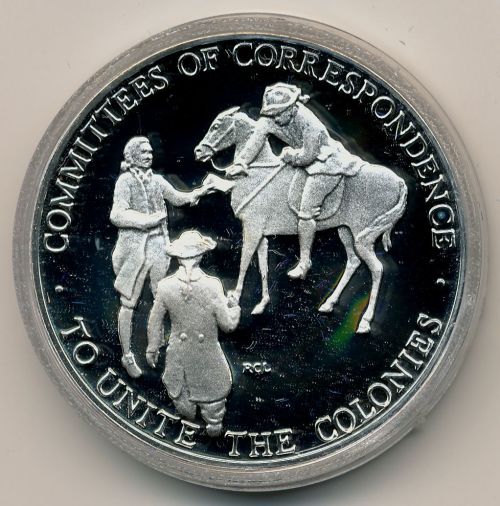
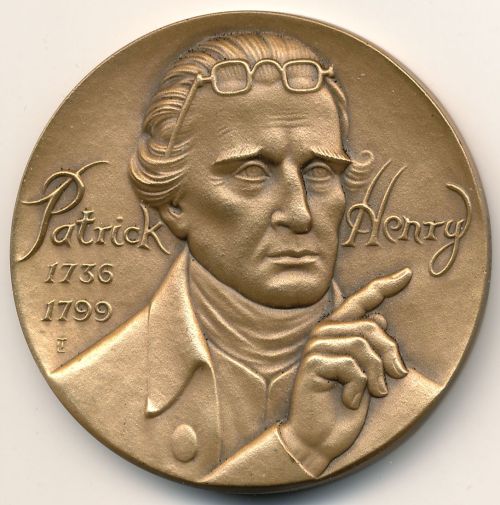
http://www.redhill.org/index.htmlThough Patrick Henry's legacy was not celebrated via a US commemorative coin in 1947, he has been recognized for his role in the American Revolution on a commemorative struck by the US Mint. In 1973 - 26 years later - the Mint struck silver and bronze medals as part of the series of medals issued by the American Revolution Bicentennial Administration (ARBA) to mark the US bicentennial. Henry shared the obverse with fellow American Revolution leader Samuel Adams. He has also been honored on a good number of privately struck medals; I've included one of my favorites.
1973 ARBA Patrick Henry / Samuel Adams Bicentennial Medal - Obverse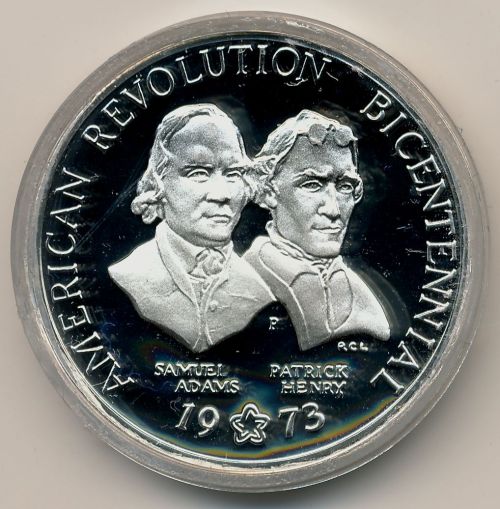 1973 ARBA Patrick Henry / Samuel Adams Bicentennial Medal - Reverse
 1966 NYU Hall of Fame Medal - Obverse
 1966 NYU Hall of Fame Medal - Reverse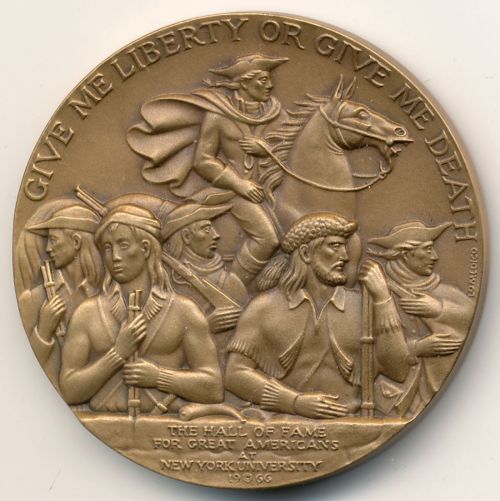







 Posted 02/09/2014 4:39 pm





