| Author |
 Replies: 35 / Views: 4,783 Replies: 35 / Views: 4,783 |
|
|
|
Valued Member
 United States
102 Posts |
Im not trying to be funny I have put out what I think to be great pictures of this coin to show because I see doubling on the full date and lines in 86 so I think its a 20 I also found more on my last page my first lucky coinshow with this same coin but I didn't think it was a 20 . Just because I'm new at this I dont know much I admit but I know what I can see and am asking for help
|
|
Pillar of the Community
743 Posts |
I am sorry if you think I was being rude. I am just trying to help you. The doubling on your coin appears to be what is called die slide and not actual doubling from what I can see (even if it was true doubling it does not match the VAM 20 perfectly), unless the doubling is raised then just ignore that for now. Your date position is normal which really doesn't help much because 90% of the VAMs for 1886-P are listed with normal dates. The next thing to look at would be the die clash coming out of the neck. Do you see any clashed letters under the clash line? They will be very faint and hard to see. If you don't know what a clashed letter is look up Clashed "n" Morgan VAM on google. Here is an example of a strong clashed n, your clash will not be as strong or noticeable. You will have to tilt the coin around in the lighting to see the "n" tick. http://www.vamworld.com/1886-P+VAM-1FThe line coming out of the neck has to match up perfectly with the VAM description photos. Kris |
|
Valued Member
United States
102 Posts |
It has that also if you check pictures on last topic I know you r just trying to help its just frustrating when I dont know anything
|
|
Valued Member
United States
199 Posts |
I agree with Kris and others.
This is not VAM-20.
Doubling inside lower loop of 6 on VAM-20 is very prominent, for which your coin clearly don't have.
|
|
Valued Member
United States
102 Posts |
I see the line under neck but no lettering
|
|
Valued Member
United States
102 Posts |
|
|
Valued Member
United States
102 Posts |
|
|
Valued Member
United States
102 Posts |
It doesn't say anything about doubling on the loop of six being prominent it just says there is a line there and the eight with doubling 1886 thats what I took pictures of
|
|
Pillar of the Community
743 Posts |
And, it is not the 1F because the clash line coming out of the neck on the 1F does not match the clash position on your coin. From here you should be able to figure it out just by clicking on each VAM until you find one that matches your coin. Once you find one that matches your coin perfectly you will have the correct VAM #. The reason these things have to match perfectly is because VAMs are cataloged as the dies that made the coins. Each die has it's own attributes. Some are close to each other, but when you really start looking you will notice the subtle differences i.e. the clash positions, die scratches, die gouges, doubling, etc.. |
|
Valued Member
440 Posts |
Looks like Machine Doubling with a little die erosion sprinkled in for good measure. |
|
Pillar of the Community
743 Posts |
I think it might be the VAM 3B with only a single clash event. The coin pictured on the 3B page is double clashed. You can see that one of the clashing events matches your coin (and appears to be the only one listed with that clashing position). These 1886-P VAMs look like they need to be gone through by an expert and reorganized. Some of them appear to have earlier die states that might be listable separately. From the way I am looking at the VAM 3A and 3B, it is totally possible that they are not actually related. My guess is that the 3A should be a separate listing from the 3B and that the 3B may have actually been clashed with the position your coin exhibits first and then clashed a second time making what is now called the 3B. As you can see on the 3B the page the clashed letters are barely visible. This could be do to it being such a (LDS) late die state example. Are you 100% sure you see letter transfer? If not then we need to completely ignore the clashes and look for other attributes. It is also possible that the clash on your coin might not be strong enough to have caused letter transfer, which could make your coin a potential VAM 1 or VAM VNA. Or it could be any of the other VAMs that have no clashed letters listed. I hope this helps and does not confuse you even more. If it does just ignore this post. Kris |
|
Pillar of the Community
743 Posts |
To find out if this coin is in the VAM 3 family you would need to show us a good photo of the 1 in the date. The VAM 3, 3A & 3B should all have the doubled 1. VAM 3A and 3B are just later die states of the VAM 3. If you can get a good photo of in front of the neck, the 1 in the date and a good clear reverse photo that would really help. I have been just taking wild guesses with what you have provided. It really is not easy to attribute without clear obv and rev photos or the coin in hand. My best advice for you is to click on every single VAM and eliminate them as you go through the list. There are many VAMs listed with attributes that we would not be able to see in your photos. For instance, the VAM 1D, 1H, 1J, 1K, all have small markers that would need closeups to be viewed. There are also some others that it could be, but you will need to figure that out since you have the coin in hand and can look at all of the places up close or take closeup photos. Your date also appears to be high, which VAM 7 is listed as a high date. You will just have to look through the list and find one that matches your coin. Even if you think you have found it, keep looking through them all so that you can learn what kind of stuff to look for in the future. Plus sometimes a VAM is listed with an attribute that can be found on more than one VAM. For instance, the VAM 3 is listed with the doubled 1 only, but the 3A & 3B also have the doubled one plus other attributes, because they are just later die states. |
|
Rest in Peace
United States
10625 Posts |
|
|
Pillar of the Community
743 Posts |
Here is one of your photos showing the 6 in the date. This proves you do not have the VAM 20. There is a line inside the VAM 20 "6" in the date from where the digit was either repunched, punched over another digit or something like that. Your coin does not have the line inside the 6 and the doubled line under the one is not at the correct angle nor is the "die slide" doubling raised on your coin. 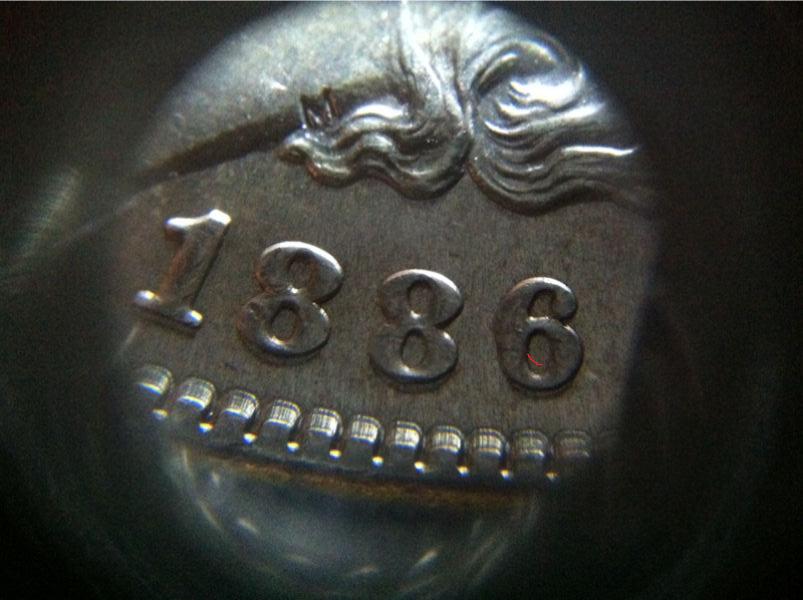 If you look back at your original photo before I added the red line to it, you will see that there is no way your coin can be the VAM 20. Kris |
|
Valued Member
United States
102 Posts |
Ok thanks I think its just a shadow putting optical allusion I will try 2 get better pic
|
| |
Replies: 35 / Views: 4,783 |







 First Page


 Posted 07/24/2014 4:14 pm


