NGC -
NGC experts determined this coin was short on both silver and originality.The Royal cob coinage of Spanish colonial Potosi is an area that has captivated coin collectors for generations. Their disputed purpose, relative rarity and striking visual differences from the more common regular-issue cobs of Potosi all contribute to their lofty values and, as such, they are an attractive series for counterfeiters.
Numismatic Guaranty Company™ (NGC®) detected one such counterfeit example that was part of a recent submission. To do so, NGC experts not only used their own knowledge but also digital resources to match marks with other examples that had sold at auction as well as a metallic composition test.
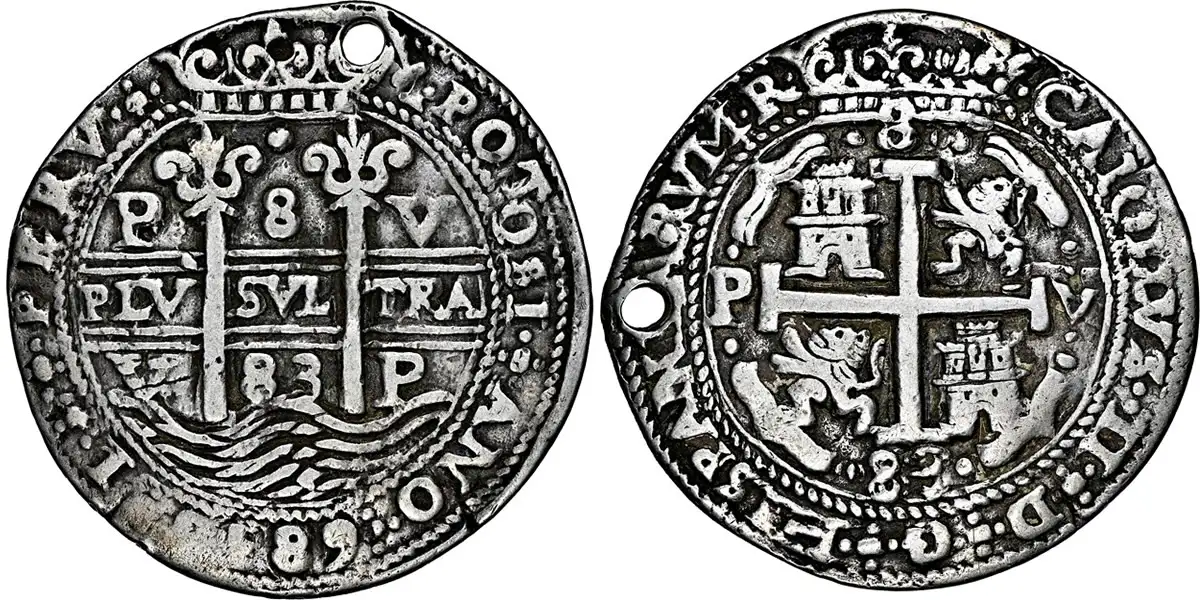 Counterfeit Bolivia 1683P V Royal 8 Reales
An initial inspection of the coin's surfaces found a uniform degradation, mushiness and loss of relief/detail. While this can at times be explained by
Die Deterioration, environmental damage or a weak strike, the uniformity of the texture and strike was off-putting.
It is standard procedure for NGC to weigh hammered issues, and this one's weight came in at 25.52 grams. This is lighter than the ideal weight for a cob, which should be about 27.00 grams for a regular issue, with Royals often weighing slightly more.
Some degree of variance is expected with cob coinage, but this is a suspicious weight for a Royal of this era. However, this could potentially be explained away by the presence of a small hole (which is extremely common on Royal coinage), loss of metal from circulation and, finally, possible environmental damage that would cause some small degree of metal loss as a result of corrosion.
While suspicions were piqued at this time, determining whether the coin was counterfeit required additional research and analysis.
Next, the coin was compared to examples of the same date and type that had sold at major auctions throughout the world over the past couple of decades. Other examples were found that displayed exactly the same strike/centering (which is always somewhat concerning for coins that are hand-struck without the use of a collar), placement of the hole, and marks/planchet issues that should be unique to an individual coin.
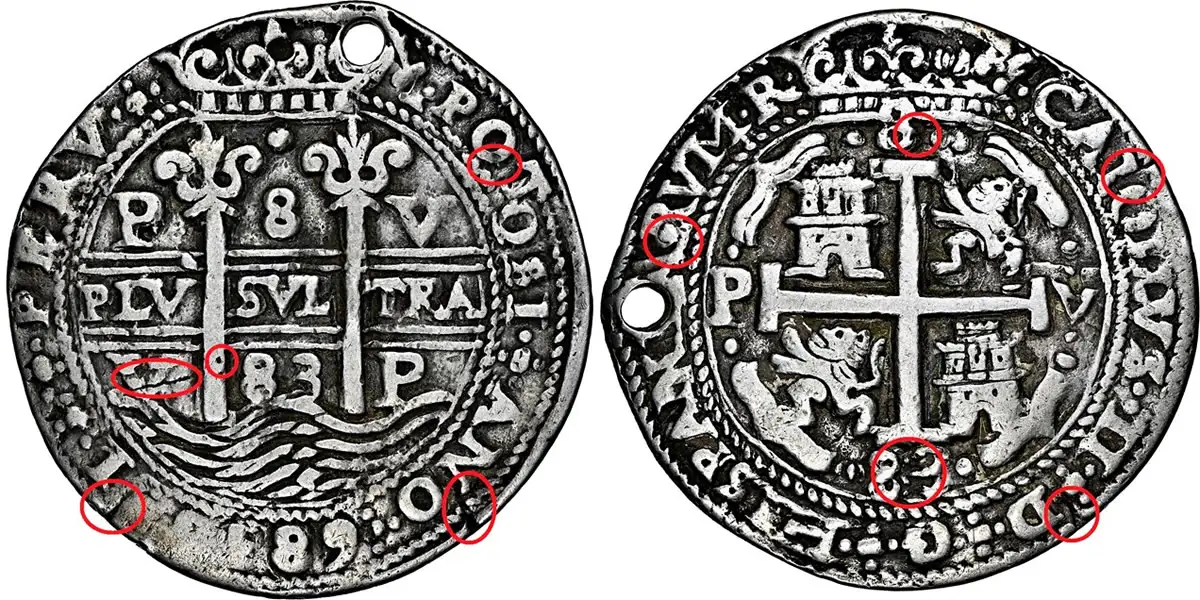 Repeating depressions on the counterfeit Bolivia 1683P V Royal 8 Reales
 The images above show areas on the counterfeit submitted to NGC that match the marks, planchet issues and striking features of other coins.
While this almost assuredly proves that the coin submitted to NGC is indeed counterfeit, one could wonder whether the example submitted to NGC is the genuine "host coin" used to create the transfer dies or casting mold (depending upon the method of counterfeit manufacture) that then, in turn, was used to create counterfeit coins.
A metallurgical analysis was performed to account for this possibility and to be thorough before declaring that the coin submitted to NGC a counterfeit. The results of this test showed a metallic composition of 70.14% Silver, 25.24% copper and 3.12% zinc, with the remaining balance being trace elements like lead. This is significantly different than the standard metallic composition of cobs during this time period, which according to the Standard Catalog of World Coins should be 93.1% silver, with almost the entire remaining balance being copper and trace amounts of gold.
This stark difference in silver purity proves that this coin cannot be the genuine "host coin" and is, in fact, a counterfeit.
Read More: Counterfeit Detection Series 









 Posted 01/03/2022 10:20 am