Representative John William Flannagan, Jr. (D-VA) introduced a bill in the House of Representatives during the 75th Congress that called for half dollars to be struck "in commemoration of the dedication of Jefferson National Forest." Flannagan introduced his bill in May 1937. Upon introduction, the bill was referred to the House Committee on Coinage, Weights, and Measures.
The area of southwestern Virginia (northwest of Roanoke, VA) that is today protected as the Thomas Jefferson National Forest traces its European-exploration history to the mid-1700s when Dr. Thomas Walker surveyed the area and found it to contain a wealth of animal life and impressive old growth Appalachian forests. Over the approximately 150 years that followed, the area was abused with the over-clearing of forests for farming/grazing and aggressive hunting that decimated local wild game populations. By the early 1900s, the area was a shell of its former self and on the verge of ecological collapse.
Through a combination of the US Department of Agriculture and the Virginia State Legislature, steps began to be taken to protect the forests of the Southern Appalachians and to establish a Federally-managed Forest Preserve in the area. With the help and support of private industry, multiple land blocks were acquired and eventually combined into the first National Forests in the Eastern US.
One such Forest was the Thomas Jefferson National Forest; it was created by Presidential Proclamation (via Franklin Delano Roosevelt) in April 1936 and officially dedicated in July 1937.
Today, the Thomas Jefferson National Forest is managed by the US Department of Agriculture - Forest Service and administered jointly (since 1995) with the adjoining George Washington National Forest.
Jefferson National Forest on Virginia Map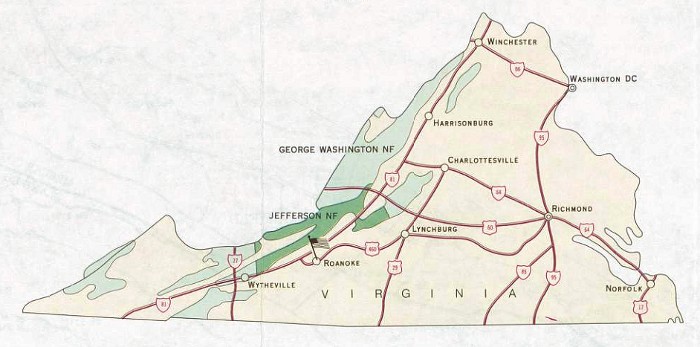 (Image Credit: Library of Congress. Public Domain.)
The bill sought up to 20,000 half dollars of standard specifications to be struck at a single Mint facility. The coins were to all bear the date "1937" and their coining authority was to expire one year after the bill was enacted into law. The Jefferson National Forest Association was identified as the sponsor/beneficiary for the coin and was given the sole right to order the coins from the Mint; there was a minimum coin order requirement of 5,000 coins.
The House Committee did not report the bill. and was it never considered by the Whole House - the bill died for lack of action.
Based on my long-held beliefs in the need to protect our valuable natural resources in their many forms, I believe I would have supported this coin proposal had I been around at the time.
For other of my posts about commemorative coins and medals, including many more What If? stories, check out:
Commems Collection. 






 Posted 12/27/2022 12:17 pm