In 1941, Hawaii wasn't yet a US State - Statehood would not come until 1959. In 1941, it was an organized US Territory. As a Territory, Hawaii had limited representation in the US Congress. It had a single Delegate in the House of Representatives, but no Senators; a Delegate could engage in House discussions, but could not participate in floor votes on bills/resolutions (the same holds true today).
A Delegate was allowed to introduce legislation, however, and in February 1941, Delegate Samuel Wilder King (R-HI) introduced a bill that called for 50-cent pieces to be struck "in commemoration of the one hundredth, anniversary of the founding of Punahou School, in Honolulu, Territory of Hawaii, the first school for American children to be established west of the Rocky Mountains."
In May 1841, the Sandwich Islands Mission, at its General Meeting, voted to create a school for the children of the missionaries working in Hawaii. The missionaries had previously established schools on the Hawaiian Islands to educate and preach to the local population, but did not have a school specifically for its own children; Missionaries had been in the Islands since 1820.
As would be expected from a school created by religious missionaries, they resolved that "the foundation of this institution [was to] be laid with faith in God." The school was to be located at Punahou (near Honolulu); $2,000 was appropriated from mission funds for initital construction of school facilities with the balance of needed funds to be raised among the missionaries themselves. The school first held classes in July 1842.
Punahou School, Front of School Hall (Dates to 1852)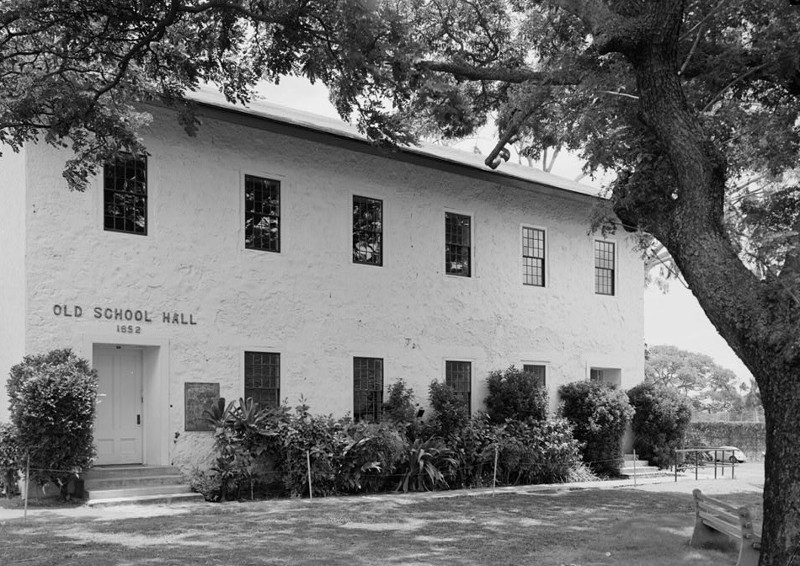 (Image Credit: Library of Congress, Prints and Photographs Division. Public Domain.)
Delegate King's bill called for up to 10,000 half dollars to be struck (reminiscent of the 1928 Hawaiian Half Dollar?); the bill did not place limitations on the Mint Facilities that could be used. In addition to the purpose outlined in the bill's title, it also specified that the coins would recognize "the remarkable contribution this school has made in the training of thousands of children for leadership and good citizenship in the Hawaiian Islands and elsewhere."
The school continues to operate as a college preparatory school, with grades K to 12.
All coins struck were to be dated "1941" and were only to be made available to the Trustees of Punahou School. Net procceeds from sales of the coins were to go toward "the erection and maintenance of a suitable memorial honoring the founders of the school, the one-hundredth anniversary of whose founding is being commemorated by the coinage."
The bill did not include ordering limitations or include an expiration date for issuing the coin. As such, while all coins would likely have been struck/issued in 1941, it would have been possible for some coins to have been struck in 1942 or beyond.
The bill was referred to the House Committee on Coinage, Weights, and Measures upon its introduction. Congress had other matters before it in 1941, however, and the coin bill was not a priority. Hawaii drew the US Congress' (and the nation's) focus for very different reasons beginning on December 7, 1941. The bill was never reported out of Committee and quietly slipped into history when the 77th Congress adjourned.
The school did have a commemorative medal privately struck for its 1941 centennial, however. You can read about it here:
-
Punahou Centennial Medal (1941).For more of my topics on commemorative coins and medals, including the 1928 Hawaiian (European) Discovery Half Dollar and more What If? stories, see:
Commems Collection.







 Posted 01/07/2023 10:53 pm





