Following my Jefferson Davis and Robert E. Lee posts, here's another story about a failed medal proposal... In the early 1910s, the US Assay Commission, in its Annual Report to the US Mint / Department of the Treasury, recommended continued enhancement of the National Numismatic Collection (NNC). It also suggested the striking of a souvenir medal to finance future acquisitions.
In its
Annual Report of 1914, the Assay Commission stated:
"First. That the commission renews the recommendation of prior commissions with reference to the maintenance and increase of the national coin collection of the mint at Philadelphia.
Second. That in the opinion of the commission, in order to facilitate this work, an official souvenir mint medal, of typical and characteristic design, should be struck off and a descriptive booklet of the mint published to be sold at a moderate price to visitors at the mint; that the proceeds from such sales be devoted exclusively, under the supervision of the Secretary of the Treasury, to the extension of this national collection of coins and medals at the Philadelphia Mint, as aforesaid.
Third. That in the opinion of the commission there should be an annual appropriation by Congress of $2,000 for the purpose of extending this collection, as aforesaid.
Fourth. That a letter be written under the hand of the chairman and secretary of this commission to the Secretary of the Treasury recommending to him that the above amount be included in the annual estimates for the purposes aforesaid and further suggesting that he recommend to Congress the desirability of authorizing the mint medal and descriptive booklet referred to herein."
In response, during the Second Session of the 63rd Congress (1914), Fred Ewing Lewis (R-PA) introduced a bill in the House of Representatives "Providing for the maintenance and increase of the National Coin Collection at the Philadelphia Mint by authorizing the coinage of one million official souvenir mint medals to commemorate the completion of the canal across the Isthmus of Panama and directing that the proceeds from the sale of such medals to the public be devoted to the extension of the collection under the supervision of the Secretary of the Treasury." (Someone had a close read of the Assay Commission's recommendations!

)
Upon its introduction, the bill was referred to the House Committee on Coinage, Weights, and Measures.
The medal was to be referred to as the Panama Official Souvenir Medal, and it was to be struck in commemoration of the opening of the Panama Canal. Its designs were to be determined by the Director of the Mint, with the approval of the Secretary of the Treasury, and the medals were to be sold at a "fair and reasonable" price by the Mint. The bill also specified that $250,000 of the Treasury's budget was to be used to prepare the souvenir medals.
The bill was never reported out by the Committee and, thus, the National Numismatic Collection did not benefit from sales of a souvenir medal. It seems likely that a dedicated souvenir medal (with an available quantity of one million pieces!) would have generated funds for the NNC for years (the bill did not specify an expiration date for medal production) and helped build the collection on an annual basis.
The NNC has been supported via other means (e.g., Congressional appropriations, private donations) over the years and continues to be an important part of the collection of the Smithsonian Institution (specifically, the National Museum of American History). In 1996, the Smithsonian Institution 150th Anniversary commemorative coin program was directed to allocate 15% of its collected surcharge funds to the NNC.
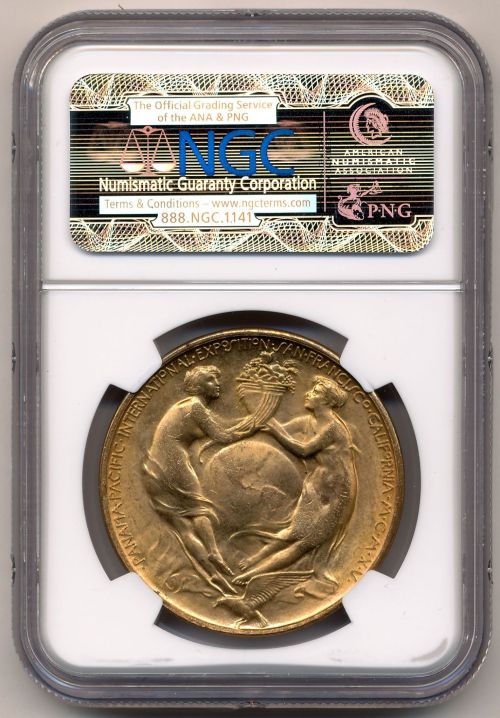
The Mint did strike commemorative medals that celebrated the completion of the Panama Canal, but these were connected to the Panama-Pacific International Exposition and funds raised from their sale were not used for the NNC.
HK-401: 1915 Panama-Pacific International Exposition - Gilt Medal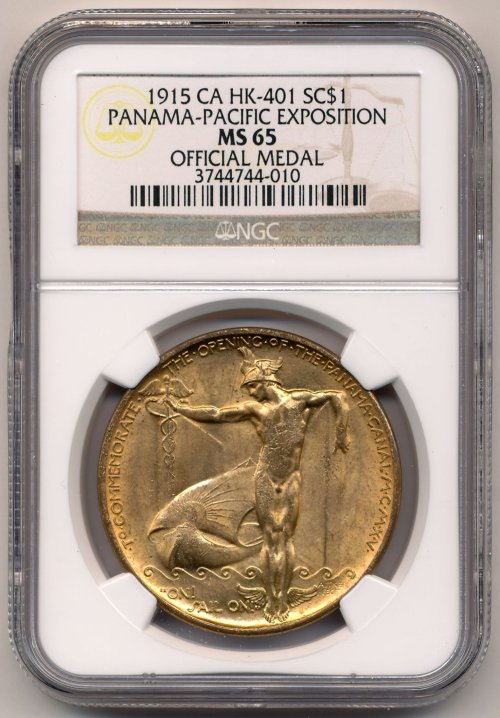
IMO, this one was a "no brainer" - the Mint would have struck the medals, fully controlled their sale/distribution and directly benefited from each medal sold as a souvenir of a visit to its facility. Where was the downside? Upon coming across this one, I was surprised and disappointed that it didn't get approved.
For more of my topics on commemorative coins and medals, including quite a few What If? stories, see:
Commems Collection.







 Posted 04/11/2023 12:04 pm





