| Author |
 Replies: 17 / Views: 2,057 Replies: 17 / Views: 2,057 |
|
CCF Master Historian of Commemorative Coins
 United States
12515 Posts |
This story of a commemorative medal bill takes a twist following its approval by Congress and the President. A series of bills calling for commemorative medals to mark the 100th anniversary of the Idaho Territory were introduced in the Second Session of the 86th Congress beginning in March 1960. The first bill was introduced in the House of Representatives by Hamar Harold Budge (R-ID), it was closely followed by a companion bill introduced in the Senate by Henry Clarence Dworshak (R-ID) for himself and Senator Frank Forrester Church (D-ID); a third bill was introduced in the House in June 1960 by Gracie Bowers Pfost (D-ID). Each of the bills was referred to the Committee on Banking and Currency of its respective chamber. The bills called for the striking of up to 10,000 silver and/or bronze medals "in commemoration of the one hundredth anniversary of the founding of the State of Idaho as a Territory." The medals were to be struck for the Idaho Territorial Centennial Commission, which was established in 1957. Orders for the medals had a minimum quantity requirement of 2,000 pieces, with the authority to strike the medals expiring on December 31, 1963. The Commission was charged with the planning and coordination of Idaho's anniversary celebration events, including the staging of parades, pageants and historical reenactments. The original area of the Idaho Territory was once part of the Washington Territory in the west and the Dakota Territory in the east. Abraham Lincoln signed into law the Act that established the Idaho Territory on March 4, 1863. When it was created, the Territory included what later would become the States of Idaho and Montana plus the majority of the future Wyoming. In May 1863, gold was discovered at Virginia City (within Idaho Territory) which fueled the area's growth and initiated the carving up of the Territory (Montana Territory created in 1864). When the Wyoming Territory was established in 1868, Idaho's borders were essentially set and have been maintained to the present. For several years, there were serious discussions regarding splitting Idaho Territory between Washington and Nevada, but in February 1888, the House Committee on Territories - in the US Congress - voted to maintain Idaho as a separate Territory. Idaho became the 43rd State when it was admitted to the Union on July 3, 1890. Idaho Territory in 1863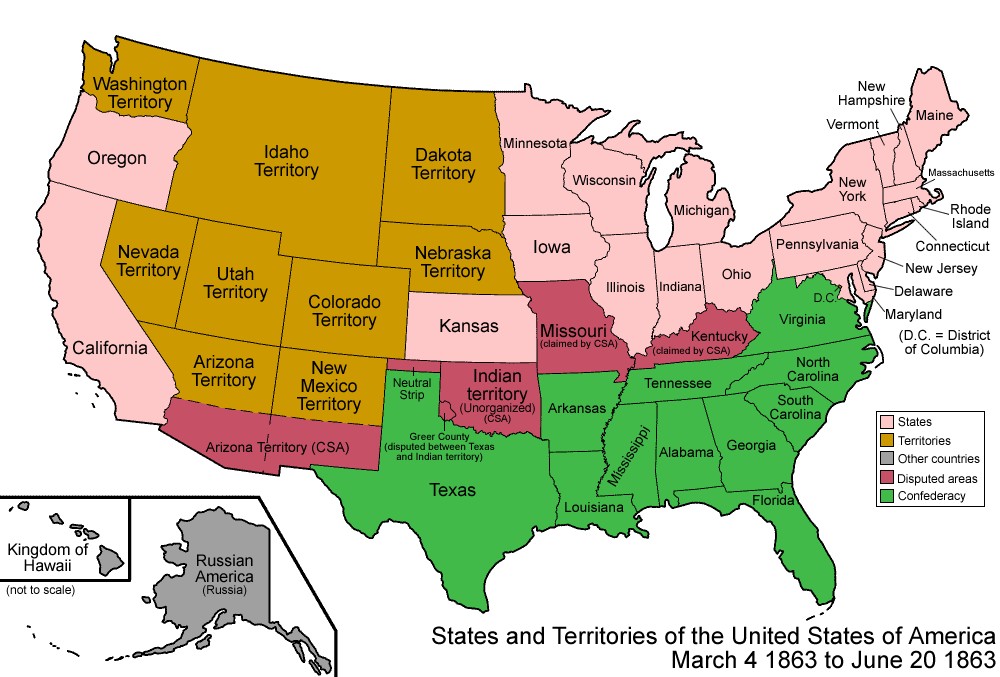 Idaho Territory in 1868 - After Montana Territory and Wyoming Territory Established Idaho Territory in 1868 - After Montana Territory and Wyoming Territory Established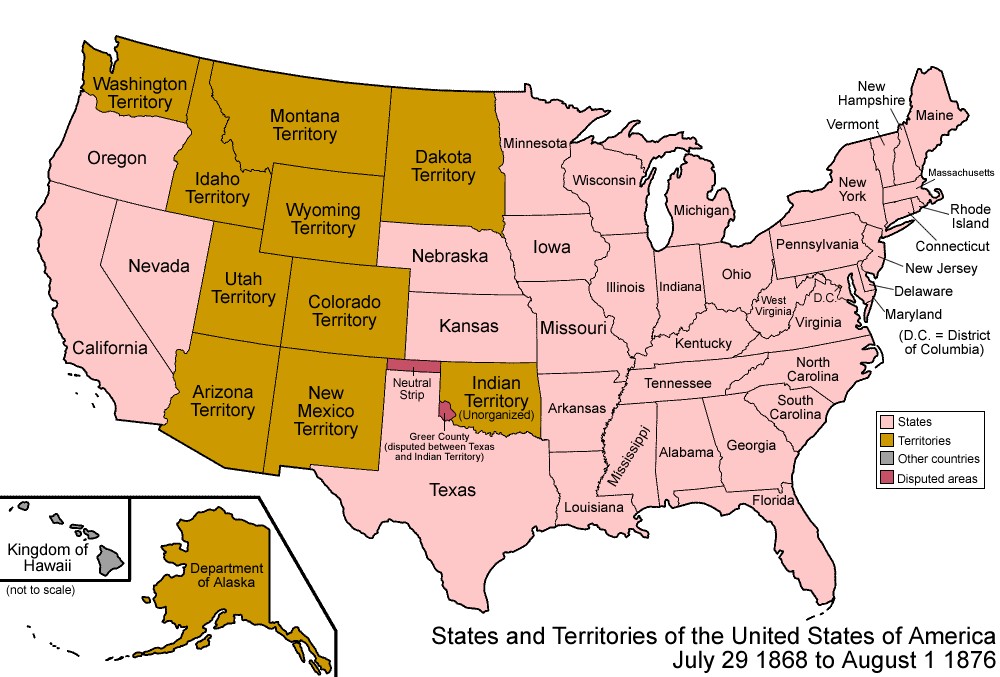 (Image Credit for Maps: Made by User:Golbez., CC BY-SA 3.0 https://www.creativecommons.org/licenses/ by-sa/3.0/, via Wikimedia Commons.) (Image Credit for Maps: Made by User:Golbez., CC BY-SA 3.0 https://www.creativecommons.org/licenses/ by-sa/3.0/, via Wikimedia Commons.)As was often the case, the Senate bill moved forward rather than either of the House bills. It was reported back from the Senate Committee in June 1960 without amendment and with a recommendation to pass. From a letter written by the Centennial Commission to the Chairman of the Committee on Banking and Currency, it is clear that members of the Commission met with Treasury officials about options for its commemorative piece and was convinced to follow the Treasury's recommendation for a medal vs. a coin. Once reported to the Senate, the bill was passed without objection and then sent to the House for its consideration. Upon being received in the House, it was referred to its Committee on Banking and Currency. The House Committee followed its Senate counterpart and reported the bill without amendment and with a recommendation to pass. The Report also gave a "tip of the hat" to the sponsors of the two Identical House bills, and stated how Representatives Budge and Pfost supported and helped advance the bill. The Senate bill was reported "in the interest of expeditious action..." but the Committee did not want to have the work of its fellow House members go unnoticed. In the House, the bill was passed without objection. It was examined and signed in each chamber, presented to the President and signed into law by Dwight David Eisenhower on September 2, 1960 - in plenty of time for Idaho's planned 1963 celebrations. The Resolution became Public Law 86-696. Following its approval, however, oversight of the medal project was shifted to the Idaho Historical Society which contracted with the Medallic Art Company (MACO) of New York to strike the medals vs. using the US Mint. MACO struck silver and bronze medals for the Historical Society. For a more detailed look at the privately-struck medals for the Idaho Historical Society, see: - 1963 Idaho Territorial Centennial MedalsFor other of my topics on commemorative coins and medals, see: Commems Collection. Collecting history one coin or medal at a time! (c) commems. All rights reserved.
Edited by commems
05/12/2023 06:55 am
|
|
|
|
Bedrock of the Community
United States
94367 Posts |
Had no idea the Idaho Territory was originally that large!
|
|
Moderator
United States
15874 Posts |
That was a lot of legislative activity to obtain a signed law authorizing an official medal - only to go hire a private company to produce it.
Seems to me the organizing committee could very have just skipped the entire congressional approval process and go straight to the Medallic Art Company.
Take a look at my other hobby ... http://www.jk-dk.art |
|
Moderator
United States
195029 Posts |
Very interesting!  |
|
CCF Master Historian of Commemorative Coins
 United States
12515 Posts |
@nickelsearcher: I agree!
I've wondered if it was a financial decision? It's difficult for me to imagine, however, that MACO was so much cheaper than the US Mint that it would be enough to override the prestige of having a Congressionally-authorized, US Mint-struck medal available to offer to collectors vs. a privately-struck piece.
Could it somehow have been design-related with the Mint wanting to impose certain details to which the IHS would not agree?
Maybe my future research will yield an answer.
Collecting history one coin or medal at a time! (c) commems. All rights reserved.
|
|
Moderator
United States
15874 Posts |
Quote:
Maybe my future research will yield an answer. I look forward to sharing in the knowledge should you uncover and report on additional insights! |
|
Pillar of the Community
 United States
2106 Posts |
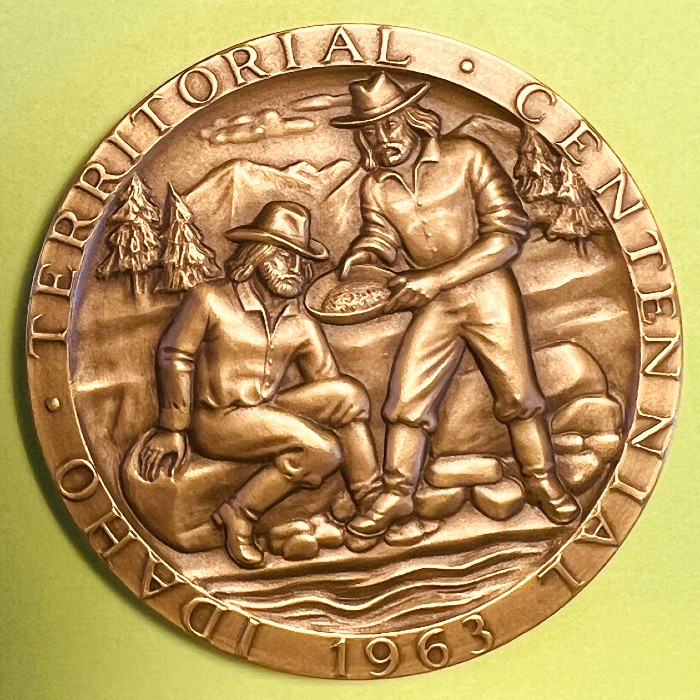 Many of the medals commems has covered in CCF forums are reasonably priced. This one was purchased as a gift for a college classmate who ended his career as City Attorney of Boise, for less than $20 " Even a clock that's stopped is right twice a day. "
|
|
Moderator
United States
195029 Posts |
That is a very nice example! |
|
Pillar of the Community
United States
2106 Posts |
Quote:
I've wondered if it was a financial decision? It's difficult for me to imagine, however, that MACO was so much cheaper than the US Mint that it would be enough to override the prestige of having a Congressionally-authorized, US Mint-struck medal available to offer to collectors vs. a privately-struck piece.
Could it somehow have been design-related with the Mint wanting to impose certain details to which the IHS would not agree?
Maybe my future research will yield an answer.
I've contacted the Idaho State Historical Society to see if they have meeting minutes of the Idaho Territorial Centennial Commission in their archives. I wonder if the decision was made over a clash of egos in the State - Federal chain or was it a clash between the ITCC and IHS. At the end of the day, somebody had to foot the bill for making the medals. . . " Even a clock that's stopped is right twice a day. "
Edited by cptbilly
08/03/2023 6:41 pm
|
|
CCF Master Historian of Commemorative Coins
United States
12515 Posts |
I look forward to reading about what information you receive.
Collecting history one coin or medal at a time! (c) commems. All rights reserved.
|
|
Pillar of the Community
United States
3778 Posts |
A very interesting topic, commems. That's quite a strange turn of events AFTER receiving final approval for a mint-issued medal. I'll be very interested to hear what your further research turns up. Thanks!
Member of SPMC, FCCB, ANA and ANS. My U.S. Classic Commemorative Complete Set: https://www.NGCcoin.com/registry/co...sets/278741/ |
|
Moderator
United States
195029 Posts |
Quote:
I've contacted the Idaho State Historical Society... Excellent!  |
|
Pillar of the Community
United States
2106 Posts |
Sec. 2 of Public Law 86-696:
(a) "The Secretary of the Treasury shall cause such medals to be struck and furnished at no less than the estimated cost of manufacture, including labor, materials, dies, use of machinery, and overhead expenses; and security satisfactory to the Director of the Mint
shall be furnished to indemnify the United States for the full payment of such cost.
(b) Upon authorization from the Idaho Territorial Centennial Commission, the Secretary of the Treasury shall cause duplicates in silver or bronze or both of such medal to be coined, and sold, under such regulations as he may prescribe, at a price sufficient to cover the cost thereof (including labor).
Commems: Is it possible the Secretary of the Treasury looked at the USM cost estimate and then directed the USM to put it out to bid ? The ITCC oversight shift to the IHS is the intriguing (to me) part of this story.
Edited by cptbilly
08/04/2023 1:43 pm
|
|
Pillar of the Community
United States
2106 Posts |
Received this via email from the ISHS a short while ago: Quote:Hello Bill, Thank you for your inquiry! Those are definitely some great questions. Unfortunately, I was not able to locate records to help answer them. I think it would be worth contacting the American Numismatic Society to see if their archives contains correspondence or documents regarding the centennial medal; ANS purchased the Medallic Art Company's archival collections: https://numismatics.org/maco/ Another good resource to explore is Newspapers.com, as it is the largest online newspaper archive, although membership is required to search records. I am able to access and search Newspapers.com for you. As a disclosure, per staff limitations, we offer 30 minutes of complimentary reference time per request. If your request requires additional research, we can assist up to two hours of research at $38 per hour. If extensive research is required we will provide you with a list of unendorsed private researchers as a convenience to customers. The acceptance of the fee charge does not guarantee records will be located. If you would like to submit a Research Request Form: https://history.idaho.gov/requests/ I hope this help! A college classmate who lives in Boise is a huge history buff. He's offered to visit the Archives for this detective story. Commems' research and scholarship on this may have already included an inquiry to ANS. . . To be continued. . . Edited by cptbilly
08/04/2023 5:35 pm
|
|
Moderator
United States
195029 Posts |
Quote:
To be continued. . . Thank you for the update! |
|
CCF Master Historian of Commemorative Coins
United States
12515 Posts |
Quote:
Sec. 2 of Public Law 86-696:
(a) "The Secretary of the Treasury shall cause such medals to be struck and furnished at no less than the estimated cost of manufacture, including labor, materials, dies, use of machinery, and overhead expenses; and security satisfactory to the Director of the Mint shall be furnished to indemnify the United States for the full payment of such cost.
(b) Upon authorization from the Idaho Territorial Centennial Commission, the Secretary of the Treasury shall cause duplicates in silver or bronze or both of such medal to be coined, and sold, under such regulations as he may prescribe, at a price sufficient to cover the cost thereof (including labor). Just so we are all clear on the meaning behind each subsection: Subsection (a) authorizes the Mint to strike the medals for the sponsor. Subsection (b) allows the Mint to strike and then sell the medals directly (vs. furnishing them to the sponsor), potentially keeping any net proceeds. This would have required the approval of the sponsor. Quote:
Is it possible the Secretary of the Treasury looked at the USM cost estimate and then directed the USM to put it out to bid ? Yes, it is possible - I wasn't there at the time so I can't say for sure either way!  - but it wouldn't be my first guess. I haven't yet seen documentation of / reference to the Secretary of the Treasury directing the US Mint to get an outside price quote for the medal's production. The Treasury Department raised no objections regarding the bill - it stood ready to have the Mint strike them when requested. Collecting history one coin or medal at a time! (c) commems. All rights reserved.
|
| |
Replies: 17 / Views: 2,057 |










 Posted 05/12/2023 12:46 pm


