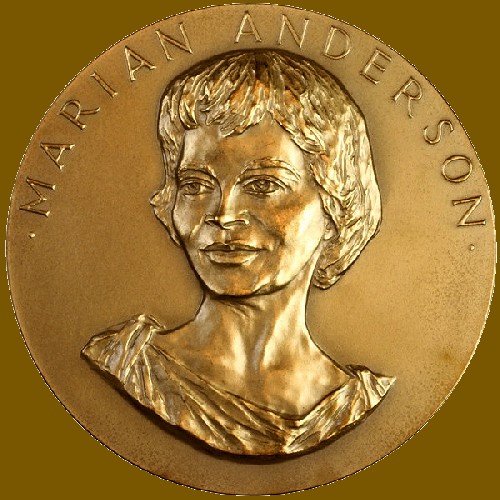
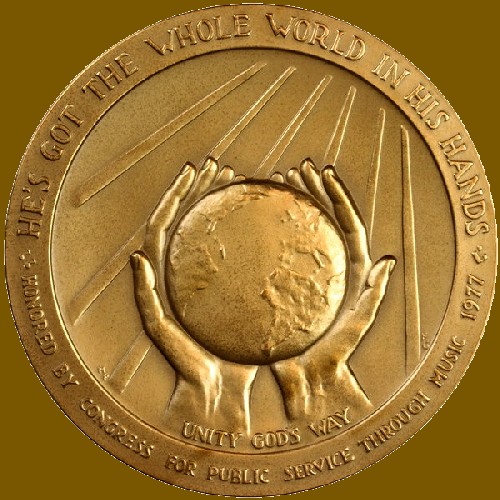
In February 1997, George E. Brown, Jr. (D-CA) introduced a bill in the House of Representatives to recognize "the centennial of the birth of Marian Anderson" with a two-coin commemorative program with an option for a third. The bill was immediately referred to the House Committee on Banking and Financial Services which then further referred it to its Subcommittee on Domestic and International Monetary Policy.
Marian Anderson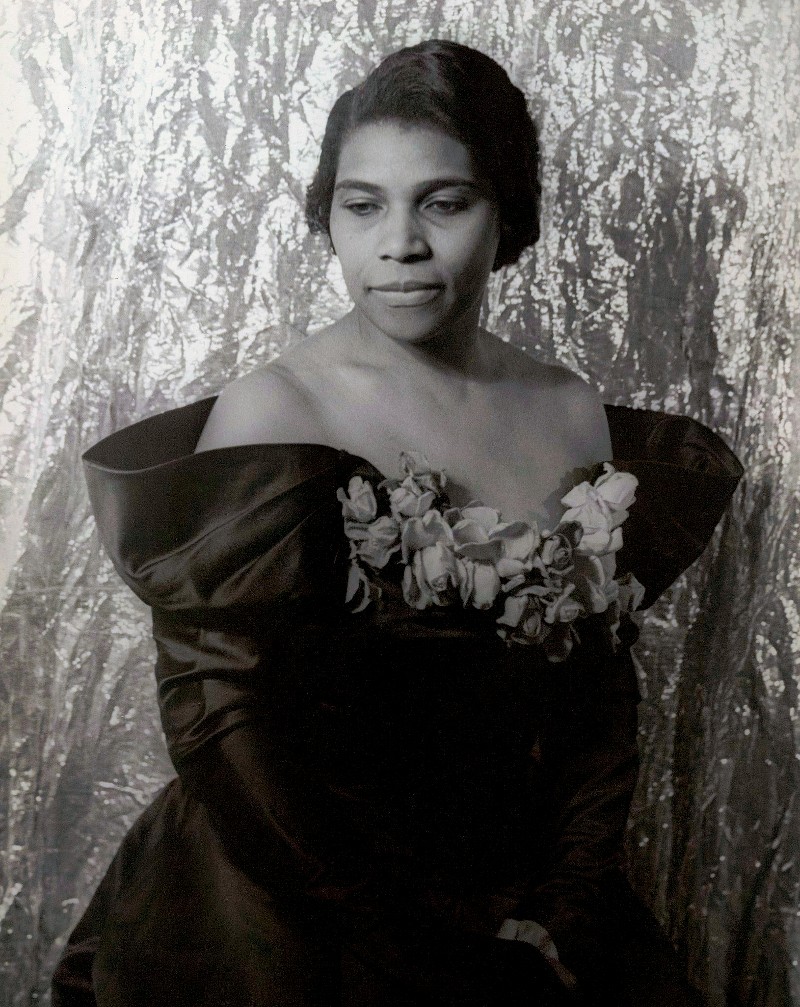 (Image Credit: Library of Congress, Prints & Photographs Division, Carl Van Vechten Collection.)
The proposed non-circulating commemorative coin component of the program was to include a 0.900 fine Silver Dollar with a maximum mintage of 350,000 and a 0.900 fine Silver Half Dollar with the same maximum mintage of 350,000. (The previous statement is correct, the bill sought
silver half dollars.)
The bill also included an interesting twist, under Title II of the bill ("Authority to Redesign Half Dollar Circulating Coins") a Marian Anderson circulating half dollar would have been a possibility. Title II specified: "At the discretion of the Secretary, half dollar coins minted after December 31, 1996, and before July 31, 1998, may bear the same design as the commemorative coins minted under Title I of the Marian Anderson Centennial Commemorative Coin Act." Representative Brown was looking for a "three-fer" - a non-circulating silver dollar, a non-circulating silver half dollar and a CuNi clad half dollar for circulation!
As is often the case for modern commemorative coin bills, the Marian Anderson coin bill included a "Findings" section:
"The Congress finds that--
(1) Marian Anderson, one of the world's greatest singers, a champion for civil rights, and a leader in the advancement of global peace, was born on February 27, 1897, in Philadelphia, Pennsylvania;
(2) Marian Anderson, a master of repertoire actress operatic, recital, and American traditional genres, played a vital role in the acceptance of African-American musicians in the classical music world;
(3) in 1963, Marian Anderson was given a Presidential Medal of Freedom;
(4) in 1974, Congress passed a resolution to have a special gold medal minted in her name;
(5) in 1977, Marian Anderson, who was an alternate delegate to the United Nations, received the U.N. Peace Prize;
(6) in 1986, Marian Anderson was awarded the National Arts Medal; and
(7) 1997 will mark the centennial of the birth of Marian Anderson."
The designs for the coins were to be "emblematic of the many accomplishments of Marian Anderson throughout her prolific life" and were to feature a likeness of Anderson on the obverse of each..
On the 58th anniversary of Marian Anderson's historic 1939 concert on the steps of the Lincoln Memorial - April 9, 1997 - Representative Brown requested the opportunity to address the House about Marian Anderson and his proposed coin bill. His request was granted and he offered extensive remarks, including the following excerpts:
"I rise today to pay tribute to the centennial of the birth of Marian Anderson, one of the world's greatest singers, a champion for civil rights, and a leader in the advancement of global peace."
"One hundred years ago, on February 27, 1897, Marian Anderson was born to a poor family in Philadelphia, PA. She died at the age of 96, on April 8, 1993. She was a master of repertoire across operatic recital and American traditional genres."
"...the magnitude of her talent eventually won her broad recognition all over the world. She became the first black singer to perform at the Metropolitan Opera in 1955. By the time she retired in the mid 1960s, Marian Anderson was recognized as a national treasure."
"...Marian Anderson not only played a vital role in the acceptance of African-American musicians in the classical music world but also made a valuable contribution to the advancement of the arts, the status of women, civil rights, and global peace."
"...In 1957, the U.S. State Department sponsored a 10-week tour of Asia, in which she sang 24 concerts in 14 countries. She also sang at President Dwight D. Eisenhower's Inauguration in 1957 and at President John F. Kennedy's in 1961."
"...Marian Anderson was a delegate to the United Nations, where she received the U.N. Peace Prize in 1977. In 1984, she became the first recipient of the Eleanor Roosevelt Human Rights Award of the city of New York."
Brown recounted the life and many accomplishments of Marian Anderson in lengthy remarks well beyond the scope of this post. Suffice it to say, Brown was an admirer. He concluded his remarks with:
"I consider it a privilege to have introduced this legislation to pass on our memory of this great humanitarian to future generations in the form of her commemorative coins. I am honored to join with my colleagues today to pay tribute to the centennial of the birth of Marian Anderson."
Ultimately, the bill garnered 129 co-sponsors in the House.
The issue prices of each of the non-circulating coins was to include a surcharge: $14 per silver dollar and $7 per silver half dollar. The surcharge distribution was subject to several provisions:

50% of the first $2 million of the surcharges collected was to be paid to the Board of Regents of the Smithsonian Institution for exhibits on African-American art, history and culture.
50% of the first $2 million of the surcharges collected was to be paid to the Corporation for Public Broadcasting / Public Broadcasting Fund for educational programs on African-American art, history and culture and on the life of Marian Anderson.
Surcharges collected beyond $2 million were to be paid to the National Museum of American History to support the National Numismatic Collection.
The bill was not reported out of Committee and never was considered by the Whole House.
I think that one thing working against the bill was the fact that Marian Anderson was the subject of one of the 10 commemorative American Arts Medallions issued by the US Mint in a series released from 1980 to 1984. With so many notable Americans worthy of honor with a coin, some may have believed that Anderson had already received her honor with a US Mint product.
1980 Marian Anderson Gold American Arts Medallion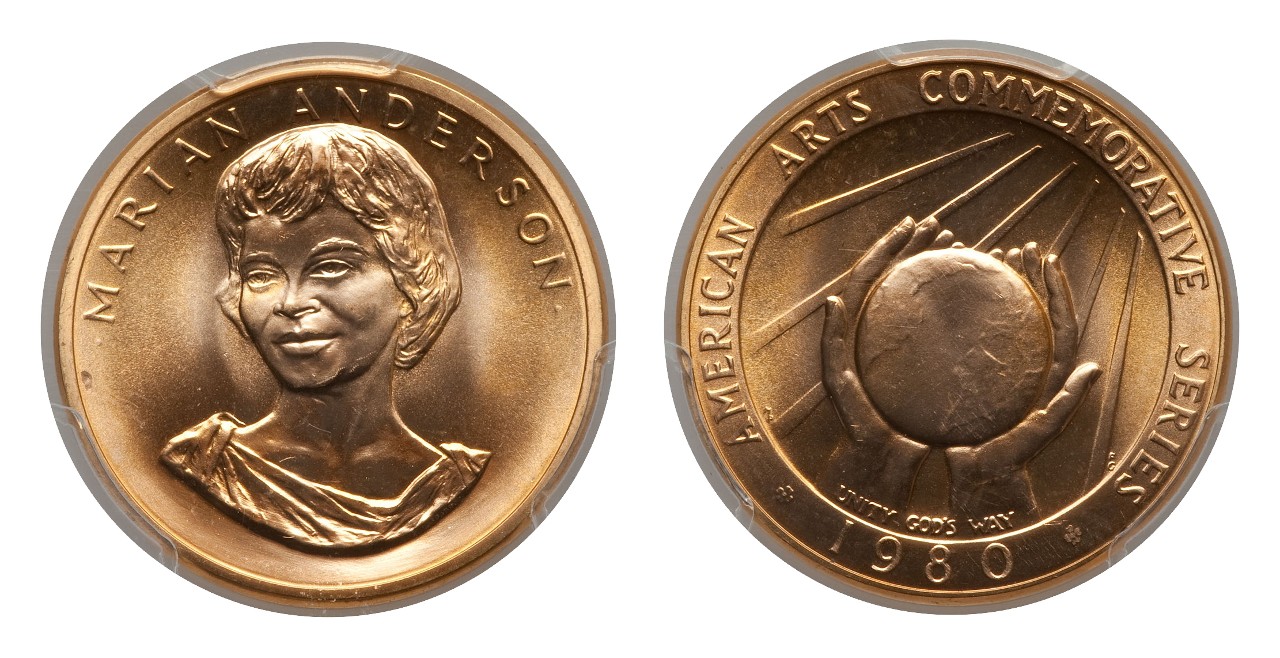 (Image Credit: Heritage Auctions, https://www.ha.com.)
I put together a series of posts on the American Arts Gold Medallions, if you'd like to learn more about the gold series:
-
1980-84 American Arts Gold MedallionsFor other of my posts about commemorative coins and medals, including more What If? stories about coins from the classic and modern series, see:
Commems Collection.









 Posted 09/19/2023 4:43 pm


 Uncirculated American Silver Eagles