Coin Community Family of Web Sites Join Thousands of Coin, Bullion, & Money Collectors
Join Thousands of Coin, Bullion, & Money Collectors Royal Canadian Mint products, Canadian, Polish, American, and world coins and banknotes. Royal Estate Auctions - $1 Coin AuctionsSpecializing in Modern Numismatics 300,000 items to help build your collection! Coin, Banknote and Medal Collectors's Online Mall Vancouvers #1 Coin and Paper Money Dealer


Username:
Password:
Save Password
Forgot your Password?


This page may contain links that result in small commissions to keep this free site up and running.

Welcome Guest! Registering and/or logging in will remove the anchor (bottom) ads. It's Free!

The Lovely Lowly Liard

To participate in the forum you must log in or register.
Author Previous TopicReplies: 163 / Views: 7,142Next Topic
Page: of 11
Pillar of the Community
Learn More...
NumisEd's Avatar
United States
5192 Posts
 Posted 06/01/2024  5:42 pm  Show Profile   Bookmark this reply Add NumisEd to your friends list Get a Link to this Reply
Just shows you that coins (in this case Liards) can tell you a lot about the times in which they were struck. In case of France, chapter 28 above clearly spells this out with the text changes on the Liards.
Pillar of the Community
Learn More...
erafjel's Avatar
Sweden
2124 Posts
 Posted 06/02/2024  08:28 am  Show Profile   Bookmark this reply Add erafjel to your friends list Get a Link to this Reply
I completely agree, @NumisEd, and that is one important reason for me to collect coins. Being a history buff, I see my coins as windows into history and sort of keepers of historical events. Coins - liards and others - that are used to convey a message to the bearer are especially interesting. The "revolutionary" liard I showed in Chapter 28 is an example, the Low Countries oorden from the Dutch Revolt and from the Dutch Republic are others.
Pillar of the Community
Learn More...
erafjel's Avatar
Sweden
2124 Posts
 Posted 06/03/2024  2:28 pm  Show Profile   Bookmark this reply Add erafjel to your friends list Get a Link to this Reply
CHAPTER 29: The Austrian Netherlands

= Late 18th Century =


Chapter 18 was a while ago, but it ended with Charles VI of Austria being given the lordship over the Spanish Netherlands in 1714. From then on, they are known as the Austrian Netherlands. That lasted until 1794, when it was occupied by France. Fast forwarding a few decades from there, we find the modern states Belgium and Luxembourg in its place.

Coins of all sorts and sizes were minted for use in the Austrian Netherlands. Liards/oorden were minted irregularly, seemingly when a need arose.

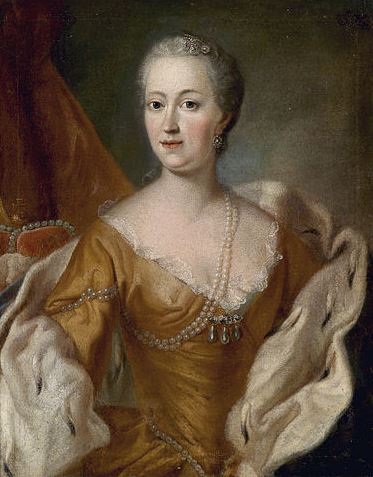
Maria Theresa

My favorite empress! (Vicky comes in second. ) Maria Theresa was the eldest daughter of Charles VI and became Empress of the Holy Roman Emperor when her father passed away in 1740. That was not a popular move among the other European great powers. For one thing, a woman on the throne of the Holy Roman Empire!?! "Okay, we did agree to that while Charlie was around, Pragmatic Sanction and all that, but for Heaven's sake, that was just diplomacy, of course we didn't mean any of it!" For another, with a feeble woman now on the throne, that is probably the best shot at a) kicking her out and replace her with a capable French/Prussian/Bavarian nobleman and take over the entire empire, or, b) if agreement cannot be reached on the nationality of that nobleman, break the empire into parts and distribute it among those interested.

So, the War of the Austrian Succession began. Maria Theresa turned out to be anything but feeble. It took nearly eight years of fighting and diplomacy, but in the end she had secured her right to the throne and sat firmly on it for several decades.

The-Lovely-Lowly-Liard
Maria Theresa ca 1740.
Source: Painting by unknown artist. Wikimedia Commons. Public domain.


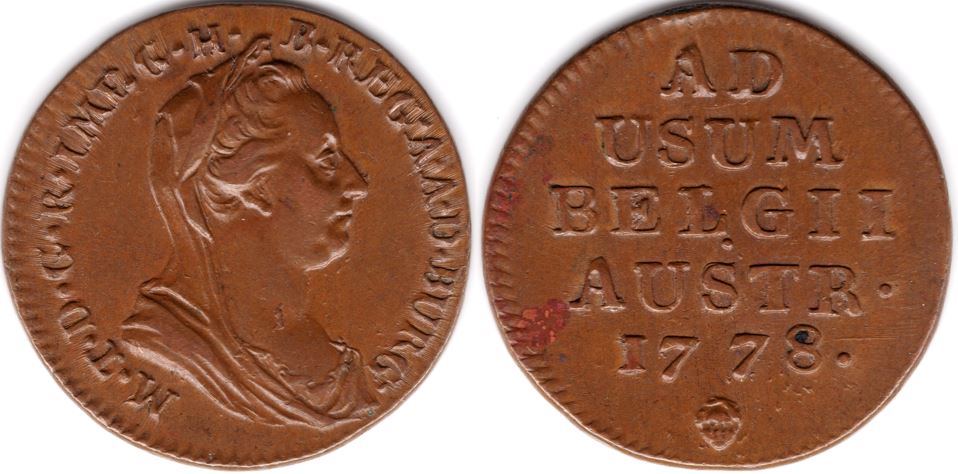
The Low Countries was of course just one of the empress's many possessions, but it was provided with a rich coinage in all metals and denominations. Liards/oorden were minted in a number of series. Here is one from the last one, just two years before Maria Theresa passed away.

Liard/oord, Austrian Netherlands 1778, Maria Theresa of Austria, Brussels. Copper. 3.90 g, 22 mm. Vanhoudt 833.

The-Lovely-Lowly-Liard

Obverse: M T D G R IMP G H B REG A A D BURG (Maria Theresia Dei Gratia Romanorum Imperatrix Germaniae Hungariae Bohemiaeque Regina Archidux Austriae Dux Burgundiae / Maria Theresa by Grace of God Empress of the Romans, Queen of Germany, Hungary and Bohemia, Archduchess of Austria, Duchess of Burgundy; see Note 1). Maria Theresa, veiled.
Reverse: AD USUM BELGII AUSTR (Ad usum Belgii Austriaci / For use in Austrian Belgium). Angel face, mintmark for Brussels.

Maria Theresa is one of those rulers whose list of titles is too long to fit on any reasonably sized coin, without making a narrow selection and use abbreviations to the greatest extent possible. Without a cheat sheet, the meanings of "M T", "G H B" and "A A" remain enigmatic. Fortunately, cheat sheets for the Habsburgs are readily available, and there are not too many strange titles here, most of them we have seen before in this thread.

Queen of Germany deserves an elaboration. Germania is a more precise translation, but what it means is not so precise. Hungary and Bohemia, the other queenly possessions mentioned, were well defined geographically, but in the 18th century, there was no "Kingdom of Germany" that was part of the Empire. Without going through too much history (leading back to Julius Caesar and the original Romans), suffice it to say that the origins of the Holy Roman Empire lay in a Germanic kingdom around 1000 AD. It consisted of a number of duchies and other territories, which over time evolved into a huge number of states, some microscopic on a map. The term "Germany/Germania" lived on as a collective term for the parts of the Empire outside of Austria, Hungary, Bohemia and other large players. (There is much more to say about this, but not here. )

The austere reverse simply states that this is a coin for use in "Austrian Belgium" (literally Belgii Austriaci translates to "Belgium of the Austrians"). A common Latin designation for the Low Countries was Belgica, the roots of which again lead us back to the original Romans and the Roman province of Gallia Belgica, which was very roughly where the Low Countries later came to be. Later the name was picked up when the kingdom of Belgium was established in 1830.

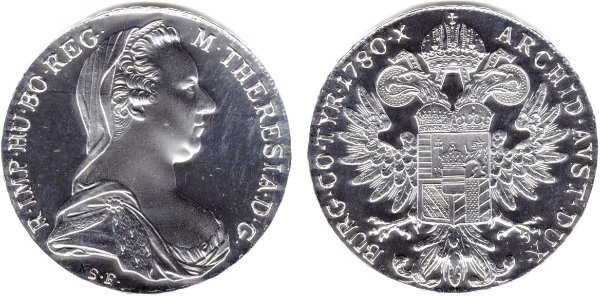
A few words about the portrait. After Maria Theresa's husband, Francis I, died in 1765, she wore a veil and dressed in mourning for the remaining 15 years of her life. That is also how she has been immortalized on the Maria Theresa Thalers, the silver crowns that continued to be minted for use as trade coins also after her death. The date on those is frozen to her death year 1780, and they are still minted (now for collectors rather than trade). Here is one from my collection:

The-Lovely-Lowly-Liard
Maria Theresa Thaler restrike, minted ca 2018 in Vienna.

Francis II - The Last Liard

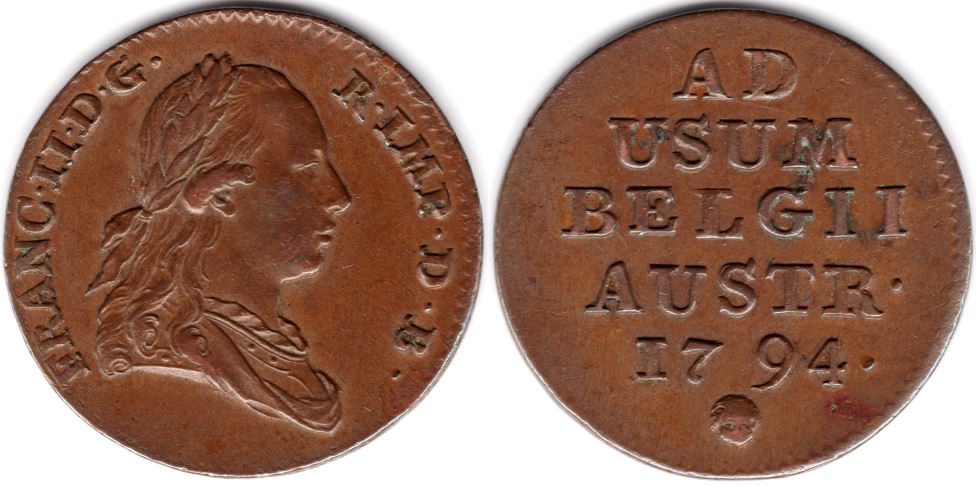
Grandson of Maria Theresa, Francis II was the last Holy Roman Emperor until 1806, when Napoleon through his warfare put an end to that fun for good. (Francis took his revenge in 1814, having a leading role in the Sixth Coalition that defeated Napoleon and forced him to abdicate.) He certainly had an eventful life, but many biographies about him fail to mention that he was also the last ruler to issue liards/oorden! That happened in 1794, two years after France minted its last 3 deniers coins (shown in the previous Chapter).

Liard/oord, Austrian Netherlands 1794, Francis II of Austria, Brussels. Copper. 3.60 g, 22 mm. Vanhoudt 888.

The-Lovely-Lowly-Liard

Obverse: FRANC II D G R IMP D B (Franciscus II Dei Gratia Romanorum Imperator Dux Burgundiae / Francis II by Grace of God Emperor of the Romans, Duke of Burgundy). Francis II, laureate.
Reverse: AD USUM BELGII AUSTR (Ad usum Belgii Austriaci / For use in Austrian Belgium). Angel face, mintmark for Brussels.

Francis holds back on his titles, even though he has as many as his grandmother. He doesn't even point out that he is Archduke. Duke of Burgundy (which he is only in theory) is apparently more important.

"Eh, I'm not quite dead . . ."

The Last Liard. Well. A coin that has been with us for some 450 years, in different forms and with various names, is maybe not that easy to kill off. It is true that Francis's 1794 liard was the last regularly minted coin with that denomination, but we need to mention the 1852 liard issue by the Bishopric of Liège. As you may recall from Chapter 22, a supreme court of the Empire ordered the Bishopric to cease issuing coins in 1754, following certain irregularities in the minting. They were still allowed some minting for ceremonial purposes, and 1852 was such an occasion. To my knowledge, that was the only time it was used to issue a small number of liards. It didn't look too bad, you can see it here.

And then, of course . . .

The Saga Continues!

We are done with all the coins in the "map" from the Introduction, true. But there is a 30th Chapter, about how the liard lived on into the 19th and 20th centuries. There were no more actual liards minted - to the best of my knowledge and with the exception of that 1852 Liège coin - but another denomination surfaced, in a nearby part of the world, which was directly derived from the liard. Feel free to take a guess at what it is I am talking about, before I tell you the whole story in a day or two! No prize other than immeasurable honor! (There is actually a clue in this post. Not too obvious, but pointing in the right direction. And, in fact, the name of the territory I am thinking of is mentioned earlier in this thread.)

And, don't forget to post your own liards! Related or not to what I have shown in this post. There is, for instance, some interesting insurrection coinage from 1790, which I myself do not have in my collection, but I am sure someone out there has it!

Notes

Note 1. Despite her apparent femininity, Maria Theresa is most often bestowed with the Latin title Archidux rather than its feminine equivalent Archiducissa (and the same for Dux Burgundiae rather than Ducissa Burgundiae). Dux was often used in a gender neutral way, and on larger coins with room for more text, Maria's title is spelled out as DUX BURG. One can stay gender neutral when translating to English and other modern languages (like for Elizabeth II, one of whose titles was Duke of Normandy, not Duchess), but it is more common to talk about the Archduchess Maria Theresa.
Moderator
Learn More...
jbuck's Avatar
United States
189767 Posts
 Posted 06/03/2024  2:41 pm  Show Profile   Bookmark this reply Add jbuck to your friends list Get a Link to this Reply
I will call that an excellent finale, even though we have one more bonus chapter tomorrow. Perhaps better to say a finale for the liard, proper.

I have donned my thinking cap in search of clues, but I do not expect to find an answer before your final chapter. Try, I must.
Pillar of the Community
Learn More...
erafjel's Avatar
Sweden
2124 Posts
 Posted 06/04/2024  1:29 pm  Show Profile   Bookmark this reply Add erafjel to your friends list Get a Link to this Reply
Thank you, jbuck.

Yes, the final Chapter remains. One more clue, if you want to take a guess at where to look for the liard's 19th century successor: Follow the advice of Horace Greeley, Village People, the Marx Brothers, and Buster Keaton, among others.
Moderator
Learn More...
jbuck's Avatar
United States
189767 Posts
 Posted 06/04/2024  2:16 pm  Show Profile   Bookmark this reply Add jbuck to your friends list Get a Link to this Reply
Hmm. Go West... To Louisiana? Is it the Picayune? That just popped into my head, so I am going to go with it!
Pillar of the Community
Learn More...
erafjel's Avatar
Sweden
2124 Posts
 Posted 06/04/2024  2:26 pm  Show Profile   Bookmark this reply Add erafjel to your friends list Get a Link to this Reply
Good try, but no, it's not the picayune (had to look that up, a new term for me ). You don't need to take such long steps, much much shorter . . .
Moderator
Learn More...
jbuck's Avatar
United States
189767 Posts
Pillar of the Community
Learn More...
erafjel's Avatar
Sweden
2124 Posts
 Posted 06/04/2024  5:42 pm  Show Profile   Bookmark this reply Add erafjel to your friends list Get a Link to this Reply
One more (cryptic) clue: Find those from the North, go West and look for quarters . Tomorrow all will be revealed.
Moderator
Learn More...
jbuck's Avatar
United States
189767 Posts
 Posted 06/05/2024  09:34 am  Show Profile   Bookmark this reply Add jbuck to your friends list Get a Link to this Reply
I keep running myself in circles without landing a guess, but I gave it the old college try!

Unless something pops into my head, I shall await the reveal today.

I am either going to hate myself for missing something so obvious, or it will be something I would have never expected even with a hundred clues.
Pillar of the Community
Learn More...
erafjel's Avatar
Sweden
2124 Posts
 Posted 06/05/2024  11:45 am  Show Profile   Bookmark this reply Add erafjel to your friends list Get a Link to this Reply
Well, your guess at least taught me about the picayune, so thank you for that!

I will give two more clues. They are somewhere in the text below.

"It was sort of a 19th century follow-up to the liard, used outside, and a bit West of, the original area where the liard was used." If this was Jeopardy, that would be the clue, with the additional rounds called Double Jeopardy and Triple Leopardy
Moderator
Learn More...
jbuck's Avatar
United States
189767 Posts
 Posted 06/05/2024  11:59 am  Show Profile   Bookmark this reply Add jbuck to your friends list Get a Link to this Reply

Quote:
Well, your guess at least taught me about the picayune, so thank you for that!
My pleasure.

Quote:
I will give two more clues. They are somewhere in the text below.
I will have to mull that over lunch.
Pillar of the Community
Russian Federation
5179 Posts
 Posted 06/05/2024  1:35 pm  Show Profile   Bookmark this reply Add january1may to your friends list Get a Link to this Reply
I think I've figured it out: someone mixed up the liard with another denomination we've seen in this thread.

It's an interesting issue and I know I've tried to find one of those for my own collection at some point
Pillar of the Community
Learn More...
erafjel's Avatar
Sweden
2124 Posts
 Posted 06/05/2024  5:49 pm  Show Profile   Bookmark this reply Add erafjel to your friends list Get a Link to this Reply
Ok, time to let the fog clear . . .
Pillar of the Community
Learn More...
erafjel's Avatar
Sweden
2124 Posts
 Posted 06/05/2024  6:07 pm  Show Profile   Bookmark this reply Add erafjel to your friends list Get a Link to this Reply
CHAPTER 30: A Double Solution

= 19th-20th Centuries =


1 livre = 20 sous = 80 liards = 240 deniers. Such was the French monetary system until 1795, when the franc was introduced as part of the reforms initiated by the French Revolution. For practical reasons, the old coins remained valid, but were successively phased out. The old liards were valid until 1856, at a value of two centimes, 2/100 of a franc. Of course there were no new coins minted for the old system, only francs and centimes.

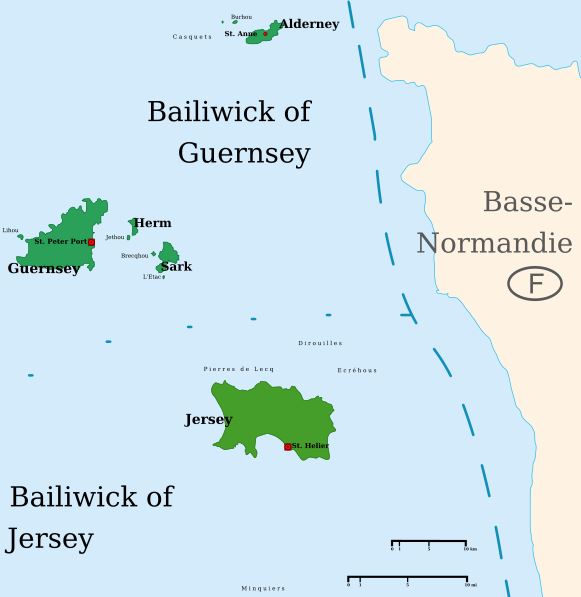
That was a problem for the two Bailiwicks in the English Channel, Guernsey and Jersey. Contrary to what one might think, these two possessions of the British monarch did not use British currency, but French. Preferably pre-revolutionary French. The islands traditionally had close ties with nearby France, being the last remnants of the Duchy of Normandy. English king Edward III had, in the 1340s, granted the Channel Islands certain rights, including the right to pay rents and dues to the crown "in the same money as is used by the inhabitants of Normandy". When the Normans began to use French coin, so did the Channel Islands. When the French revolutionaries shifted over to the franc, so did the islanders, after a few years and with some hesitation. All accounts continued to be kept in livres, though, with regular updates of the exchange rate to French francs, British pounds, Spanish dollars, and other currencies that were used on the islands.
The-Lovely-Lowly-Liard
Guernsey and Jersey in the English Channel.
Source: By Hannes2. Wikimedia Commons. Creative Commons Attribution-Share Alike 3.0 Unported license.


In the 1820s, it was becoming difficult to fill the need for coins from the old sous-deniers system, and the ones that were available were quite worn. Other copper pieces besides French circulated as small change as well: English farthings, Dutch and Spanish coppers of various denominations, the odd uniform button too. The new franc system didn't help much, because copper small change was scarce in France too (as usual, the French found other, more belligerent uses, for their copper - not least during the Napoleonic wars which raged until 1815). France had restored the monarchy after Napoleon but did not seem to have any plans to restore the old money system. Something needed to be done.

To an ignorant foreigner like me, a natural course of action seems to have been to introduce British money on the islands. After all, that too used the same division: 1 pound = 20 shillings = 240 pence. Precisely that was actually suggested to the Guernsey authorities by the British home secretary in 1826. He got an extensive answer, that referred to the grants made by Edward III and later kings about the right to use French coin, as well as the recent instability of the British currency (brought about by the many years of war) and the detrimental effect it would have to force it upon the inhabitants of the Bailiwick. Then no more was said about that. Clearly, Guernsey wanted to have its own monetary system, not tied to that of the Realm. And it was probably useful to stay on par with the existing stock of (more and more worn) French 18th century coins. Guernsey came up with a solution to meet both requirements.

The Double (and the "Guernsey Penny")

All sorts of old French coins circulated in Guernsey in the beginning of the 19th century. Common smaller denominations were 2 sous, 1 sou, ½ sou, and 1/4 sou. The last one of those, yes, that's the liard. In Guernsey, those were called doubles (I elaborate on the name further down).

The new system was based on the liard/double, the smallest coin that circulated, and the denomination officially became double. The first coins, 1 double and 4 doubles - corresponding to 1/4 sou and 1 sou - were issued in 1830. An 8 doubles - 2 sous - coin came in 1834. 8 doubles were thus equal to 1/10 French livre (French currency continued to be valid, if you managed to find any). The 8 doubles coin eventually became known as the Guernsey penny. 12 of those made a Guernsey shilling, 20 of which made a Guernsey pound. In 1829 the exchange rate was set to 1 franc = 10 Guernsey pence (which matches the 8 doubles = 1/10 livre, ignoring the 1.25 % difference in value between livre and franc). The British pound (sterling) was worth 25.50 francs (defined by the gold content of the two currencies' coins), which made 1 £ sterling = 1 £ 1 s 3 d Guernsey.

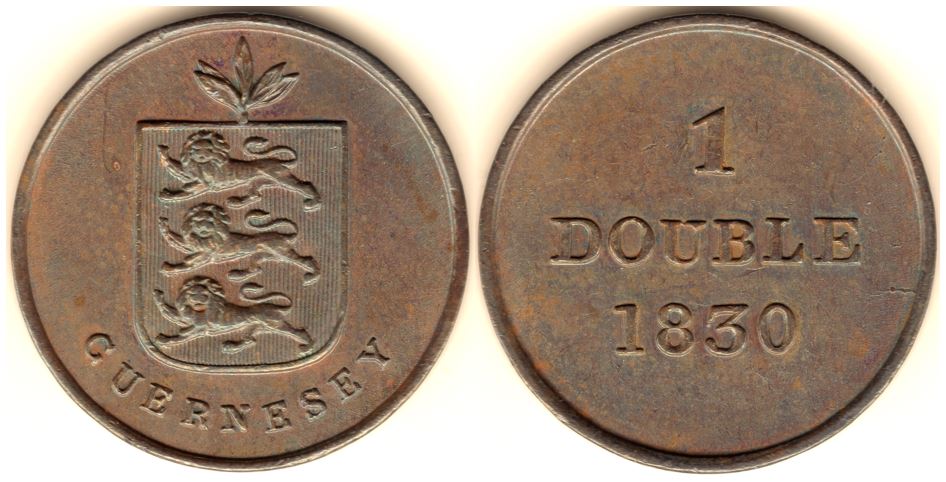
That is perhaps enough numbers for now, let's look at a coin! Here is the first coin minted in the new system, a 1 double - or liard, if you like:

1 double, Guernsey 1830, Soho. Copper. 2.48 g, 19 mm. Spink 7202.
The-Lovely-Lowly-Liard

Obverse: GUERNESEY. Guernsey coat of arms.
Reverse: 1 DOUBLE.

Not much to see here. French spelling of Guernsey. The three lions are the same three that roam the English coat of arms. That was created for Richard the Lionheart, king of England until 1199, and it reached the Channel Islands probably in 1279, when king Edward I granted them his seal for local use. (To a heraldist, these lions passant guardant are leopards, by the way.) The shield is topped by a sprig of what at least originally was broom, Latin name Planta genista, a symbol of the Plantagenet kings, the royal line to which Richard and Edward belonged.

To mint the coins, the Soho mint in Birmingham, UK, was contracted. The single 1830 issue of about 1.6 million 1 double coins and ca 650,000 4 doubles coins, complemented with a single issue of ca 220,000 8 doubles coins in 1834, was considered sufficient. The next issue did not come until 1858.

The Absolutely Last "Liard"

In 1870 British coins were made legal tender, with a rate of 1 British shilling = 12½ Guernsey pence. In 1921, the Guernsey pound was made equal to the pound sterling, with 21 Guernsey shillings to the pound. The 1 double coin was minted now and then until 1938. That year the last of this minute denomination - corresponding to ½ farthing - was made.

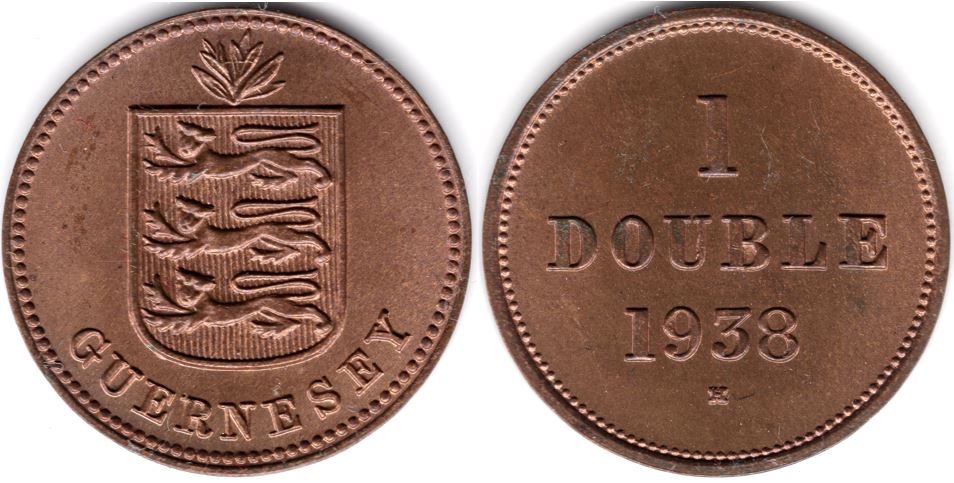
1 double, Guernsey 1938, Birmingham. Bronze. 2.27 g, 19 mm. Spink 7220.
The-Lovely-Lowly-Liard

Obverse: GUERNESEY. Guernsey coat of arms.
Reverse: 1 DOUBLE. Mintmark 'H' for Heaton & Sons, Birmingham.

No need to change a winning design . . . The lions/panthers have been updated to a more modern look, and the mint has been bestowed with a letter. (Heaton & Sons, also known as Birmingham Mint, was located not far from Soho Mint. When the latter closed in the mid 1800s, Birmingham Mint took over some of its equipment.)

I think we can call this the last coin minted with a value of one liard.

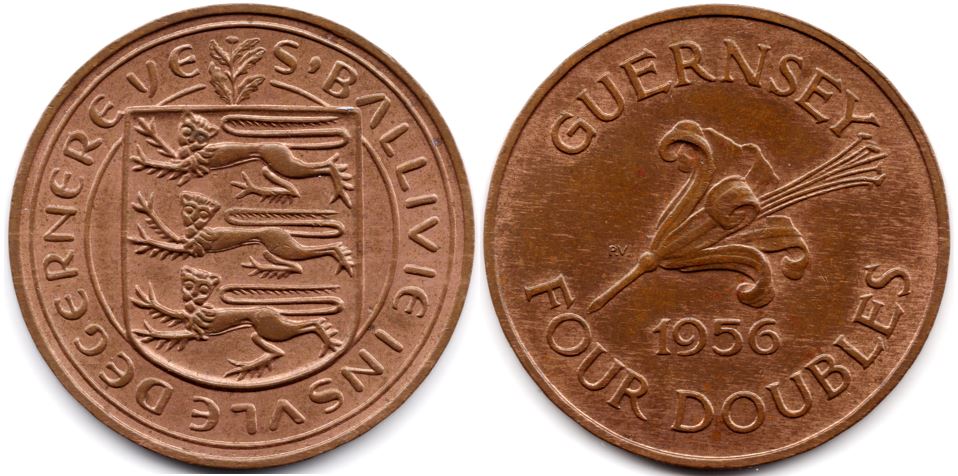
The name double continued to be used, though. Here is a 4 doubles (corresponding to a halfpenny) from 1956.

4 doubles, Guernsey 1956, London. Bronze. 4.81 g, 25.5 mm. Spink 7226.
The-Lovely-Lowly-Liard

Obverse: S'BALLIVIE INSVLE DEGERNEREYE (Sigillum Ballivie insule de Gernereye / Seal of the Bailiwick of the Island of Guernsey). Guernsey coat of arms.
Reverse: GUERNSEY // FOUR DOUBLES. Guernsey lily. Initials 'P.V.' for engraver Paul Vincze.

Now this one looks different. The coat of arms is still there, but the lions have become even more stylized. My first thought when I saw this coin was "Hm, nice 1950s model on those lions, and the text, what is that, something on the local Guernsey dialect?" A bit of research showed that it is a slightly modernized rendition of a seal closer to the 1250s. The original is shown below.
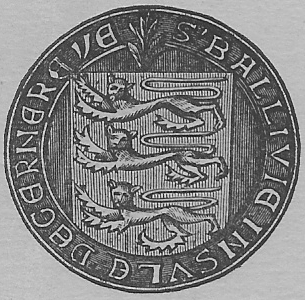
The-Lovely-Lowly-Liard
13th century seal used by the Bailiwick of Guernsey.
Source: From Note-Book of Pierre Le Roy (1600-1675). Wikipedia. Public domain.


The lions have been modernized a bit . . . And it is all Latin, Ballivie and Gernereye are just Latinized forms of the local words at the time.

The red Guernsey lily has been cultivated on the island for centuries. It originates in South Africa and the legend has it that bulbs from a sunken ship floated ashore in 1659, took root and flourished.

The very last regular coin for circulation with a denomination in doubles was the 1959 8 doubles, with a design similar to the 4 doubles.

Some Irregular Latecomers

While the 8 doubles issued in 1959 was the last coin put into circulation, there were a number of 4 and 8 doubles proofs, with the same design, issued in 1966. There is also a commemorative coin, issued 2012-2015, with the 8 doubles design used 1914-1949, but in silver and with the real denomination of 2 pounds.

Why "Double"?

In France the liards were valued at 1/4 sou in the 18th century, but in Guernsey the rate liard to sou varied. In 1763 the Guernsey authorities set the rate to 6 liards per sou, that is, a value of two deniers. Liards from France (and similar sized coins from other countries) were named grand doubles (maybe to differentiate them from ordinary double deniers, which may have been around too). The reason for the undervaluation was to attract silver coins to Guernsey - the calculation was that the islanders would take their copper liards to France, where they were still worth 1/4 sou and could be exchanged into silver coins at a better rate. I am not sure how well that scheme worked, but a value of 1/6-1/7 sou remained until the 1820s, and so did the name double. At the introduction of the Guernsey coinage in 1830, however, the value of the double again corresponded to 1/4 sou.

What About Jersey?

Jersey had the same issues, of course, using the French livre-sous-deniers system, and running out of useful coins. Like Guernsey, they were not too keen to simply move to British currency. But using the same system as the neighbor bailiwick - well, that was just not going to happen. Despite - or because of - the fairly short distance between Jersey and Guernsey - 43 km/27 mi - the two islands have been rivals about most things. Calling the inhabitants of the other island "toads" respectively "donkeys" gives an idea of the level of mutual appreciation. Guernseys being considered as strongheaded on Jersey, while Guernsey sees Jerseys as too lenient towards the English Crown may have its roots in the two islands taking different stands during the English Civil War. That the inhabitants of the other island were seen, overall, as a bit backward, goes without saying.

In any event, Jersey came up with its own solution. It was decided to make the British pound legal currency, and likewise for the British shilling. The shilling, however, was divided into 13 "Jersey pence", the official name being "1/13th of a shilling". The pound was defined as equivalent to 26 French livres, which made the Jersey penny equal to 2 French sous. That is, the same value as the Guernsey penny or 8 doubles coin. Coins were minted with values of 1/13th, 1/26th, and 1/52nd of a shilling, but no 1/104th of a shilling, which would have equaled the 1/4 sou or liard.

Epilogue

600 years of existence in various forms - from 1368 to 1966 (if we take hardi, liard and double to all mean the same) - silver, billon, copper and bronze, English, French, Flemish and Dutch, thin and tiny, thick and sturdy. Not bad for a small coin.

I am also a bit marveled at the fact that the last doubles/liards were issued under a monarch who was with us until very recently. Although her name was not included on the Guernsey coins until the 1960s, Elizabeth II (and her predecessors) was head of state and ultimately responsible for the minting. Going back to the first hardi of 1368 - presented in Chapter 1 - we have another English royalty, Prince Edward, who minted those for his Duchy of Aquitaine (and it was his father, Edward III, who granted the Channel Islands their rights). We have come full circle.

  Previous TopicReplies: 163 / Views: 7,142Next Topic
Page: of 11

To participate in the forum you must log in or register.


Disclaimer: While a tremendous amount of effort goes into ensuring the accuracy of the information contained in this site, Coin Community assumes no liability for errors. Copyright 2005 - 2026 Coin Community Family- all rights reserved worldwide. Use of any images or content on this website without prior written permission of Coin Community or the original lender is strictly prohibited.
Contact Us  |  Advertise Here  |  Privacy Policy / Terms of Use

Coin Community Forum © 2005 - 2026 Coin Community Forums
It took 0.51 seconds to rattle this change. Forums