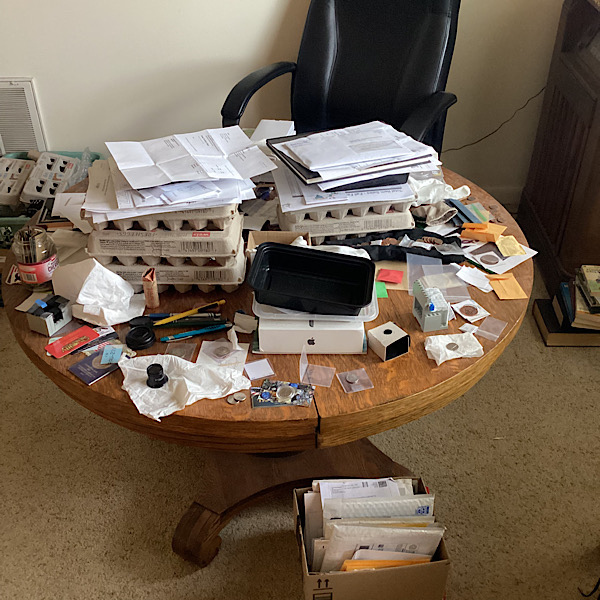
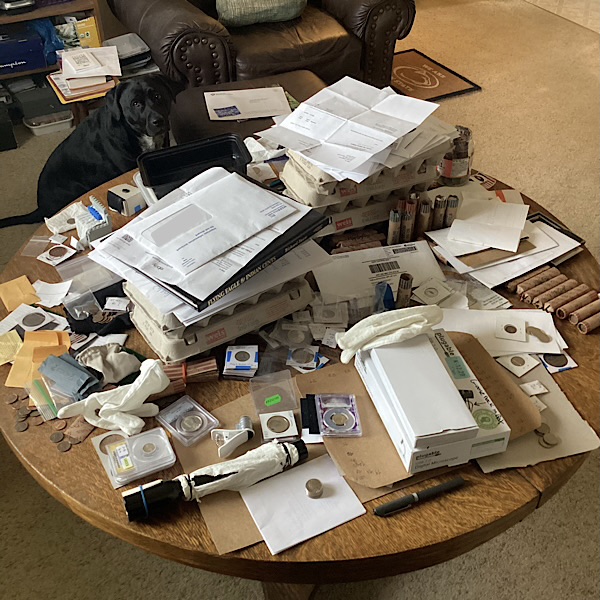
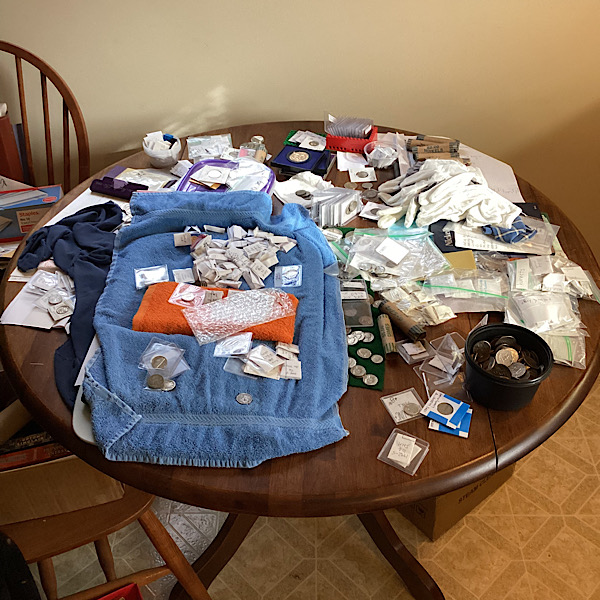
I'm also going through the avalanche. It started innocently enough, with a bird-dog scout I've known for years telling me to go to an estate sale. Then a second. Then a third. To avoid the long story, I came back with quite a few bags of wheat cents.* I had to make the search manageable. Here's what I did.
1.) I bought a lot of parts organizer trays from home improvement box stores. These have 17 adjustable compartments and are typically around 17"x13"x3.5" and run around $20-ish to $25-ish each. They sometimes go by the amusing name "large small parts organizers." They are stackable and uniform size.
2.) I printed labels for date and mint for the full run of Wheat cents, using generic address labels. I put each label on the short end of a 3"x5" index card, folded the card about 1/3 the way through the length, and stood the cards up in the tray compartments. It's important to make sure the sorting box top will close and lock without squishing the label cards. I adjusted the compartment sizes by relative mintages. I used three date-sorted trays for each decade, one for each mint.
3.) I made up two additional parts organizers for pre-sorting. The first had four larger trays, labeled "1909-1929," "1930s," "1940s," and "1950s." The second had four trays, two labeled "P," one labeled "D," and one labeled "S." (I made a second card labeled "D" because the 1950s coins need two Denver trays and one Philadelphia tray.)
4.) I gathered a lot of plastic coffee cans and large peanut butter jars. A LOT of them.
5.) I went bag-by bag, sorting the coins. My first sort was by decade. (See step 3 for the sorting tray set-up for this step.)
6.) My second sort, within each decade, was by mint. (Again, see step 3.)
7.) My third sort was by year, with the piles of mint-by-decade previously pre-sorted coins. (See step 2 for the sorting tray set-up for the final sort.)
8.) When the specific year-and-mint trays filled, I scooped those coins out and dumped them into the coffee cans (for the larger dates, like 1940s P and 1950s D cents) and into peanut butter jars for the other dates. I labeled these cans and jars with the specific date and mint, e.g., "1956-D."
9.) I moved
all of the coins to the basement, so they are out of sight and out of my way.
10.) I selected one specific date and mint to examine at a time. I bring that date and mint upstairs.
11.) Before tackling a specific year, I spend a week or so studying the known DDOs and major RPMs in detail. I make a full cross-reference sheet starting with the Variety Vista listings, then the Copper Coin listings that aren't on Variety Vista, then the Wexler listings that aren't on Variety Vista or Copper Coins. These cross-references make labeling the 2x2s easy. I make MS Word cheat-sheets with .jpg images of the 3 key identifiers for each major. As I go through the coins, I add to the marker lists with things I discover, such as "NW-SE die polishing through IN." These notes help narrow down the choices.
12.) I set up sorting trays for that specific date and mint. I used specific trays for each of the most desired DDOs, along with other compartments for the minor DDOs. The minors were labeled "eyelid," "motto," "LIBERTY," "date," and "other." I set aside one compartment for "DDRs." I used a small compartment for "Woodies." I used a small compartment for "errors." and I always kept one compartment for "mis-sorts" for the stray coins that landed in the wrong date or mint.
13.) I set up another tray/trays for the unlisted DDOs. I give them nicknames that make it easy for me to sort, e.g. "IN to NE."
14.) I toss all of the RPMs into a large pile. I sort them later, using the same method as the DDOs. I go through the DDRs for RPMs, too. I have zero desire to sort by DDRs, because I don't have time or interest in them I will bulk-sale them by miscellaneous roll.
15.) I have a coffee can for "shrapnel." These are the uncollectable culls that, frankly, just need to go back into circulation, because nobody wants them.
16.) I don't put ANY coins into 2x2s until I (a) have
absolutely verified the
DDO / DDR/RPM, (b) have individually photographed the obverse, reverse, key markers, and any damage affecting grade/details, and (c) entered the coi9n into my inventory (Excel spreadsheet). I have already worn out two sets of needle-nose pliers crimping 2x2 staples. Never forget that step.
17.) The 2x2s go into the generic red storage boxes by date. I'll sort them by variety before I wholesale them out.
18.) The remaining coins I run through coin counters, roll them, and wholesale them.
That long process keeps my work area manageable. It also can be a bit boring, seeing the exact same die pairs over and over for weeks or months.
By working with just one date and mint at a time, the search is faster, the identifications are better, and the knowledge gained is fascinating. It's the old adage differentiating generalists from specialists: "Generalists know less and less about more and more until they know nothing about everything. Specialists know more and more about less and less until they know everything about nothing."
That's just my nerdy approach. It isn't THE way to do things. It's just the way my mind works and the way I can avoid drowning in coins.
*The first estate sale had 47 bags. We won't talk about the other two estate sales or mention the 16 coffee cans of steel cents. Nope. Never.






 Posted 12/08/2025 07:28 am


 Uncirculated American Silver Eagles





 I don't know if it would help but I have many of my finds in 2x2's in a portable filing cabinet in different file folders. You would have to have a full-sized filling cabinet though, or more.
  It's like 80% unblocked.


