| Author |
 Replies: 16 / Views: 5,604 Replies: 16 / Views: 5,604 |
|
Valued Member
United States
102 Posts |
I found this outside at a car wash the other day. Any idea what it is? It feels light and cheap. I've googled it but I could only find coins like it not the exact one! 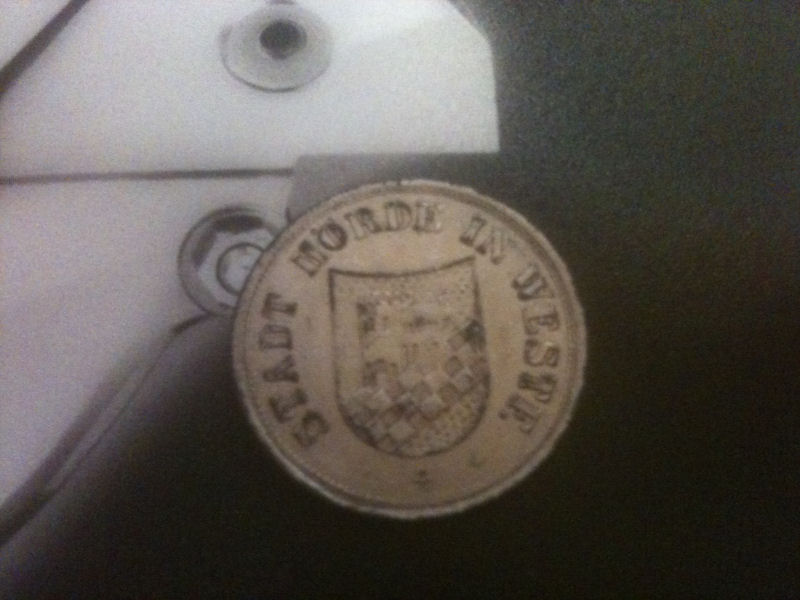 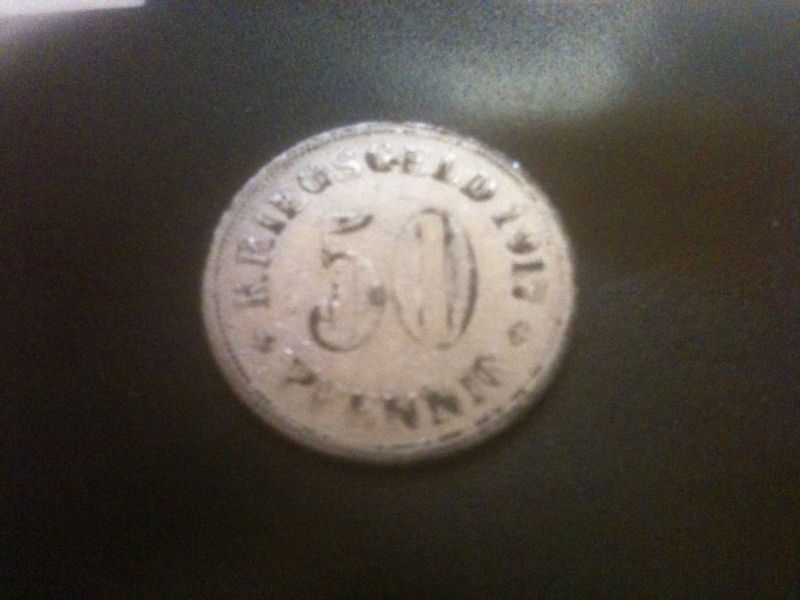 |
|
|
|
Pillar of the Community
United Kingdom
2490 Posts |
|
|
Valued Member
United States
200 Posts |
Algan is mostly correct, as it is a WWI war emergency issue coin. The reverse states Kriegsgeld, which translates to war money. The obverse STADT denotes a state or city that issued it, the literal translation is State North of Vest. What that state is, I do not know, Krause doesn't cover it, and all the sites I have are very definate on the issuing city or state for kriegsgeld.
What has my curiosity peaked is that, since the coin does not STATE the issuing entity, it could Maybe, just may be a prisoner of war camp issue, although that is very slim.
Edited by Tam
05/20/2011 5:11 pm
|
|
Valued Member
 United States
102 Posts |
Thanks for the replies, it's fun trying to figure out what this coin is. Great hobby!
|
|
Pillar of the Community
Germany
1238 Posts |
The issuer was "Stadt Hörde in Westf.", ie. the city of Hörde in Westphalia. Today Hörde is part of the city of Dortmund, in the state of North Rhine Westphalia.
Christian
|
|
Valued Member
United States
200 Posts |
ah, that explains a lot, I saw a "N", not an "H". Thanks, chris.
|
|
Pillar of the Community
Germany
1238 Posts |
Had been wondering about your previous post, as your explanation was basically right except for the city name. Maybe it helped that I don't live too far away. ;) Oh, and I just noticed that Hörde even has an English-language Wikipedia page. Click here. The CoA is the same as the one on the 50 Pf piece ... (Edit: Sorry, even though I added "url" in brackets, the address won't become a clickable link here. So copy and paste it.) Christian Link fixed - SapEdited by chrisild
05/21/2011 04:21 am
|
|
Valued Member
Netherlands
309 Posts |
This is a 50 Pfennig piece from the City of Hörde, listed in the Walter Funck catalog under number 216.2.
The coin is minted in Bochum, at the Wilhelm Kuhne werke, zinc, with diameter 24.1mm
Carl
|
|
Valued Member
United States
200 Posts |
Thanks carl, I appreciate the additional information!! Cool.
|
|
Moderator
 Australia
16994 Posts |
I fixed the link for you, chrisild. This forum doesn't like umlauts and other accented letters. Back to the object in question, and I want to know why a 100 year old German token is lying around a carwash in America? I guess we'll never know.  Don't say "infinitely" when you mean "very"; otherwise, you'll have no word left when you want to talk about something really infinite. - C. S. Lewis
|
|
Valued Member
Netherlands
309 Posts |
Sap, I could give you a hint on that point, IF you use in the states car wash tokens, like we use them here in Holland ;-)
Those machines, also parking machines, shopping cars, and much, much other "coin eating" type of machinery, automaticues etc.. can be "fooled" by using a lookalike coin to start or activate it.
For example, here in europe, where we got stuck on the Euro, a lot of folks used the Thailand 10 Bath (KM 227), or the Turkish 1 new lira (KM 1169) instead of the 2 Euro piece, same coinsize and almost looks same if you don't pay atention!
So it is easy to get yourself some bulk kilo's and look for coins that are same type/struckture as a coin or token, that you need for a sertain machine or automat.
This is nothing new by the way false coins, AND false tokens are as old as the coins and tokends itself, sometimes to cheat on other folks, other times just to keep up your gasmeter running!
(gasmeter? yes, in the years around WWII folks here had a meter in their home who counted the cubic meters of gas provided for heating and cooking, you had to buy gas meter coins, so you could "buy" so many cubic meters gas with a token. For folks who runned out of the tokends, they could choose, sitting in the cold and not cooking, or take a 2 1/2 cent piece, a saw and copy a gas token. That is the reason you sometimes find a 2 1/2 cent piece dith a > in it in the bulk.)
|
|
Pillar of the Community
Germany
1238 Posts |
Quote:
For example, here in europe, where we got stuck on the Euro, a lot of folks used the Thailand 10 Bath (KM 227), or the Turkish 1 new lira (KM 1169) instead of the 2 Euro piece, same coinsize and almost looks same if you don't pay atention! Guess that was primarily a problem in those countries that (or for those people who) had not used bimetallic coins before 2002. "Hmm, bi-met, must be a euro coin." ;) Vending machines in the euro area, except for some pretty old ones maybe, do not accept those 10 baht or 1 lira coins anyway since they check many parameters of an inserted coin. Now as for how and why this notgeld piece made it to the US and then got lost and found at a car wash, I don't know. But it sure is a nice find! Christian |
|
Valued Member
Netherlands
309 Posts |
Christian,
believe me, I saved loads of parking money by using the Turkish and Thai coins :)
And if you look treu the bulk coinage, you find not always often nice coins and tokens, but also a lot of other stuff.
kind Regards, Carl
|
|
Valued Member
United States
102 Posts |
I thought I found a very rare coin!
|
|
Pillar of the Community
Germany
1238 Posts |
You actually did, in the sense that the mintage of your piece will be relatively low when compared to regular coin mintage figures. It's just that, when it comes to notgeld, there are so many different designs, denominations, cities/counties, etc. that hardly anybody would even aim at having a complete collection. So unfortunately "rare" does not translate to "precious" here. But I think it still is a great find, particularly in a car wash in the US. :)
@Carl: Tsk tsk, you cheater. ;) Ah well, guess there were, and maybe still are, machines around that use "antique" coin checking technology and (in the case of the pieces from Thailand) cannot even differentiate between magnetic and non-magnetic. Earlier this week the magazine "Der Spiegel" had a "20 years ago" link to a story about Polish 20 zloty coins, worth one third of a pfennig, that were used as 1 DM pieces in some machines here in DE. Seems that all one had to do was to manipulate the edge a little ...
Christian
|
|
Valued Member
Netherlands
309 Posts |
maichinht,
it is always nice to find some coins and or tokens that have got your interrest, and like Cristian sayd, there are so manny types of notgeld (i only have around a 100 or so), and so manny places where they where struck, it is a enormous job to get them, I myself always look for them, and luckely most of the time they are not expensive, and you have a nice period of German history covvered with it.
It is a verry wide collection to start, you can look all over for them, couse lot's of them have been made pre for selling to collectors, so for example, you could just go for collecting the once they made from coal or porselan, or only the iron type, etc.. etc..
Next to that, if you find a coin or token, it's always nice annyway :)
Christian, maybee you know if they also mentioned the 1 bath? (KM Y 183 type) far as I could remember they where same size and weight as the old 50 pfennig type 1972/91? I know that my grandfather always wanted those to take with him to Germany couse he know they fitted in some automatics?
Greetings, Carl
|
| |
Replies: 16 / Views: 5,604 |










 Posted 05/20/2011 5:06 pm


