
First off, don't clean them. Coin collectors dearly love that original patina that comes from use in commerce. Jangling in somebodies pocket day over day.
Condition is everything to do with a coin's value: you can go here -
http://www.pcgs.com/photograde/ - to see a series of photos of the coins in the various grades.
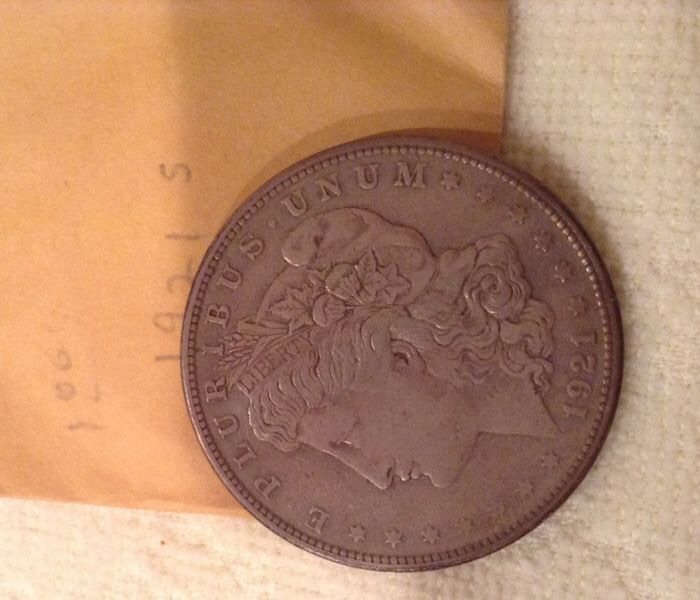
Today, with silver at 14.92/14.96 (bid/ask), the silver in that
Morgan dollar is worth about 11.57.
Yes they are worth a bit more than the silver price, but the spread between what a dealer will buy them for and what they will sell (which is how coin dealers pay the rent) is not in your favor.
There is a guide here:
http://www.numismedia.com/fmv/price...icesgd.shtml that shows you full retail, what you would expect to pay at a downtown coin shop.
On the reverse, under the eagle's tail might be a letter "S" for San Francisco or "D" for Denver telling you which US Mint manufactured the coin. If there's no letter, that's Philadelphia.
We would need better photos and of both the front (obverse) and back (reverse) to tell you a grade (we have a photography forum, where with a little effort, a couple hundred bucks and some effort you can learn to take photos every bit as good as all but the best professional's work)... (and a grade forum where we all say we can't really grade from photos and then give it a shot).
1921 Morgans are very common (last year of mintage for that coin design) and the spread between G4 (Good 4 - heavily worn, say it was used in a Vegas Casino for many years) and AU50 (About Uncirculated 50 - just a tiny bit of wear on the highest points) is only a $ or 2, plus/minus from 28.
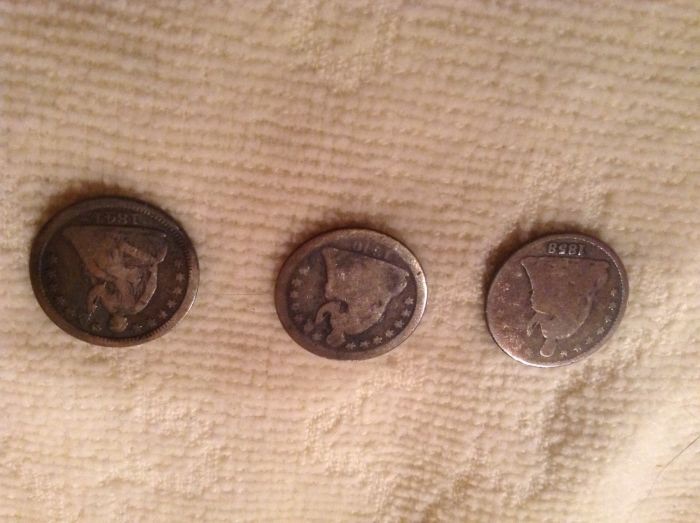
Each coin is unique, depending of the number minted, how old, whether they survived various waves of melting of old coins, etc. An 1858
Half Dime is worth from 17 (VG8 - Very Good 8) to 21 (F12 - Fine 12).
It was called a
Half Dime because it was made of silver and had half as much silver as a dime.
The original Nickel was the
3 Cent Silver coin (which, unlike the dime and
Half Dime) didn't have quite enough silver to be worth 3 cents. Then they minted
Indian Head cents out of a Copper - Nickel alloy (more copper so it was redish) and they were sometimes called Nickels. Finally they started minting the 3 cent coins (price of a postage stamp in the 1850s/1860s) out of a silverish looking Copper Nickel alloy.
Finally in 1866, they started minting a 5c coin out of copper nickel. And that too was called the Nickel. Then in the 1870s they stopped minting the silver
Half Dime and the
Three Cent coins and the way was clear for the one nickel as we think of it today.
As coin collectors, we have our own grading scheme. It's really no better or worse than any other scheme. Why is 32F freezing water and 212F boiling? Ask Mr. Fahrenheit. But it does give us ENDLESS fodder for arguments.
The grades we use range from Po1 (Poor 1) through Fair (Fr), Good (G), Very Good (VG), Fine (F), Very Fine (VF), Extra Fine (XF or EF), About Uncirculated (AU) and then to MS (Mint State). The numbering scheme was standardized years ago based on the relative prices of a single, fairly common copper coin by a man named Sheldon. At that time, a Fair coin was worth twice as much as a Poor, so Po1 and Fr2. The Very Fine coin was worth 30x so VF30.
-----Burton
50+ year / Life / Emeritus
ANA member (joined 12/1/1973)
Life member: Numismatics International, CONECA
Member: TNA, FtWCC, NETCC, EveryCountry (online) coin club
Owned by three cats and a wife of 40+ years (joined 1983)
Author: 3rd Edition of the Sample Slabs book,
https://www.sampleslabs.info/











 Posted 08/10/2015 07:49 am


