| Author |
 Replies: 8 / Views: 2,884 Replies: 8 / Views: 2,884 |
|
|
New Member
United States
45 Posts |
Greetings! I've been lurking here and learning for a while now, and this is my first post. My grandson and I have been going through many years of change that I have dumped into jars. We have found various minor errors, like RPM's, Cuds, etc., but then we came across this. It seems to be a 1982P quarter that is missing it's obverse nickel cladding. The coin does seem to be a bit thinner than the normal coin. I weighed it and a "normal" quarter and it is lighter. The normal quarter weighed about 5.7 grams and this on weighed about 4.7 grams. So I guess my questions are: Am I correct in assuming that the clad in missing, and just not some type of discoloration? Also, if it is missing, is this something that happens before/during the minting process or after? Thanks for any replies. 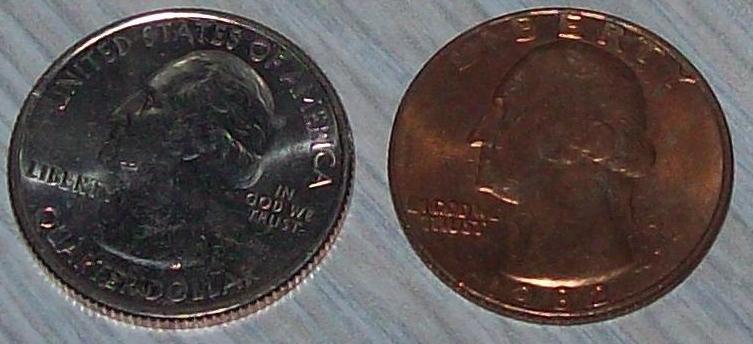 Edited to insert a missing period Edited to insert a missing period. Edited by MIA
11/16/2011 7:33 pm
|
|
|
|
Rest in Peace
United States
7075 Posts |
 It certainly looks like that is what has happened. And, since you weighed it, that would be my guess. However, I am not an expert and somebody with more experience will be along to either confirm my opinion or set me straight! I believe that if it is missing the clad layer that would have had to have happened at the mint but I only write that because I never heard of a clad coming off. |
|
Rest in Peace
United States
7075 Posts |
 Still waiting for an expert...and giving this thread a bump... |
|
New Member
 United States
45 Posts |
Thanks Buddy, I appreciate your input!
|
|
Bedrock of the Community
United States
12437 Posts |
Your weight is correct for a quarter missing a clad layer, your coin would have had a pre-strike separation but post-strike separations can also occur(looks like damage to most collectors). |
|
New Member
United States
45 Posts |
Thanks Buddy and biokemist6. I guess that I'll put it in a holder and save it to give to my grandson after he gets a bit older. Now, only 14 more gallon jars for us to search through...
|
|
Pillar of the Community
United States
6406 Posts |
You might consider sending your error coin in for grading and authentication. It potentially could be worth $100 or more, but most people wouldn't take a chance on it unless it is authenticated. ANACS grades error coins for a reasonable fee. You can go to their website and look up their rates or give them a call to discuss.
You are correct that these coins are mint-made errors. The clad metal strip from which blanks (planchets) are punched is occasionally made without one outer layer. When the resulting incomplete planchets are struck the result is a "missing clad layer" mint error.
Your coin looks to be in uncirculated condition, with nice luster. If ANACS grades it they will put it in a tamper-proof holder that will preserve and protect the coin.
Congratulations on what potentially is a very nice find from change!
|
|
New Member
United States
45 Posts |
Thank you for the advice, I hadn't considered that. I'll call them after the holiday and look into it.
|
|
Bedrock of the Community
United States
17884 Posts |
Quote:
It potentially could be worth $100 or more, but most people wouldn't take a chance on it unless it is authenticated. Most error collectors who know what they are doing wouldn't care if it was authenticated or not. They don't need someone else to tell them what it is. |
| |
Replies: 8 / Views: 2,884 |
|







 Posted 11/16/2011 10:50 pm





