| Author |
 Replies: 31 / Views: 6,548 Replies: 31 / Views: 6,548 |
|
Pillar of the Community
United States
4253 Posts |
I have been collecting Roman coins for a day or so as most of you know, but now I am going to show my ignorance. When I attribute a coin, any coin, I generally pass over the description of the attire. But I just purchased another coin (go figure) and there are two variants of the coin. One with cuirass and the other draped w/o cuirass. I've looked at the the images of these two variants and I personally don't see the difference.
So, my question is: How can one tell if the bust is cuirassed or not? If this isn't a newbe question I don't know what is. But there you have it. I don't know (I feel like I'm confessing at a group meeting of Roman coinaholics).
JW
P.S. I'll post images of this new coin later. I think it's a doozey.
|
|
|
|
Pillar of the Community
United States
4778 Posts |
Are you talking about a coin that has two variants with both being cuirassed, yet one is described as without cuirass?
|
|
Pillar of the Community
 United States
4253 Posts |
No. I know what a cuirass is, but how do you tell on a coin if the bust is wearing a cuirass? On this particular coin that I bought, it has two variants in RIC. One wearing a cuirass and one without but draped. When I look at the images of these two coins, I do not see the difference. What, on the coin, makes the one "wearing cuirass"?
|
|
Moderator
 United States
23731 Posts |
I must admit I've also wondered about this. I'd say that some piece of the armour has to be visible to be curiassed and only part of the cape or robe has to be vi sable over a shoulder and no armour to be just draper. This can be difficult to see on small coins and those that are worn.
|
|
Pillar of the Community
United States
4253 Posts |
Quote:
I must admit I've also wondered about this Whew, I'm glad I'm not alone. Thanks echizento. We can "crash and burn" together. Back to the topic at hand. I purchased a Soloninus Antoninianus, RIC V 36. It had been slightly mis-attributed in that the seller described the reverse with a star above. It's obvious to me that it is a wreath which means it is a coin struck at Samosata (my first). The problem then is whether the image is cuirassed and draped or just draped. I think it is cuirassed, but am unsure why I think so. Tell me why this image is described as cuirassed. 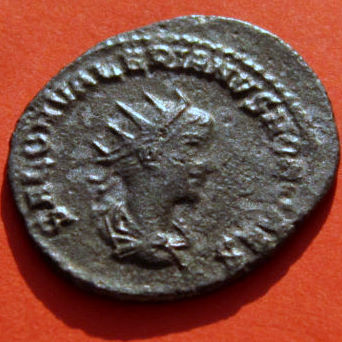 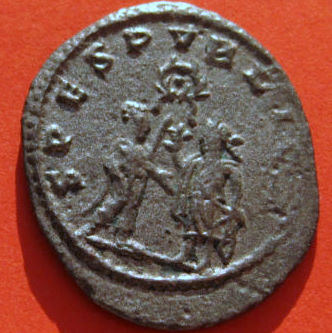 |
|
Moderator
United States
23731 Posts |
This one is the drapped and curiassed. The draped bust has the shoulder and breast covered.
|
|
Pillar of the Community
United States
4253 Posts |
OK, I agree. But what tells us that this bust is cuirassed. What in particular on this coin tells me that. I want to be able to glance at any coin and say that is is cuirassed or not. Its easy to see on a Probus and Aurelianus, but on this coin and many others I find it very difficult.
Edited by Bing
11/22/2011 10:04 pm
|
|
Rest in Peace
United States
9104 Posts |
|
|
Moderator
United States
23731 Posts |
On this coin there is not clear evidence of any armour. For all we know he could just be wearing a tunic under the cape. Though the draped example only shows the drape.
|
|
Pillar of the Community
United States
4253 Posts |
Quote:
medieval body armor that covers the chest and back Hello biggfredd. Alas I am not making myself clear. I know what the word means. But on some coins like the one on this thread it's very difficult, for me at least, to tell that he is cuirassed. What on this coin tells me that it's cuirassed? I own a ton of coins and I've just never asked this question before even though I use the description when I attribute and catalog my coins. |
|
Pillar of the Community
United States
1549 Posts |
I don't see the cuirass on that particular coin but that does not mean that a clear photo of a better strike would not show something I'm missing. In some coins, I consider all the distinctions made by some collectors to be very artificial and unnecessary but on some issues there is a clear difference that seems like it needs to be cataloged. The bottom line is that a bust is cuirassed if armor shows and not if all you see is cloth held with a shoulder pin. These terms and distinctions are inventions of coin collectors and they fit some issues better than others. If there is armor, it often shows on the shoulder with straight vertical lines breaking through the drapery folds. These are typified on my Caracalla shown here and missing on the Aurelius just above it but you realize I selected those photos to be clear as to the matter and many coins are questionable as to which group fits best. http://www.forumancientcoins.com/do...osshead.html |
|
Pillar of the Community
United Kingdom
2838 Posts |
This can be a frustrating area when IDing coins. Consider this example:  If you look at the shoulder blade you can see quite faint angular vertical lines on it, this is the cuirass under the drapery, the coin has been IDed correctly as RIC V 36v on Wildwinds. If you look at the shoulder blade you can see quite faint angular vertical lines on it, this is the cuirass under the drapery, the coin has been IDed correctly as RIC V 36v on Wildwinds.I cant see any cuirass on yours, this either means its detail that has disappeared or it was never there in the first place, I'd go with the later but often its a matter of opinion as both you and echizento think it does show evidence. With this bust being 'from rear' I would assume the shoulder to be the important area but sometimes its the chest or back, essentially you are looking for angular features that stand out against the flowing drapery. I also think that sometimes the reference material is incorrect - I have a few coins (including the Gordian III I posted yesterday) that can only be IDed to a RIC No that states 'draped cuirassed' but there is absolutely no evidence on the coin of any cuirass. Coins may not fit the 'known' because they are worn or not in RIC. |
|
Pillar of the Community
United Kingdom
2838 Posts |
Forgot to add, remember the net is full of mis-attributed coins so dont believe everything you see.
|
|
Pillar of the Community
United States
1549 Posts |
That Saloninus is a perfect example of a cuirass that causes trouble (I say needless trouble) to collectors. Yes, it is there but my level of collecting does not really care and half of the coins (not as nice as this example) probably won't show those little lines at all. My coin here is not as nice but probably should be described as cuirassed as well. With very little eyestrain you can see a few bumps on the bottom of the mostly flat cuirass.  |
|
Pillar of the Community
United States
4253 Posts |
Quote:
I'd go with the later but often its a matter of opinion as both you and echizento think it does show evidence. Thanks Doug and bobbyhelmet. Its clear as mud - well, muddy water in this case. I understand what both of you are saying (and I've bookmarked that page Doug), but in coins like this one of mine, it may just come down to "opinion". In this case, just below the drapery clasp there is a horizontal line I think (thought) represented the cuirass. It's not obvious at first glance, but it's there. Am I correct then in assuming this is part of cuirass? Quote:
Forgot to add, remember the net is full of mis-attributed coins so dont believe everything you see. Oh for sure. Not only in the seller's description as in this case, but in much of the reference material as well. I just want to be sure that when I call something "cuirassed" that I can say it with some reasonable amount of certainty. Either I can see it or that was the only way the coin die was made. JW |
|
Pillar of the Community
United States
2044 Posts |
Wow, that's barely noticeable. Apparently it wasn't a stupid question and now I know as well.
|
| |
Replies: 31 / Views: 6,548 |










 Posted 11/22/2011 7:53 pm


