| Author |
 Replies: 15 / Views: 1,573 Replies: 15 / Views: 1,573 |
|
|
Pillar of the Community
United Kingdom
2121 Posts |
I just thought it worth sharing a recent addition to my collection:- Lucania, Thurium, Ar Nomos, 4th C. B.C. Obv:- Head of Athena in Attic helmet decorated with Skylla Rev:- ΘOYPIΩN above, Bull butting right, tunny fish in exe. Minted in Thurium. 4th Century B.C.  Regards, Martin |
|
|
|
Valued Member
Sweden
71 Posts |
Unbelievable design for 4th century BC
|
|
Pillar of the Community
United Kingdom
2838 Posts |
|
|
Pillar of the Community
United States
842 Posts |
|
|
Pillar of the Community
United States
4253 Posts |
That's a true beauty!  I would love to own one of these, but like I've said before, I know so little about these coins. |
|
Bedrock of the Community
United States
10045 Posts |
Beautiful coin! With all that relief and detail, it's like a miniature classical sculpture. |
|
Pillar of the Community
United States
1315 Posts |
maridvnvm, you find the most amazing coins. This one is wonderful. Although the bull is the strongest image I find the depiction of Scylla on the helmet to be the most interesting. Scylla was a sea monster who inhabited the Italian side of the narrow straights of Messina between southern Italy and Sicily and the dogs around her waist devoured all who sailed too close by. I believe you can see one of the dogs at her waist on your coin. The other side of the channel was inhabited by another monster Charybdis who created whirlpools. Any who sailed these straights had to choose between facing the dangers of Scylla or Charybdis. Your coin comes from a place in southern Italy so it would stand to reason they would use this mythical image. Congrats. http://en.wikipedia.org/wiki/Lucaniahttp://en.wikipedia.org/wiki/Scylla |
|
Valued Member
United States
292 Posts |
That's the most interesting ancient I've seen posted yet. Very cool.
|
|
Bedrock of the Community
United States
10045 Posts |
Quote:
Scylla was a sea monster who inhabited the Italian side of the narrow straights of Messina...the dogs around her waist devoured all who sailed too close by I had missed Scylla at first, but I agree--it's one of the strongest design elements.  Scylla with the dogs at her waist, strikes me as a rather odd "monster", until I remembered what happens to ships straying too close to underwater rocks, such as that tragic cruise ship accident in Italy. Nature's hazards are often spun into mythology. |
|
Pillar of the Community
United States
4253 Posts |
I wonder if the bull on your coin inspired the die makers for this Augustus denarius: 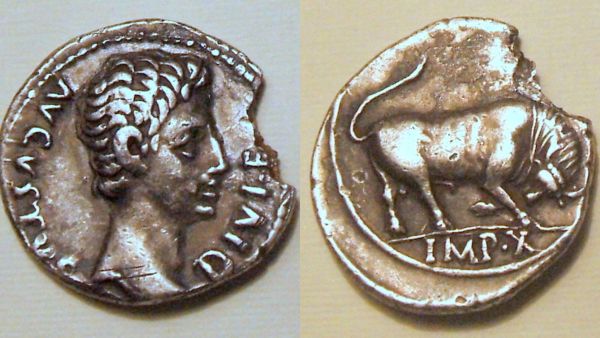 |
|
Bedrock of the Community
United States
10045 Posts |
Now I remember where I saw that bull. I would not be surprised if the Romans saw these Greek coins or other art; a lot of their early coinage seems to borrow designs from Classical Greece. JW, that's also a good example where a break doesn't sacrifice the beauty of the coin. |
|
Pillar of the Community
 United Kingdom
2121 Posts |
Quite possibly. It can be quite interesting to look at some of these types and see were they might derive their prototypes from. The Bull on the Augustus coin leads with the other leg but the main design elements are very similar.
Regards,
Martin
|
|
Pillar of the Community
United States
2596 Posts |
another nice coin both sides are very interesting.
|
|
Moderator
 United States
23731 Posts |
Beautiful coin, . |
|
Pillar of the Community
United States
1549 Posts |
Worn Greek silver has always had a special appeal to me. Sure I'd like to have the high grade things but I can't afford them. These retain a lot of interest long after the fine details have blurred.
|
|
Pillar of the Community
United States
3229 Posts |
That is one very cool Greek! I would love to have that in my collection! Thanks for sharing!
|
| |
Replies: 15 / Views: 1,573 |
|







 Posted 01/24/2012 08:56 am





