| Author |
 Replies: 16 / Views: 3,992 Replies: 16 / Views: 3,992 |
|
New Member
United States
5 Posts |
I found a bicentennial half dollar and when weighing it I found that is weighed in at 12.1 grams. All of the other ones I have weighed have been around 11.3g is this a mistake or should I not bother holding on to it. I can't see anything that would add such a drastic weight change
*** Moved by Staff to a more appropriate forum. ***
|
|
|
|
Pillar of the Community
United States
6406 Posts |
That is unusual; even the 40% silver bicentennials should top out at about 11.6 grams. Have you double-checked the weight on a different scale and/or made sure your scale is calibrated? If the weight is correct at 12.1 grams I'd start looking for a possible alteration. Perhaps it is a magician coin with something heavy hidden inside! I suppose it might be struck on an out-of-spec (thick) planchet. I've never seen such an error but I expect they are possible. Do you have photos you can post? By the way, welcome!  |
|
Pillar of the Community
United States
2295 Posts |
A photo of both sides and the edge might help to see. |
|
New Member
 United States
5 Posts |
The 12g coin is the one of the right. From my images it looks like the right coin is larger than the right but when they are held together they are the same size. The rims are the same width too. I can probably take better pictures when my better camera is back. 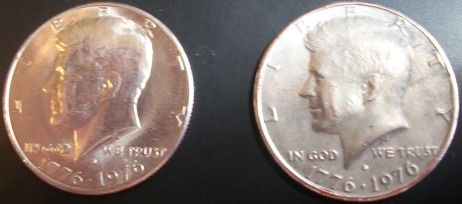 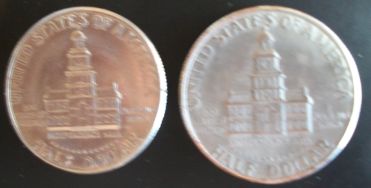 |
|
New Member
United States
5 Posts |
I also weighed it on my four scales to make sure only fluctuate .1 g
|
|
Pillar of the Community
United States
4132 Posts |
Edited by CaptainFwiffo
05/10/2012 09:55 am
|
|
New Member
United States
5 Posts |
I cannot find anything that would indicate a seam. I am trying to find my caliper to measure the thicknesses
|
|
Pillar of the Community
United States
1796 Posts |
If it's a well-made Magician's coin, finding the seam may be difficult. You might need to use a bang ring to pry it loose. The only other possibilities are that it could be struck on Ike stock (which would be unimaginably rare, nigh impossible) or it could be a counterfeit. Or heck it could simply be a fluke. :-) |
|
New Member
United States
5 Posts |
If it was a magician coin it would be magnetic right?
|
|
Pillar of the Community
United States
4132 Posts |
No, it wouldn't be magnetic (unless it happened to have something ferrous hidden inside)...
|
|
Pillar of the Community
United States
1227 Posts |
This may be a stupid question, but:
When I was in my high school chemistry class, one of our experiments involved bringing in a post-1982 penny, filing off a portion of the rim, and then dropping it in some solution or other. About 30-60 seconds later we were all the proud possessors of hollow pennies.
Is it possible that something similar was done to this coin, which was then re-filled with a different core metal? I know the metal makeup of halves and pennies is different, but it seems at least possible.
|
|
Bedrock of the Community
United States
17884 Posts |
Struck on Ike stock wouldn't do it. A half struck on Ike stock would be 14.63 grams. Most likely it is simply a "thick" half dollar that was struck on stock that wasn't quite rolled done to the proper thickness.
And forget the calipers, trying to measure the thickness of a struck coin won't give you any meaningful data. First where do you measure? Rim it rim? Field to field? Obv field to rev devices? Rev field to obv devices? (which can give a different value that the last option) How can you make allowances for strength of the strike? (A stronger strike will result in smaller field to field measurements but greater rim to rim, and two coins that started with the smae thickness planchet could have different thickness measurements do to different strengths of strike.) And finally there are no standards to compare your measurements to. You can't even compare them coin to coin.
And the difference in thickness between a blank rolled to the proper thickness to give an 11.34 gram coin, and rolled to give a 12.1 gram blank is only .011 mm or .00046 inches.
Edited by Conder101
05/11/2012 10:13 am
|
|
Bedrock of the Community
United States
12437 Posts |
Quote:
Is it possible that something similar was done to this coin, which was then re-filled with a different core metal? Completely impossible. Did you ever wonder why you could only do that experiment on a post-1982 Lincoln Cent? That is because the experiment will only work on a copper-plated Zincoln, the zinc core can be selectively dissolved leaving the copper shell behind. It will not work on a pre-1982 cent because it is a solid alloy and it will not work on a Kennedy because it is composed of a copper core with two cladding layers of cupronickel- there is no "shell" involved with any other US coin. |
|
Pillar of the Community
United States
1227 Posts |
Quote:Completely impossible. Did you ever wonder why you could only do that experiment on a post-1982 Lincoln Cent? That is because the experiment will only work on a copper-plated Zincoln, the zinc core can be selectively dissolved leaving the copper shell behind. It will not work on a pre-1982 cent because it is a solid alloy and it will not work on a Kennedy because it is composed of a copper core with two cladding layers of cupronickel- there is no "shell" involved with any other US coin. But if there's a copper core, why couldn't that be removed? Maybe not melted out like the zinc was in the experiment, but removed and replaced, for whatever reason? |
|
Bedrock of the Community
United States
12437 Posts |
Look at the edge of a CuNi clad coin and you will have your answer- remove the core and the cladding falls away in two halves.
|
|
Valued Member
Canada
262 Posts |
even if it were some 90 percent silver freak error it'd be 12.50 grams. Definitely check the rim, you might have a major error coin somewhere between 40 and 90 percent silver if a planchet error was made on one of the clad 1976 silver issues. Either way it wouldn't be intended for circulation.
Edited by MercuryDime
05/12/2012 2:41 pm
|
| |
Replies: 16 / Views: 3,992 |






 Posted 05/10/2012 09:25 am





