| Author |
 Replies: 142 / Views: 11,695 Replies: 142 / Views: 11,695 |
|
|
|
Pillar of the Community
United States
1315 Posts |
Eng5858, I believe your example from Thessalonica is an SMTS∆ (D) 4th officina.
You can find out a lot about them on Helvetica's web site.
|
|
Pillar of the Community
United States
1316 Posts |
Thanks Doucet, I'm on it.. Steve you crack me up...  |
|
Pillar of the Community
 United States
842 Posts |
Doucet, that is a very interesting fact you pointed out! It raises a few questions. Did the engraver of the obverse die also work at the Delta officina? Or was an obverse die from the Delta shop paired with an Epsilon officina reverse die for some unknown reason? We will never know, but it is fun to speculate as to why the bust differs from the normal style seen at workshop E. Steve, that is one fantastic commemorative coin you have there. Eng5858, your coin seems to have a very close match in patination color to mine. I have to ask...would you be willing to part with it? I think they would look amazing together.  Also,  This is my 600th post on these wonderful forums!  I feel honored to share my collection with you all and I feel equally honored to view yours. I have mad respect for everyone here. P.S. I will be posting my 3rd coin shortly after midnight. Why? I simply can not wait until tomorrow morning! 
|
|
Pillar of the Community
United States
1549 Posts |
Quote:
I should also mention that according to RIC this coin is an R2. I sincerely doubt this. RIC 188 with officina E is R2. RIC 230 is S. Eng5858's coin is an RIC 188 with shop delta (C3) as evidenced by his giving the weight at 2.4g. I suspect coin #2 is a 230 and weighs under 2g. No? <sermon> I'd also like to know the weights of Doucet's coins before assigning an RIC ID. The E shop one looks like it could be heavy but we are really puching it trying to weigh coins from photos. The note to RIC 229 admits that there could be some mixup in the two groups as they have separated them and I would really, really suggest no one pay any premium for rarities in this series unless they can explain the differences more eloquently than the authors of RIC which only talk about weights in footnotes. Perhaps even more strange to my eye is that RIC Volume VIII lists only the Constantinopolis obverse paired with the Gloria Exercitus reverse (one standard) giving it #59 (page 407 and R4) but no normal reverse coins which would be very hard to separate from the Volume VII #230 coins. Below is my example of RIC 188 weighing 2.84g (compare style to Doucet's coin which is partly why I suspect his may be the heavy issue 188 rather than the later, lighter 230). RIC notes mention two wing variations according to the degree of spread but stops short of saying the tucked wings are earlier than the spread ones. The mention the difference but do not assign different RIC numbers to them. The fact that I have what I believe to be the RIC 188 E shop R2 and Doucet seems to have another suggests what we all should know that a lot of coins have been found since RIC was written so R2 may not mean anything here anymore. 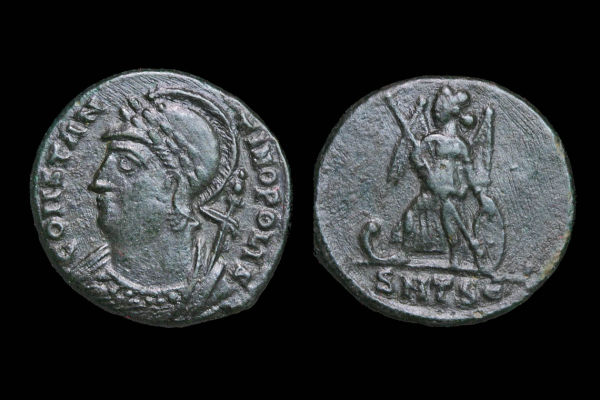 Why do I write all this? Either you want to be a specialist student in these coins or you are not so inclined. I'm not but when I get a coin I tend to study up on it. If you are going to worry about which RIC number your coin is you really need to buy RIC (at least Volumes 6, 7 and 8 which cover Post Reform Diocletian through Jovian). As an owner you may as well also read all the notes and try to figure out why the authors did some things the super detailed way they did and did not bother with others. Otherwise you may prefer to consider these coins just commemoratives. You might even want one from each mint but stop short of paying extra for an R2 E over a C3 delta. I paid $12 for my E RIC 188 coin shown here but that was because it seemed a different style than others I had and looked to be worth $12. For the record, I like coin #2 for its refined style even if it is 'only S'. Don't get hung up in RIC rarity ratings. Don't worry if you have trouble running every coin through the catalogs. There is a lot of fun to be had as a general collector until, eventually, you find out what specialty really means enough to you to lose sleep over workshop letters and wing positions. </sermon> I hope every coin you post is as interesting and nice as the two we have seen so far. Edited by dougsmit
06/04/2012 10:06 pm
|
|
Pillar of the Community
United States
842 Posts |
dougsmit, I do not know where I got my attribution from, but it is undoubtedly incorrect. Thanks for pointing this out. Could you help me fix my mistake? I can not tell a difference between RIC 188 and RIC 230. Edit: I have all 12 volumes of RIC on my PC in PDF format.
Edited by ancientcoinguy
06/04/2012 10:06 pm
|
|
Pillar of the Community
United States
1549 Posts |
Quote:
Did the engraver of the obverse die also work at the Delta officina? Or was an obverse die from the Delta shop paired with an Epsilon officina reverse die for some unknown reason? We will never know, but it is fun to speculate as to why the bust differs from the normal style seen at workshop E. Don't assume that the workshops each had separate die engravers. Maybe they did sometimes but there is nothing in the workshop system that would not allow obverse dies to be issued to the striking teams from a central pool. I believe the style difference you see here might be more a matter of time passing or individual cutters coming and going rather than proof that one shop should have one style and another another. The Commemoratives were issued for several years and styles do change in that time. Perhaps someone is working out the order of issues and will someday publish something that makes this all clear? |
|
Pillar of the Community
United States
1549 Posts |
Quote:
I can not tell a difference between RIC 188 and RIC 230. The coins of the Commemorative types were issued alongside the types with Imperial portraits and the GLORIA EXERCITVS reverse with two soldiers. At first, the coins were made with a heavy weight and the soldiers had two standards between them. Then, the weight was reduced and they eliminated the second standard so the two soldiers had to share one. Unfortunately, there was no similar change on the commemorative coins (I have no idea why not!). However most mints have commemoratives that weigh about the same as the two standards coins and coins that weigh about the same as the one standard coins so you really need to weigh a commemorative to see which group it belonged to. RIC assigned different numbers to the two groups which makes sense to us when considering the coins with two or on standard but not so much sense when the weight is the only difference. Two standards coins tend to weigh in the low to mid 2 gram range while one standard coins tend to average under 2 grams by a couple tenths. In general, undamaged commemorative coins weighing over two grams are dated to the two standards period while lighter coins are thought to belong with the one standard types. RIC 188 is a heavy coin while 230 is a light. Without a scales, some heavy coins tend to look robust and round while the smaller ones may be less well made and raggedy but the difference is easier to see 'in hand' than in photos. As an exercise, take a handful of these coins from a pickout group and try to guess which have two standards and which have one looking only at the obverse. BTW, some coins gain weight when they have a sand patina and others lose weight from wear or chipping. That means there will be coins that weighs 2.0g and makes my rule of thumb not work. I have a couple 2.0g one standard coins but they are high grade. I cheated by selecting nicer than average coins so they may weigh higher than average. The occasional and exceptional two standard coin can hit 3g in high grade. This is a guideline - not a hard and fast rule. I prefer not to own 2.0g commemoratives and I suspect there are coins in most collections (including mine?) that are misidentified. |
|
Pillar of the Community
United States
1315 Posts |
My SMTSE (1st photo) weighs 2.5g
The second SMTSD actually weighs 3.0g
I am no expert by any means, especially about weights and dates, and don't have access to RIC (except for Helvetica) but I have about forty of these types and have looked at a lot of them to acquire the ones I have.
Doug said "You might even want one from each mint but stop short of paying extra for an R2 E over a C3 delta."
I agree with this. The RIC rating might not be the same today as when it was written. I have indeed seen a few like Doug's SMTSE and mine for sale in the last year.
I have gone a little further in that I'm trying to locate one from each officina as well, but I have never bought one in consideration of it's (R) value. Only for it's eye appeal or clearness of mint mark and legend, and now price.
I have made a number of price mistakes though. In the beginning I bought a few coins that I liked from an expensive dealer in France , only to see them sell for a quarter of the cost as I looked for others that I needed.
If how often a coin comes up for sale or how many examples you can find that have been sold is a good determining factor for rarity then I can tell you there are three or four of officinas for the Constantinopolis that are quite rare, even though RIC shows them not to be, and vice versus is probably true as well.
|
|
Pillar of the Community
United States
4253 Posts |
 Very interesting  |
|
Pillar of the Community
United States
1316 Posts |
Ok Guys, I have 2 of these and I got the wieght wrong on the first.....  ..1.98gm x 19 mm and after looking threw the 10x,... mintmark...SMTS-D..... The 2nd. coin 2.53 gm x 16 mm.. dot BSIS dot here's the pic.. I've got a lot to learn .. Does any one know what my first coin is worth.? 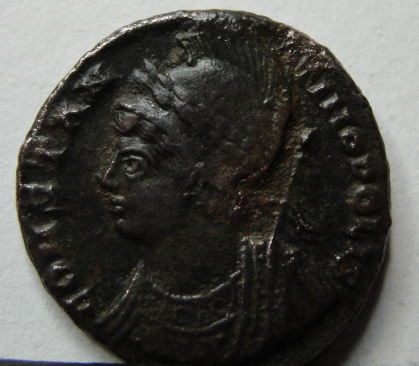 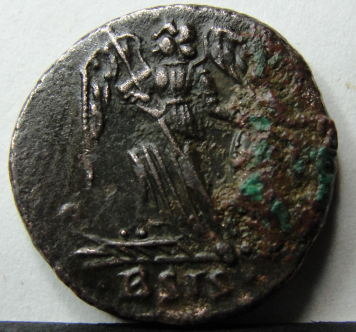 Yes it's soaking right now.... |
|
Pillar of the Community
United States
842 Posts |
It's midnight, so I can post a new coin!  #3: #3: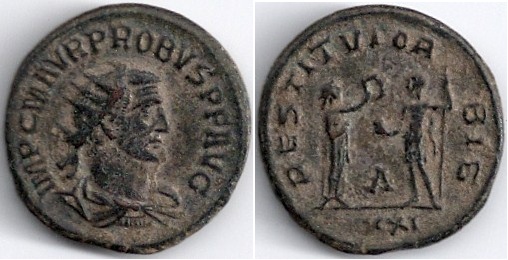 Probus, Antioch 276-282 A.D. Obv: IMP C M AVR PROBVS P F AVG, radiate, draped, and cuirassed bust right Rev: RESTITVT OR-BIS, emperor standing right, recieving wreath from woman, A between XXI in exergue. There is literally nothing negative about this coin that I can see. It has great patina, crisp detail, and it is well-centered. You can even see the brow lines on 'ole Probus' face! I do have several questions regarding this coin, though. How did historians pin down Antioch as the city in which this coin was minted? And what does the mint mark XXI mean? |
|
Pillar of the Community
United States
4778 Posts |
I believe XXI is in reference to it's copper to silver ratio: 20 parts of copper (XX) to one part of silver (I).
|
|
Pillar of the Community
United States
3229 Posts |
ACG, really nice detail, center, and patina!  I do believe that that is one attractive coin! I just got a Probus myself and have been trying to find out more about it before posting. Your post has helped already! |
|
Pillar of the Community
United States
1316 Posts |
yacg, Your third coin is, Sweet, well centered , patina, brings out the high lights of the coin...  I would like to give you the first coin that I posted.(city Commem).. I'm not at 250 posts to sell, so i'll give to you...Found that I have 10 of these coins, 1 is a Constantinople mint...hope this one is a rare one!!!  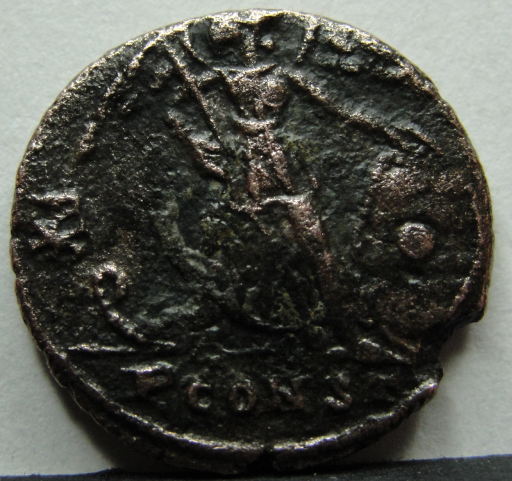 looks like big P CONST mint mark..also looks like star in left field...I don't see this style in wildwinds...maybe dougsmit or Doucet can help.....small coin 1.44gms x 10mm... |
|
Pillar of the Community
United States
1315 Posts |
Eng5858,
I think it may be a 'chi rho' symbol in the left field of your PCONST. You don't see them real often. I have seen about seven or eight for sale in the last year and a half.
It's a very small flan at 10mm, for some reason you often see smaller coins from the 1st PCONST officina at Arles where the devices and legends don't really fit on the flan. At the 2nd SCONST officia the opposite is true, you often see them with extra metal around the edge. I don't know what the explanation for this would be .
ancientcoinguy,
Nice coin...........you pick some good ones.
|
| |
Replies: 142 / Views: 11,695 |




 First Page
 Previous Page


 Posted 06/04/2012 9:50 pm





