| Author |
 Replies: 514 / Views: 79,655 Replies: 514 / Views: 79,655 |
|
|
|
Pillar of the Community
Canada
2845 Posts |
Ever since XforX was introduced by RCM in the 2011, its prominence by sheer volume has far surpassed that of all other NCLT collector coin that is minted each year. That it would not be a topic of high interest would be very unusual. We've certainly reached the point of understanding non-circulating XforX cannot be readily spent like circulation coin (as was initially beleived by some when it was introduced) and RCM cautions that it is redeemable only at banks or businesses "willing to accept it". That is certainly no guarantee of easy redemption. This excellent article was written almost 2 years ago. I think it's fair to say we're still scratching our heads. Legal tender subtleties leave collectors and dealers scratching their heads http://canadiancoinnews.com/legal-t...ching-heads/Unless my eyes are deceiving me, has anyone noticed RCM has changed the design of the XforX webpages and removed reviews and QandA's? In the past, the top two questions pertained to the ambiguity around avenues of redemption and the actual $ value of the silver content. |
|
Pillar of the Community
United States
2408 Posts |
Quote:
Probably partly explains why they often have poor investment performance in the numismatic aftermarket. sel_69I, I always respect your posts but this isn't a fair argument. How can you say that a coin purchased at face value has poor numismatic aftermarket value? Should we consider pocket change in the same manner? Did one try selling a shiny 2016 caribou quarter lately? Quote:
If NCLT is not LT, then these numismatic objects are not coins Old topic, ad nauseam. What is legal tender? The German Mark was until they used it for fire, so was the playing cards in the early colonies. The Canadian 50 cent, the penny... All European coins before the Euro... Are bitcoins - coins? Quote:
In the practical sense, they are not even money of any sort. I would agree that they are not money in the "practical" sense. Credit and debut cards are way more practical. But you went a step further stating that they are not money of any sort. Personally I would rather accept a $20 silver dollar coin instead of a bogus check. BTW - they are not medallions. They have denomination and are authorized by the government. |
|
Pillar of the Community
Canada
2845 Posts |
Quote:I think they ( RCM) limit redemptions at the mint stores to one coin per visit. I don't remember where I read it, or I'd provide a link, but I think it was on their website. Yes the reference is on RCM's website, General QandA. I was under the impression only exchanges were offered at the RCM Mint Store, but this reference indicates one legal tender coin ($10+) per day may be redeemed. However as RCM appears to limit redemption exposure by legal avenues, "payment" may also refer to paying for another NCLT. Is there a limit to the amount of coins I can redeem at the store? Section 8 (2) of The Currency Act states the limitations of payments with coins. Please visit the Department of Justice Canada for further information. http://www.mint.ca/store/mint/custo....V7HaQHjOerU |
|
Pillar of the Community
Canada
5342 Posts |
Most of these rules do have some practical everyday usage, where some one try to buy a sofa with 1200.00 of nickels or similar regular coinage, as a business you would want to take a van load of change to the bank. On the other hand there are still quite a few business that still refuse 100.00 bills around the GTA.
|
|
Pillar of the Community
Canada
2845 Posts |
Quote:
On the other hand there are still quite a few business that still refuse 100.00 bills around the GTA.
Yes I've noticed that some businesses, particularly 24/7 gas stations and convenience stores commonly post notices that $50s or $100s are not accepted, I assume I n order to mitigate risk of robbery. And if a business or bank were forced to unquestioning accept anything that customers insist is legal tender, counterfeiters would have a hay day. It's my understanding that in the UK, it was written into legislation that the broad acceptance of legal tender is optional. To some degree that's already a common practise in Canada however I can't find it stated in the Cdn Currency Act, or anywhere else for that matter. That suggests the legislation in Canada may also be due for an amendment. |
|
Pillar of the Community
Canada
1192 Posts |
In Canadian legal tender law there is a distinction between payment of a debt vs. transaction. In payment of a debt, such as a fine or a restaurant bill, ANY form of "legal tender" can be used to pay it. It is up to the person paying off the debt, not the person who is owed. There are however, some limits. Quote:
(2) A payment in coins referred to in subsection (1) is a legal tender for no more than the following amounts for the following denominations of coins:
(a) forty dollars if the denomination is two dollars or greater but does not exceed ten dollars;
(b) twenty-five dollars if the denomination is one dollar;
(c) ten dollars if the denomination is ten cents or greater but less than one dollar;
(d) five dollars if the denomination is five cents; and
(e) twenty-five cents if the denomination is one cent.
Marginal note:Coins of denominations greater than ten dollars
(2.1) In the case of coins of a denomination greater than ten dollars, a payment referred to in subsection (1) may consist of not more than one coin, and the payment is a legal tender for no more than the value of a single coin of that denomination. Currency Act of Canada http://laws-lois.justice.gc.ca/eng/.../page-1.htmlIn a transaction where the payment is made at the same time you take ownership of the purchase, businesses and individual may choose to accept or not accept any form of payment. This is where stores can choose to not accept $50 or $100 bills. The above limits for coinage do not apply. A store could refuse to accept any pennies, or choose to accept more than the maximum amount of other coins, it is up to them. They could say they only take quarters as payment if they wanted, it is entirely up to the business. A couple examples: I have hundreds of loonies and some $50 face value NCLT coins that I want to spend. Transaction A1) I go to a store and pick out $200 worth of clothing. At the counter and try to pay with four $50 face value coins. They can refuse to accept them. A2) I try to pay with 200 loonies, they can refuse to accept them. Debt B1) I go to a restaurant and after eating my bill is $50. I try to pay with a $50 NCLT coin. Under the law, they must either accept this coin as payment, or forgive the debt. B2) I try to pay with 50 loonies. They could choose to accept it, but they do not have to. Under the law, only up to 25 loonies constitutes "legal tender". Therefore the most amount of loonies that I could legally force them to accept to pay off this debt with is 25; plus $25 worth of some other type of legal tender that adds up to $50 total. |
|
Valued Member
Canada
192 Posts |
Thanks for the clarification, PokerManDude. I thought there was some sort of component where if the tender isn't accepted then the debt goes bye-bye. So, the master-plan of the RCM is to get more restaurant owners and food-service workers collecting NCLT coins because they got dumped on them? :) |
|
Pillar of the Community
Canada
2845 Posts |
Quote:
In Canadian legal tender law there is a distinction between payment of a debt vs. transaction.
Thanks Pokermandude. Do you have a source for your information? Just above the section for limitations that you quoted, the definition of Legal Tender is this: 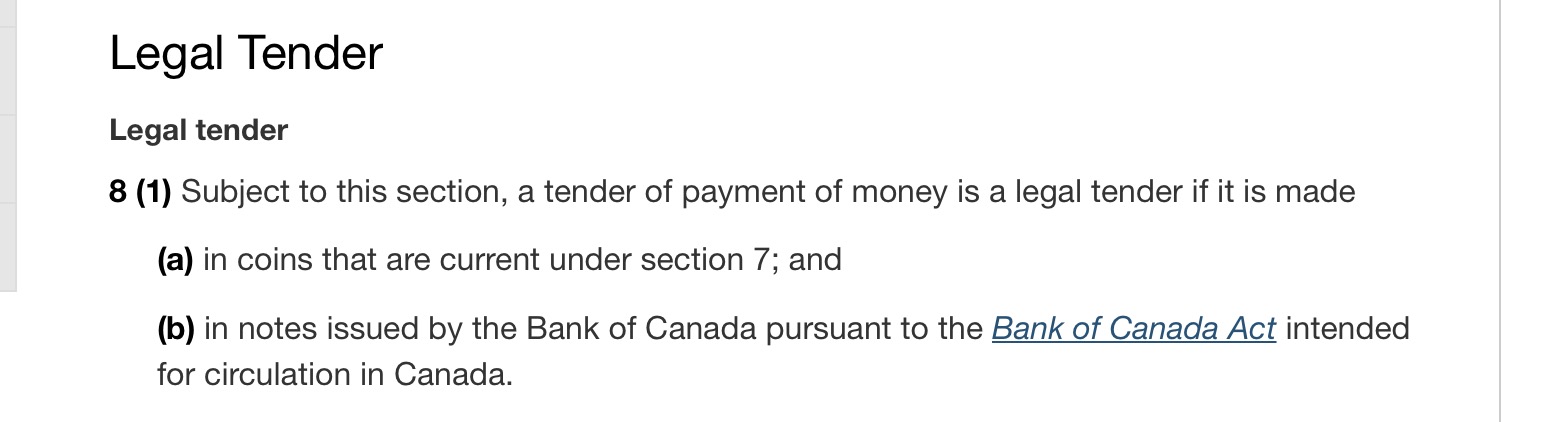 Wouldn't a "tender of payment of money" include both debts and transactions? |
|
Pillar of the Community
Canada
1192 Posts |
I can't find a source for the case of debt repayment. But when owed a debt, the debtor has a bit more leeway when it comes to repaying it, so long as it is still within the guidelines from the Currency Act (eg not more than 40 pennies, 25 loonies, etc). Here is the RCMP page on legal tender. You'll notice they specifically talk about this type of transaction, as opposed to debt payment. http://www.rcmp-grc.gc.ca/count-con...htm#retailerQuote:
What can I do if a retailer refuses to accept my $100 note? Can retailers legally refuse notes?
The method of payment (e.g. cash, debit or credit card) used in a transaction is a private agreement between the buyer and the seller. Each has the right to accept or refuse a bank note when accepting payment or receiving change.
We encourage retailers to use security features; this is more customer-friendly than refusing notes for counterfeiting concerns and it's also a more effective protection against counterfeiting losses.
There are several reasons why a retailer may choose to refuse notes (e.g. security for 24-hour operations; maintaining float). |
|
Pillar of the Community
Canada
2845 Posts |
@ Pokermandude Thanks for that RCMP link, for no special reason I was curious where it was stated that merchants have the right to refuse "legal tender" if they choose. So anyone with a $100 banknote that a store adamantly refuses to accept, no point in calling the police to report their contravention of the Cdn Currency Act! Or an XforX either, I suppose. But that's another reason I think Canada's 1985 legislation will be amended at some point in the future as presently it's subject to interpretation.
Edited by wildflowerAB
08/15/2016 11:13 pm
|
|
Pillar of the Community
 Canada
9903 Posts |
The Currency act does not define tender.
Tender means offer.
Legal tender is a legal offer of payment.
"Dipping" is not considered cleaning...
-from PCGS website
|
|
Pillar of the Community
Canada
9903 Posts |
From the RCMP site; Quote:
What is legal tender?
A "tender" is an offer of payment of a debt. Payment, of course, may take many forms, with cheques, credit or debit cards, and cash (coins or bank notes) among the most common. If bank notes are being offered as cash, they must have been issued by the Bank of Canada. No other bank notes are "legal tender" in Canada.
There must be mutual consent between the retailer and the consumer as to the particular form of payment in order to conclude a transaction. It is the Bank's understanding of the general law in this area that a tender of bank notes as payment does not necessarily compel the party who is owed money to accept that form of payment. The form of payment which is mutually acceptable to the parties to a transaction appears to us to be essentially a matter of private agreement between those parties. For example, a provider of goods or services could insist on payment by credit card or cheque. "Dipping" is not considered cleaning...
-from PCGS website
|
|
Pillar of the Community
Canada
1571 Posts |
Pay government agencies with these coins. If they refuse them, that's a problem.
|
|
Pillar of the Community
Canada
5342 Posts |
A few years ago before the poly notes, most business that I dealt with had bad 5 and tens more than 100 bills yet many refused to accept 100,00 bills, although it seems all currency and bills are like any x for x coin if anyone refuse to accept, they can but that would be a stupid way to conduct any business either you trust the currency or not, look at most of the South American countries, Zambia trillion dollar note, even China.
|
|
Pillar of the Community
Canada
2845 Posts |
Quote:
Pay government agencies with these coins. If they refuse them, that's a problem.
Yes, even in the UK XforX is "legal tender" in payments to the federal courts --- although I can't imagine anyone deliberately incurring fines. Canada Post, CRA, the average person would not owe them money. As far as municipal govts (property tax, water bills, etc) although they share the word "government" by definition, they are not a branch of the Government of Canada. They're legal entities that operate within our borders, but so are businesses. If you intend on saving up XforX just to prove a point, perhaps you might contact either RCM or the RCMP in advance, to ensure it's not a problem? It would be interesting to hear what they have to say. |
| |
Replies: 514 / Views: 79,655 |








 First Page
 Previous Page


 Posted 08/14/2016 10:19 pm


