| Author |
 Replies: 13 / Views: 5,978 Replies: 13 / Views: 5,978 |
|
|
Pillar of the Community
United States
4778 Posts |
I'll admit I would have been easily fooled by the first two coins. Nothing about the first two would stand out to me if I found them being offered online as genuine. And the first was made with the lost wax casting that was described to me a while back. I'm ok at spotting fakes, but again, I would be duped by them, so I'm hoping some of you can tell the rest of us what maybe stands out about these coins, especially the first two (and any similar ones you may want to share), obviously without having the coins in hand. Preferably I want to keep this to late Roman bronzes, since hardly anyone would suspect them being fake unless they were really bad fakes.   (This one is cast) (This one is a little more obvious IMO - lettering and style are off, but I can see this one fooling new collectors)  All are from FORVM's fake database. Edited by VisigothKing
07/15/2012 12:41 pm
|
|
|
|
Pillar of the Community
United States
1549 Posts |
So far the scariest ones to my eye have been given away by their being offered in groups and the group all looks too similar to each other. That means a single from the group would be very deceptive but a pile of them are not as much. Different mints and different rulers should look different so a group where the Theodosius of one mint looks like the Constantius of another should make one suspicious. This is where experience with handling a lot of coins comes in handy. When you get to the place that you look at the obverse of a late Roman and can guess what reverse type and mintmark will be on the other side, you are a bit better protected from fakes. I certainly hope I have not been fooled by any of these but each of these three show something that makes us at least look again. Odd style and cast look should be obvious. We also need to realize that faking a sand patina is easier than other surfaces and there are certainly real coins with fake sand patinas so we can't declare a coin bad just because it was doctored up with new dirt. Traditional wisdom used to be that there was no money in faking common late Roman bronzes but prices have risen and there are enough people willing to pay $20 for a $5 coin that the old belief no longer provides protection. Now there are decent looking (not tourist or gift shop level) fakes of coins that the average collector a decade ago would not have bought in 'genuine'. The question I have to ask is whether my education in such things is able to keep up with the advances in fake technology. The answer is probably a great big "No!" Out of the last 100 coins I bought, how many are fake? 1 or 2? I can live with that unless those 2 are the ones that I paid too much for even if they were real. Then I would not be so happy.
|
|
Valued Member
United States
209 Posts |
Wow, I would not have hesitated to drop a little money for that first Theodosius. Not a lot of money, but enough to be extremely p/o'd if I ever realized that I had been had. The other two just rub me the wrong way, but I can't really explain why. I would buy 2 from a dealer I trusted, but not 3. I don't like number 3 at all. Thanks for posting this.
|
|
Moderator
 United States
23731 Posts |
The first one for sure would have fooled me.
|
|
Pillar of the Community
United Kingdom
946 Posts |
Note also the "crested Theodosius" coin, the obverse side seems to have been artifically worn, however only the lower half... Natural wear would not look like that.
|
|
Pillar of the Community
United States
5010 Posts |
the first coin is a fake? wow. 2 and 3 just look strange but the first is spot on. compared with this coin on ebay... 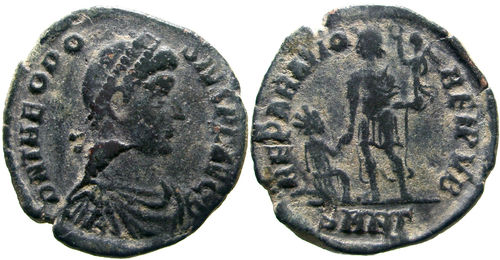 what is the the clue that the coin is fake? and is it woth it to fake 20 dollar coins?! |
|
Pillar of the Community
United States
4253 Posts |
Quote:
what is the the clue that the coin is fake? Good question. I would like to know the answer too. I've been collecting for many years, and I would be fooled by this coin. As of today, I would still buy this coin if I were in the market for one like it. |
|
New Member
Canada
34 Posts |
The fakes are way too obviously round for hammered coins. None of the hammered coins should be perfect unless they were specially done as a presentation example to a King or Emperor. The people doing them didn't have time to make sure the strikes were perfect with the amount they were making a day.
|
|
Pillar of the Community
United States
4253 Posts |
I would disagree with you. I have some Ancients that are just as round as any modern coin. You may be right that the coin makers did not have time due to the large number of coins being produced; however, many were masters at their trade and took pride in their product (not like many today).
|
|
Pillar of the Community
United States
5010 Posts |
 I'm still stumped by that first coin! |
|
Pillar of the Community
 United States
4778 Posts |
Quote:
I would disagree with you. Same here. Jason13, I also have genuine ancients that are perfectly centered. They are a little more scarce than regular, off-centered ones but not impossible to find. If you think about it, after several dozens of strikes, the hammerman was bound to have gotten a few perfectly centered ones, right? Edited by VisigothKing
08/02/2012 11:23 pm
|
|
Bedrock of the Community
Australia
21792 Posts |
Buy the cheap genuine L.R.B.'s that are in poorer condition, and are harder attribute fully. They are cheaper, and more fun to answer the challenge of full attribution.
Much more fun.
|
|
Pillar of the Community
United States
4253 Posts |
Just as an example, here is a Gratian I have that looks very much like the first coin, but I have no doubts about it's authenticity. It too is centered and round. 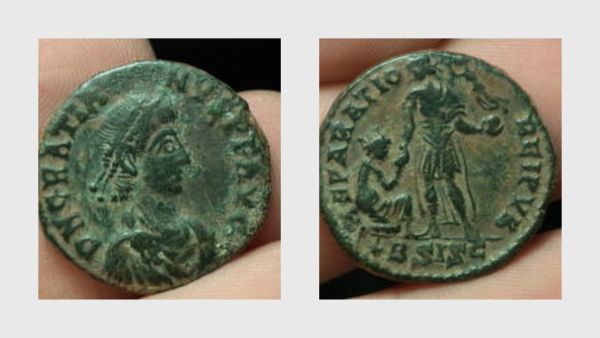 |
|
Pillar of the Community
United Kingdom
4208 Posts |
My Two Cents: The top one, on the left of the second photo appears to be where the metal was poured/injected and has slightly overlapped the coin. Chrs's coin has a similar problem, with a snub on the bust. |
| |
Replies: 13 / Views: 5,978 |
|










 Posted 07/15/2012 2:13 pm


