| Author |
 Replies: 25 / Views: 4,305 Replies: 25 / Views: 4,305 |
|
Valued Member
Australia
236 Posts |
|
|
|
|
Valued Member
 Australia
236 Posts |
I took the liberty of welcoming myself to the UK forum, not game to attempt an embarrassed emoticon. LOL
|
|
Valued Member
United Kingdom
449 Posts |
Hello, I'm struggling to work out what the text says over the kings head, maybe you could translate it? I would say though it's post mint damage.
|
|
Moderator
 Australia
17002 Posts |
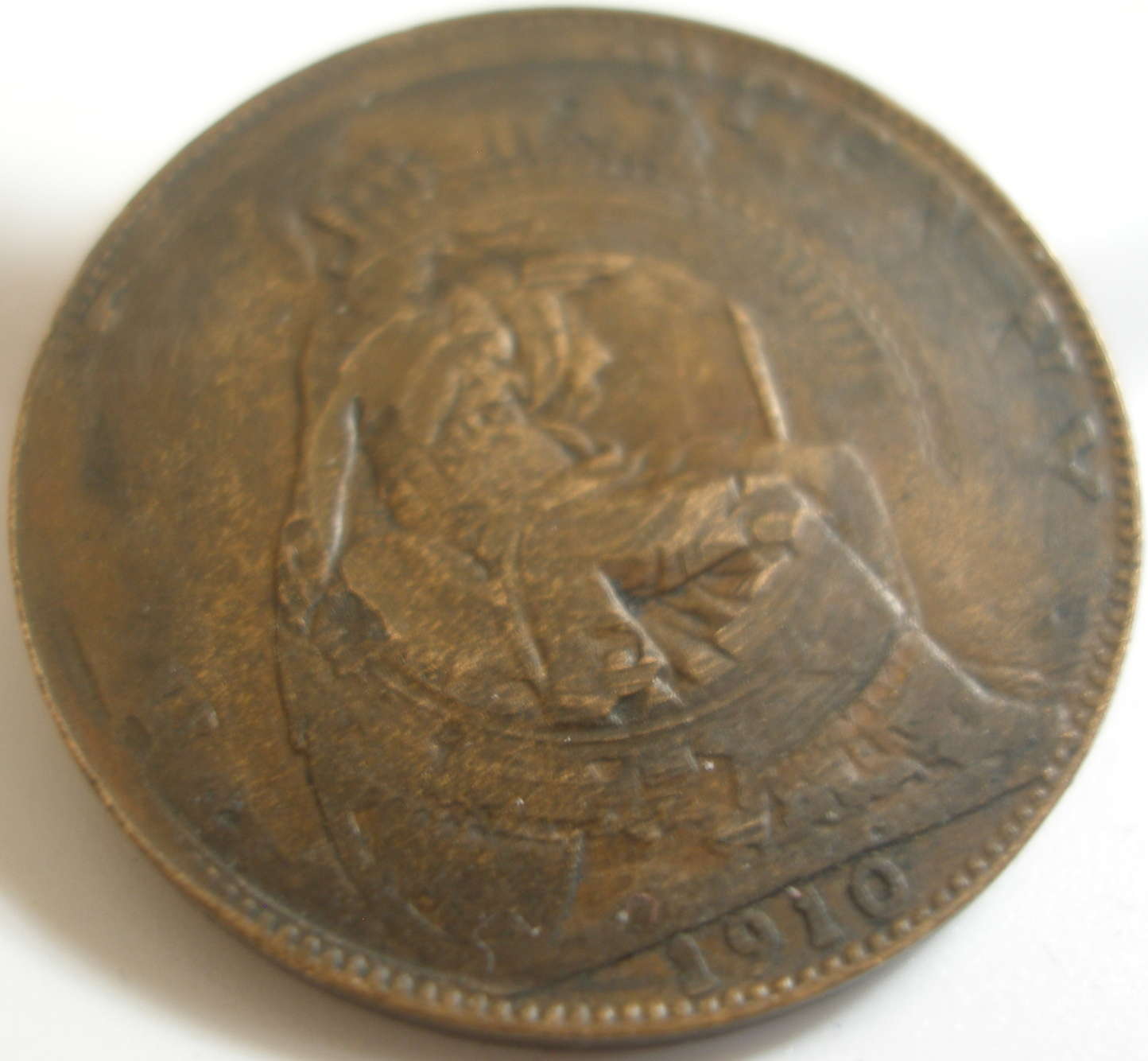
It appears to be "ONE HALF PENNY", as can be found on the reverse of Australian halfpennies of George V and early George VI. WCG example. There appear to be at least two partial backwards impressions. The "A" on the king's neck is from "COMMONWEALTH". It's post-mint-damage, not an error. It's a vise job, with the design of the Australian coin squeezed onto this coin in a vise or similar device. At a guess, it was done by somebody who was under the impression that British halfpennies were not spendable in Australia (they were, up until the 1920s), so they attempted to make their coin more acceptable.  Don't say "infinitely" when you mean "very"; otherwise, you'll have no word left when you want to talk about something really infinite. - C. S. Lewis
|
|
Valued Member
Australia
236 Posts |
Hi coinage and sap thanks for your thoughts.
Well spotted by sap except I think the A on the neck is from ALIA.
Surely there wasn't anyone thick enough to have such a halfarsed attempt at redesigning a foreign halfpenny for the purpose of passing it off as legal Aussie tender.
The damage sticks out like a red flag. LOL
What about the damage to the obverse sap? Any theories? Or the same theory?
|
|
Valued Member
Australia
236 Posts |
|
|
Valued Member
United Kingdom
449 Posts |
Quote:
What about the damage to the obverse sap? Any theories? Or the same theory? I would say it is vice damage. |
|
Valued Member
Australia
236 Posts |
Yes. I agree it is PMD and that a vice is plausible, probably highly likely. I appreciate the input you have both had in edifying me. But I'm curious about what caused the multiple reducing rings on the Reverse. A COA halfpenny couldn't do that - or I can't see how it could at least. Your thoughts if you have the time please. |
|
Valued Member
Australia
236 Posts |
While we are at it there is a large variation in the two Edward V11 effigies. Is this wide a variation discussed somewhere? Anyone know? 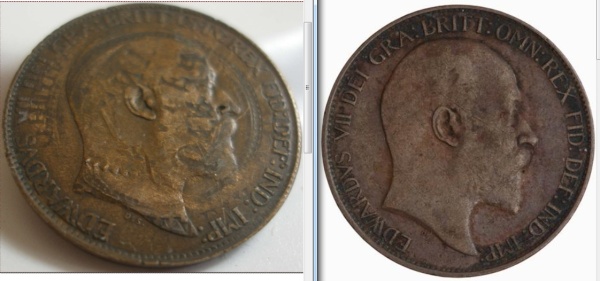 |
|
Valued Member
United Kingdom
449 Posts |
Sorry, I should of gone into a bit more detail in my other post. I would guess that the rings on the reverse are the imprint of the the vice itself when it was crushed between an Australian Halfpenny.
Edited by Coinage123
01/23/2013 08:30 am
|
|
Valued Member
Australia
236 Posts |
Hi coinage I assume you are referring to a PRESS rather than a vice and I can see that as being plausible. The area at around 2.00 to 2.30 looks like legend from a coin to me but now that it is agreed it is PMD there isn't any need to identify the causes so I won't waste more of anyone's time. Thanks to both of you for your assistance, I can throw this coin in the scrap bin now. Still interested to read any articles about the diversity of the Edward V11 effigies on what are both 1910 coins. The second coin is from the Victorian Museum website. If anyone knows of anywhere that would be great. I've tried to find references on Google. |
|
Pillar of the Community
Australia
2180 Posts |
According to Michael J. Freeman in The Bronze Coinage of Great Britain there was only one Edward VII halfpenny effigy type (but two for the penny).
|
|
Valued Member
Australia
236 Posts |
"According to Michael J. Freeman in The Bronze Coinage of Great Britain there was only one Edward VII halfpenny effigy type (but two for the penny)."
Hi! Mr.T The 2 images of the 1910 halfpenny above appear to dispute that. Any thoughts?
|
|
Pillar of the Community
Australia
2180 Posts |
I don't think my reference is the most comprehensive. http://www.michael-coins.co.uk/BBCbook.htm looks like it has more information but I don't have it. They look pretty similar to me, except the imprint on the damaged one makes the head look shorter. Or am I missing something? |
|
Valued Member
Australia
236 Posts |
Hi! Mr T I see glaring differences, but I have a builder's eye so I see small differences easily.
The nose is greatly different, the ear, the forehead, the top of the head, width of the neck, the attitude of the pose.
I believe these are very different effigies. Cheers darge.
|
|
Moderator
Australia
17002 Posts |
The changes in effigy of the George V halfpenny series are well documented. There is no similar documentation for any changes for the brief Edward VII series.
I'm not seeing any differences between these two effigies that couldn't be explained by the damage on one coin, and the heavy wear / weak strike on the other.
Don't say "infinitely" when you mean "very"; otherwise, you'll have no word left when you want to talk about something really infinite. - C. S. Lewis
|
| |
Replies: 25 / Views: 4,305 |









 Posted 01/23/2013 03:14 am





