










 Posted 03/07/2013 6:28 pm


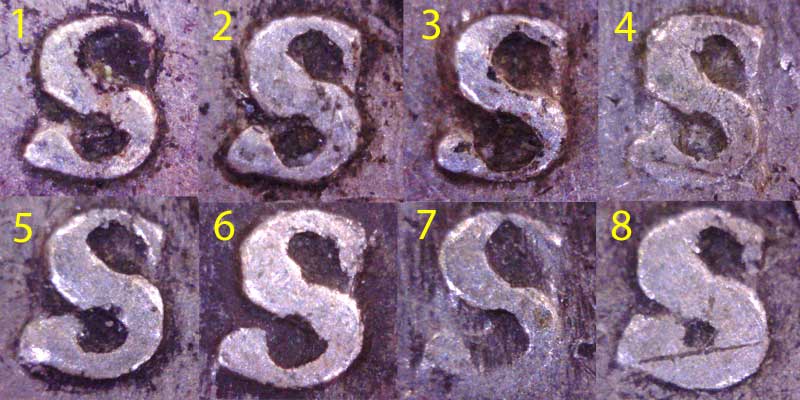
I've looked at these coins again and given it more thought. I'm having trouble believing that the differences I'm seeing in those knobtails is just Die Deterioration, PMD, minting stages, etc.
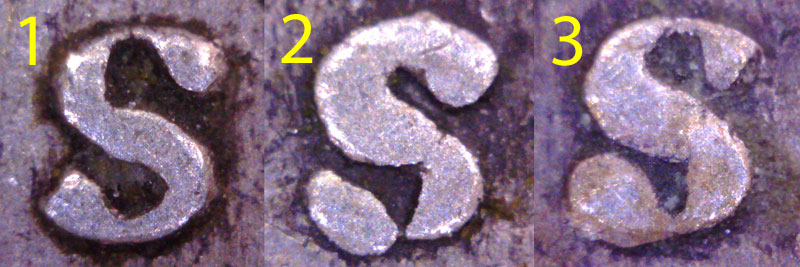
Look at the space inside the loops-- the shape of the negative space. One space has a more vertical component (in the half with the knob) and the other loop space is more rounded/elliptical. In the example picture, coin 1 shows the knob (and more vertical component) in the top portion of the S; in coin 3, the knob and vertical component are in the lower S.
Macmercury-- I see what you are saying about the possible chipping away of the loop (coin 3) but I see that same appearance at the tip the blunted lower end of the S in picture #1.
In addition to loss of the knob tip on the die, an additional event or condition has to happen to create a 'false knob' on the other end. I realize that metal does move and flatten out as the coin is banged around, but for that to explain the appearance of a false knob on the lower part of coin 3, there would have to have been a very fortuitous hit to a very discrete area and I just don't see that happening. The moved metal would have retained the blunted shape or if struck by something smaller than the knob, an irregularly deformed shape.
Look at the space inside the loops-- the shape of the negative space. One space has a more vertical component (in the half with the knob) and the other loop space is more rounded/elliptical. In the example picture, coin 1 shows the knob (and more vertical component) in the top portion of the S; in coin 3, the knob and vertical component are in the lower S.
Macmercury-- I see what you are saying about the possible chipping away of the loop (coin 3) but I see that same appearance at the tip the blunted lower end of the S in picture #1.
In addition to loss of the knob tip on the die, an additional event or condition has to happen to create a 'false knob' on the other end. I realize that metal does move and flatten out as the coin is banged around, but for that to explain the appearance of a false knob on the lower part of coin 3, there would have to have been a very fortuitous hit to a very discrete area and I just don't see that happening. The moved metal would have retained the blunted shape or if struck by something smaller than the knob, an irregularly deformed shape.


