| Author |
 Replies: 12 / Views: 1,886 Replies: 12 / Views: 1,886 |
|
|
Pillar of the Community
Canada
1996 Posts |
i started a new box of pennies today and pulled this out.was this crater done during the minting process? I think it was because under high magnification it shows no signs of marks (grind scrape scratch etc...) no burrs. if it was done after being released the copper coating would be gone in this area right? notice how the rim appears to look rolled over on the obverse in the same area as the crater. and is it worth anything? thanks 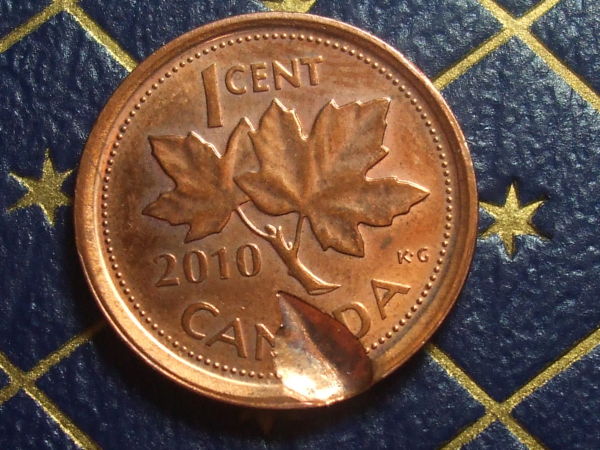 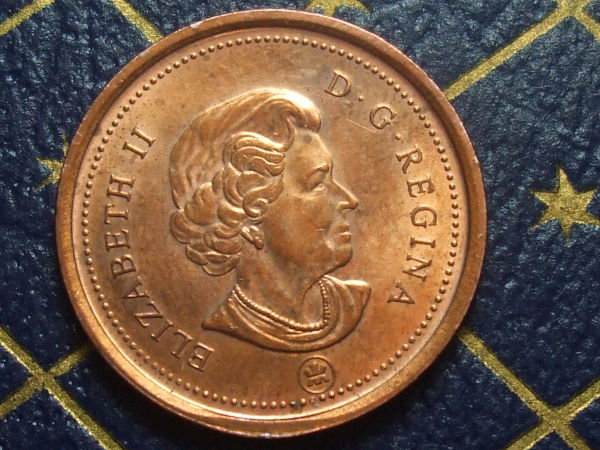 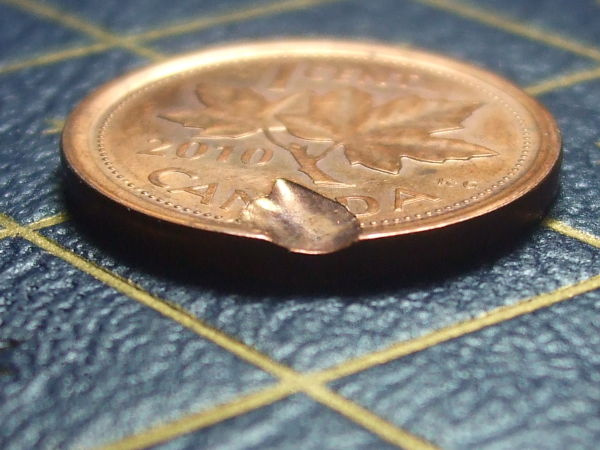 Edited by gidjit
04/02/2013 4:38 pm
|
|
|
|
Pillar of the Community
United States
1812 Posts |
My guess is that it was struck on a flawed planchet.
|
|
Moderator
 Canada
10477 Posts |
Most definitely a mint error - I love how the rim on the obverse also shows the effect of the missing metal...
"Discovery follows discovery, each both raising and answering questions, each ending a long search, and each providing the new instruments for a new search." -- J. Robert OppenheimerContent of this post is licensed under a Creative Commons Attribution-NonCommercial 3.0 Unported License. See: http://creativecommons.org/licenses...0/deed.en_USMy eBay store
|
|
Rest in Peace
United States
4078 Posts |
Very nice! My first impression was, it is in the shape of a leaf.
|
|
Pillar of the Community
 Canada
1996 Posts |
|
|
Valued Member
Canada
334 Posts |
Nice strike through error . If it was a flawed planchet , there would be weakness on the obverse .
|
|
Pillar of the Community
Canada
1161 Posts |
Quote:
If it was a flawed planchet , there would be weakness on the obverse. There is weakness showing on the obverse @ aprox 6:30 on the rim. If you flip the coin the weakness is in the same location as the anomaly on the reverse. |
|
Moderator
Canada
10477 Posts |
I concur with errorone2012. If it was struck on a flawed planchet, the beads on the obverse would not show up as strong as they do...
"Discovery follows discovery, each both raising and answering questions, each ending a long search, and each providing the new instruments for a new search." -- J. Robert OppenheimerContent of this post is licensed under a Creative Commons Attribution-NonCommercial 3.0 Unported License. See: http://creativecommons.org/licenses...0/deed.en_USMy eBay store
|
|
Pillar of the Community
Canada
1996 Posts |
im not sure I agree. I understand your theory that there would be no support to form the beads on the obverse but, if you think of it, it would act as a bridge with the shape being an arch(one of the strongest shapes)and the span only being 1/8" wide and it was not left paper thin but about .050" thick, I think this might be sufficient to support the coin enough to show the impression of the beads.
|
|
Pillar of the Community
Canada
1996 Posts |
i took a close up of the crater. can you see where the last bead on the left is partially formed in the crater? which should prove this was done at the mint because if it was done after the bead wouldn't show in the crater 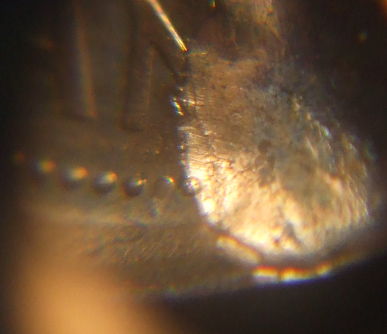 |
|
Pillar of the Community
Canada
1996 Posts |
so does anyone have a guess at its value? $5? $50?
i have never collected error coins so I have no idea what this variety might be called or its value
|
|
Moderator
Canada
10477 Posts |
Around $5 to $15 for a coin like that - depends on the demand at time of sale. Typically, the larger the area that is affected, the more it is worth.
Call it a strike-through error.
"Discovery follows discovery, each both raising and answering questions, each ending a long search, and each providing the new instruments for a new search." -- J. Robert OppenheimerContent of this post is licensed under a Creative Commons Attribution-NonCommercial 3.0 Unported License. See: http://creativecommons.org/licenses...0/deed.en_USMy eBay store
|
|
Pillar of the Community
Canada
1996 Posts |
|
| |
Replies: 12 / Views: 1,886 |
|










 Posted 04/02/2013 01:23 am


