| Author |
 Replies: 24 / Views: 8,944 Replies: 24 / Views: 8,944 |
|
|
|
Valued Member
United States
250 Posts |
I have a couple of common dates in AG that are more worn on the obverse than the reverse, but not quite the disparity of your coin. Also have a couple of others where the lettering is almost gone but the date is easily readable. I looked at my ICG 1877 in AG as comparison, the dates look the same, but mine has a little more lettering visible and the reverse is noticeably more worn than yours. I'd take it to some local shops for opinion and maybe a coin show if one is in your area- I believe some of the grading companies show up on site sometimes to help in cases like this. Good luck.
|
|
Pillar of the Community
United States
5230 Posts |
Send it back while you can and look for a better example.
If anything when the seller relists it you may get it for a lower price if you really ant to take a gamble as I'm sure he wouldn't let you return it a second time.
|
|
Pillar of the Community
United States
1796 Posts |
That's a toughie. Everything looks pretty good (including the date). The only thing that's "off" to me is that something looks wrong with "STATES." The font is different and the placement is different, unlike the rest of the legend (which seems in place). 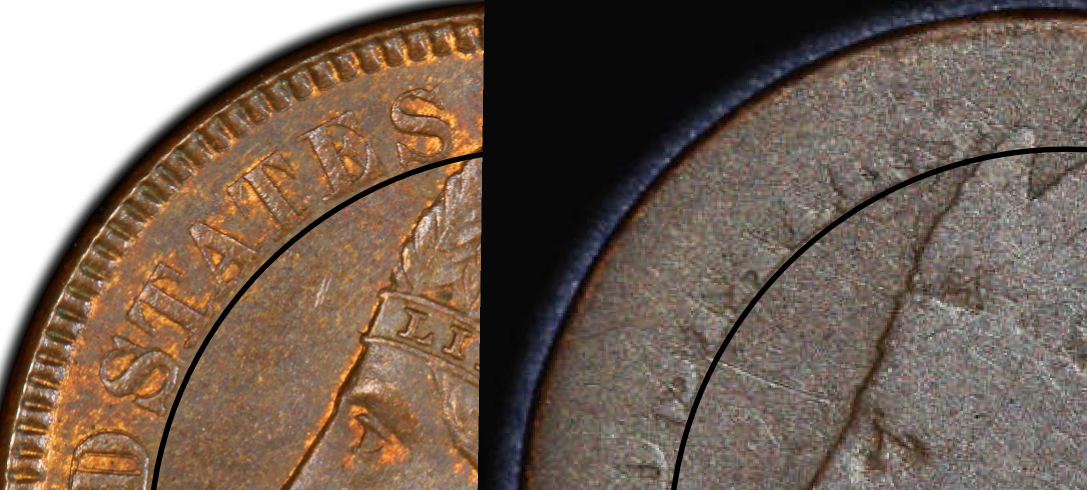 However, given how much torture this coin has been through, I cannot give a definite opinion. A *lot* of metal has been moved around and removed from wear. Edited by SteveCaruso
09/02/2013 10:40 pm
|
|
Pillar of the Community
United States
5854 Posts |
The style of the date and the characteristic shallow N's appear to match the diagnostics of genuine examples but I do agree with others the discrepancy between the grades of the obverse and reverse is strange. The ones I have seen in low grades do seem to have a stronger reverse than obverse but not this great. One thing about the reverse that I noticed is there seems to be brighter patches of copper on the denticles, edges of the leaves, and One Cent which may be a clue to why the reverse has so much more detail. The obverse is more or less an even brown doesn't have the same patches the reverse has. Near the rim by the ribbon, the is some piece of black gunk which I am not sure if its clue or not. My guess is there may have been some substance on the reverse, though I am not sure why only the reverse, which protected it while it circulated and was much later cleaned and retoned/recolored producing the bright patches seen. That piece of gunk that I mentioned may or may not be that substance. Just my attempt at some sort of explanation but I could be total wrong.
Edited by D0ubl3Eagle
09/03/2013 01:09 am
|
|
Pillar of the Community
United States
2760 Posts |
|
|
Pillar of the Community
United States
959 Posts |
I agree with what Stylez said about mounting them in a ring. My father mounted two IHC cents and made a pair of cuff links (remember them?); the date being 1907 (his birth year). While the obv of these is much better than the 1877, they're also 30 years newer, and might have had much more use. He has them mounted to a round piece of metal, the same size as the coin, so I can't see any detail on the rev, but it has to be better than the obverse. These coins were also harshly cleaned. The question was also asked; who would put a coin like that in a metallic holder? Of course 100 years ago, they were not viewed the way we see them today. |
|
Valued Member
 United States
374 Posts |
Thanks for all the replies. I feel better about this coin now. I think that possible it could have been mounted in some sort of jewelry/ money clip, or something, causing the obverse to wear and not the reverse. I did not think about that before. The seller was upfront about the difference in wear, but did not offer an explanation or really get into the extent of the difference. There does appear to be have been some substance on the reverse. I may have noticed it, but did not think about is as a clue! Perhaps it was glued/ mounted in something and then restored, as was suggested. If it were a less valuable coin this effort to remove it from the jewelry probably would have not happened.
Edited by Bababooey
09/04/2013 02:02 am
|
|
Valued Member
United States
374 Posts |
Steve: thank you for your analysis and thoughts. It seems this is your area of interest/ specialization! I'd say if you can't say there is not something definitively wrong, then I'm satisfied as I'm going to be.
I'm not going to pursue this any further now. I bought what I could afford at this point, and the price of that savings comes with a little bit of doubt!
Perhaps, in the future, a graded specimen, for a coins of similar value, would bring more piece of mind.
If it is ever sold, sending to a grading services would be helpful. If/ when it is deemed genuine, the cost of the grading would be made up in the increase in sales price, that a graded coin would bring.
Edited by Bababooey
09/04/2013 02:01 am
|
|
Pillar of the Community
United States
9810 Posts |
Give ANACS a shot at the authentication, they are good and cost reasonable! $10-15.00 + S&H no club to join either! If you're an ANA member you can also submit directly to NGC without joining their club. Saves some money in the end, but would give you the piece of mind whether or not it's genuine. I think it looks okay from the photos. "Buy the Book Before You Buy the Coin" - Aaron R. Feldman - "And read it" - Me 2013! ANA Life Member #3288 in good standing since 1981, ANS, Early American Coppers Member (EAC), Colonial Coin Collectors Club member (C4), Conder Token Collector Club member (CTCC), Civil War Token Society (CWTS) member, Liberty Seated Collectors Club (LSCC) & Numismatic Bibliomania Society member (NBS), USMex, Member in good standing, 2¢ variety collector. See my want page: http://goccf.com/t/140440 |
| |
Replies: 24 / Views: 8,944 |








 First Page


 Posted 09/02/2013 8:24 pm


