| Author |
 Replies: 15 / Views: 2,415 Replies: 15 / Views: 2,415 |
|
|
Pillar of the Community
United States
1761 Posts |
There is some debate? whether to be genuine these pieces should have hand cut edges (striations) normally with hand-cut ~45* angular striations on the EDGE 360* around? Are Plain Edge pieces - acceptable? See here (these types): http://www.ebay.com/itm/MEXICO-1813...141179725936John Lorenzo United States |
|
|
|
Pillar of the Community
France
1591 Posts |
I would not buy that coin from this seller, it's a complete gamble ... I don't like it, I'm not sure why. Anyway, here is the edge from mine, which looks smoothed (I should take better pictures, but I don't have it on hand now) : 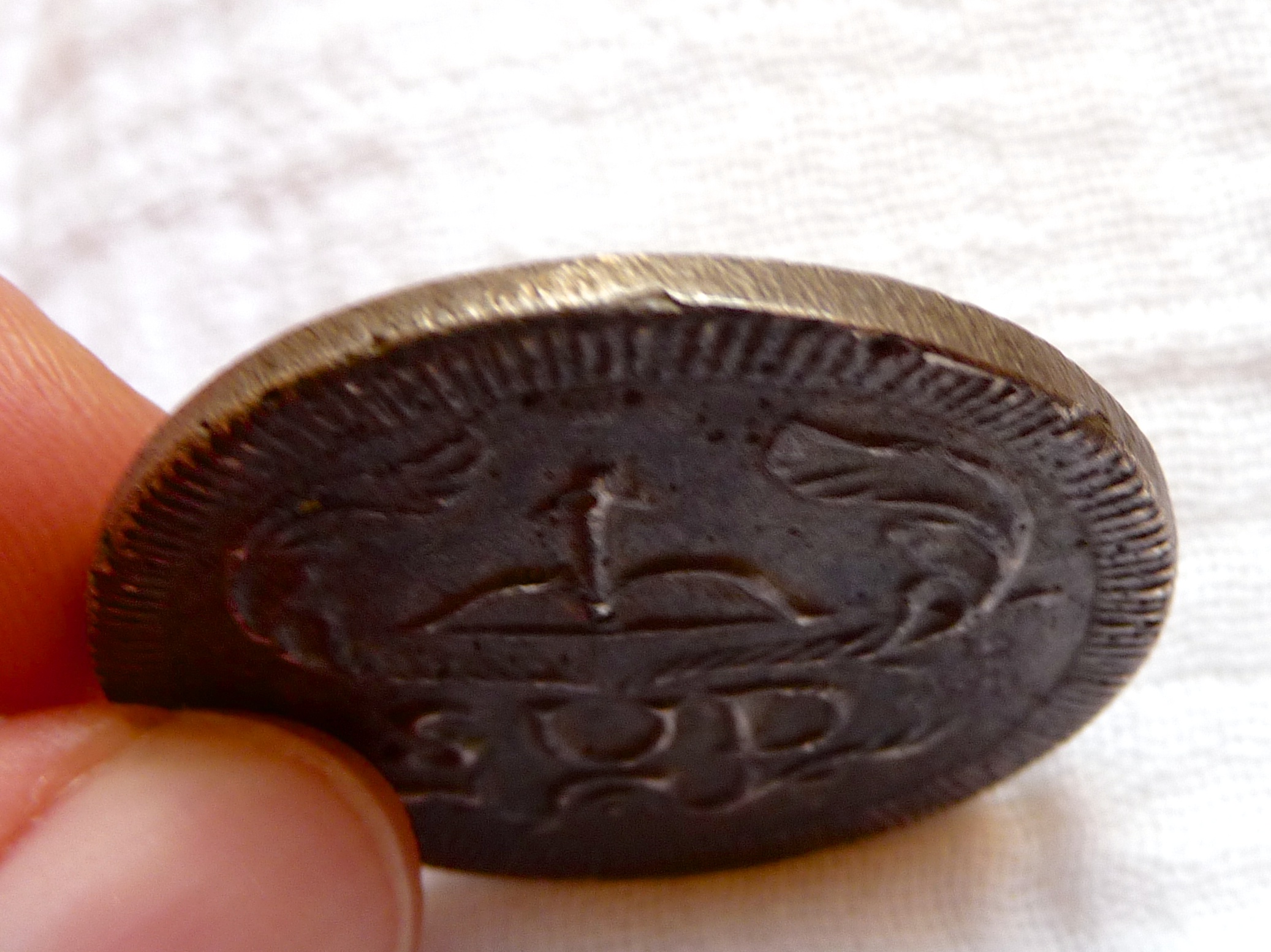 |
|
Pillar of the Community
 United States
1761 Posts |
Mine has striations - but its one of those situations of years of experience and some laboratory analysis on the Ag, Au, Pb & Pt levels - even then - still an easy coin to forge ... is there any real certainty with this issue?
|
|
Valued Member
Germany
194 Posts |
In my opinion there is no real certainty, and there won't be. A simple reason is that the original coins are cast, which means that any cast copy will just look as cast as the original. Most people apparently do not care. Many collectors simply stay away from the coin, especially once they hear that even the example that has been used for decades to illustrate the Krause catalogs is a modern counterfeit! So apparently is my own example, which I bought in a Ponterio auction a few years ago when they still were Ponterio - not even the largest auction house for Mexican material was able (or cared to) identify the fakes! For many years, the "hand-reeding" of the edge has come to be taken by collectors as a sign of a coin's authenticity. The reason behind this is that, starting from the Fonrobert auction, not a single numismatic publication or catalog ever described the edge of the Morelos casts. As nobody cared, neither did the counterfeiters, and consequently the many modern forgeries all show plain edges. I haven't looked at many coins graded by TPG services, but the ones that I have seen in holders don't show the edge for apparent reasons, so I can't really tell how they assess the authenticity of a coin. However, a counterfeiter knowing what to look for on the edge will not have any difficulties reproducing it. And apparently this is what has happened lately, at least in Mexico. Coins known by its style to be modern forgeries with "correct" edge reeding are beginning to appear on the market! So, for the moment, it is difficult to establish a coin's authenticity, but it is at least possible to "weed out" the more obvious forgeries, such as the ones that look like "chocolate money" with unoxidized surfaces, the ones which are identical to the one shown in Krause, the ones that have plain edges (light filing marks could be present, though, otherwise one would expect to see the seam from the casting process), and the ones with the date 1814 (as one Mexican expert in the field told me that there are no known originals with that date). One problem is that most auction catalogs STILL don't mention the edge, if the coin is in a holder, you don't see it, meaning that it is an absolute gamble buying one of these unless you literally hold them in your hands. Note that I have deliberately left out any mentioning of XRF testing. I guess most modern forgeries will be detected by this as I seriously doubt that the forgers used "contemporary" silver alloys to produce them. However, to my knowledge nobody has ever done such a study on these coins, at least not with published results. |
|
Pillar of the Community
United States
1761 Posts |
As you may? know I am a world authority on the English & Irish 18th & 17th C Irish and English Halfpence/Farthing contemporary counterfeit coppers as written in the Forgotten Coins of the American Colonies in the Anton/Kesse book. Just saying - with copper issues Cast copper of this period is also easy to duplicate and I have seen it done. A well know U.S. Type dealer in the U.S. and C4/EAC copper member David Wnuck gave me as a present of some English Halfpence cast coins made at a demo and they looked very much if not identical to the originals and XRF tested the same as the demo people knew the composition of English cast coins. Wnuck swore after this demo he would never buy any cast coin EVER AGAIN! <BG>. I still have the pieces in my collection.
In terms of cast silver ITS DIFFERENT and the saving grace may be the trace platinum and gold that must be in the silver for this period of coinage and this is ALMOST impossible to duplaicate unless you melt and use period silver as you know. As you saw from Chihuahua Paper the levels must be around ~ 0.1-1.0%. An order of magnitude lower (i.e., 0.01 -0.1%) and its questionable. Two orders of magnitude lower and its UNQUESTIONABLY MODERN.
The other factor is if you melt good period silver the lead due to its low boiling point and various ancient coinage studies have shown this fact (no studies yet for 18th/19thC Coinage) the lead values drop out of the normal range for the coinage - significantly. These again are the lead values in the Chihuahua Paper. I have not attempted this kind of study yet - simply because you need a population say of around ~ 25-50 pieces to get a handle it what is a normal lead value range for a Silver 8R Sud.
The ONLY one in my collection I can post the results but it does show good Ag,Pt & Au and its not a Plain Edge. Just need to examine some plain edge pieces see if they are debased? and see the trace Pt & Au levels. Time will be needed to see about the Pb levels - yes I know Ralph - what are the good standards for this kind of study? <VVBG>.
John Lorenzo
United States
Edited by colonialjohn
02/04/2014 12:30 pm
|
|
Pillar of the Community
United States
1962 Posts |
Quote:
Note that I have deliberately left out any mentioning of XRF testing. I guess most modern forgeries will be detected by this as I seriously doubt that the forgers used "contemporary" silver alloys to produce them. However, to my knowledge nobody has ever done such a study on these coins, at least not with published results. That sounds like a hint to someone... OK, John, start buyin 'em up. Only $700 a pop - a slight savings vs. the klippes! This series is absolutely a poster child for something which almost HAS to be verified this way. In lieu of that... These are NOT my thing at all (I honestly never even read entirely through you guys' good discussions about a year ago on these and other casts - only so many hours in a day)... but a couple thoughts: Quote:
A simple reason is that the original coins are cast, which means that any cast copy will just look as cast as the original. Quote:
Cast copper of this period is also easy to duplicate and I have seen it done... some English Halfpence cast coins made at a demo and they looked very much if not identical to the originals and XRF tested the same as the demo people knew the composition of English cast coins. --- Hmmmm... I would think that if you could definitively isolate some examples that are KNOWN genuine, there should be SOME minute traits that are telltale for (or against), or at least primarily associated with (not with), the "real casts" as opposed to the "casts of casts". Like with wreck material... many/most people tend to say "oh, it's hard to tell salvaged vs. cast". I think, though, that when you know what you're looking at, you can certainly tell apart salvaged from cast, and even salvaged from "casts of salvaged". It's certainly more difficult in this scenario, and as John said, some simulated pieces can be scary good/nearly perfect... but maybe not impossible? Something else to ponder... some of you are quite knowledgeable on these types and/or have access to people who are... and there is still confusion or what's real and what's not. If devotees or even EXPERTS can't totally be sure... how probable is it really that a given forger is going to get things EXACTLY right? --- Seems that detailed study should be conducted on the silver MINORS to compare style points (edges as discussed, exact right surface texture as noted above, etc... I know there are certainly fakes of all ages for those also, but probably not to the degree that exists for the 8R, and I'm guessing it would be a bit easier to weed them out. Quote:
such as the ones that look like "chocolate money" with unoxidized surfaces --- That always catches my eye right away... all of "those types" have that same bare look. I saw a piece in an NGC holder last year with fairly detailed pics that I saved - almost bit, didn't, sold quickly for IIRC $600-ish - that to my uninitiated eye seemed much in contrast to that effect with a nice, deep patina... Posted below for your consideration... thoughts? I haven't taken a really close look at this, compared to others, etc... so I'm just throwing it out there as a piece that looks fairly old-toned, no claim beyond that:  |
|
Pillar of the Community
United States
1962 Posts |
Quote:
Anyway, here is the edge from mine, which looks smoothed Mat, from the pics, your edge does look kind of striated to some degree (esp. around 1-2 o'clock) - it's not perfectly smooth. |
|
Pillar of the Community
France
1591 Posts |
Here is mine then, if you want chocolate, you have it (although it's also there on the high points) : 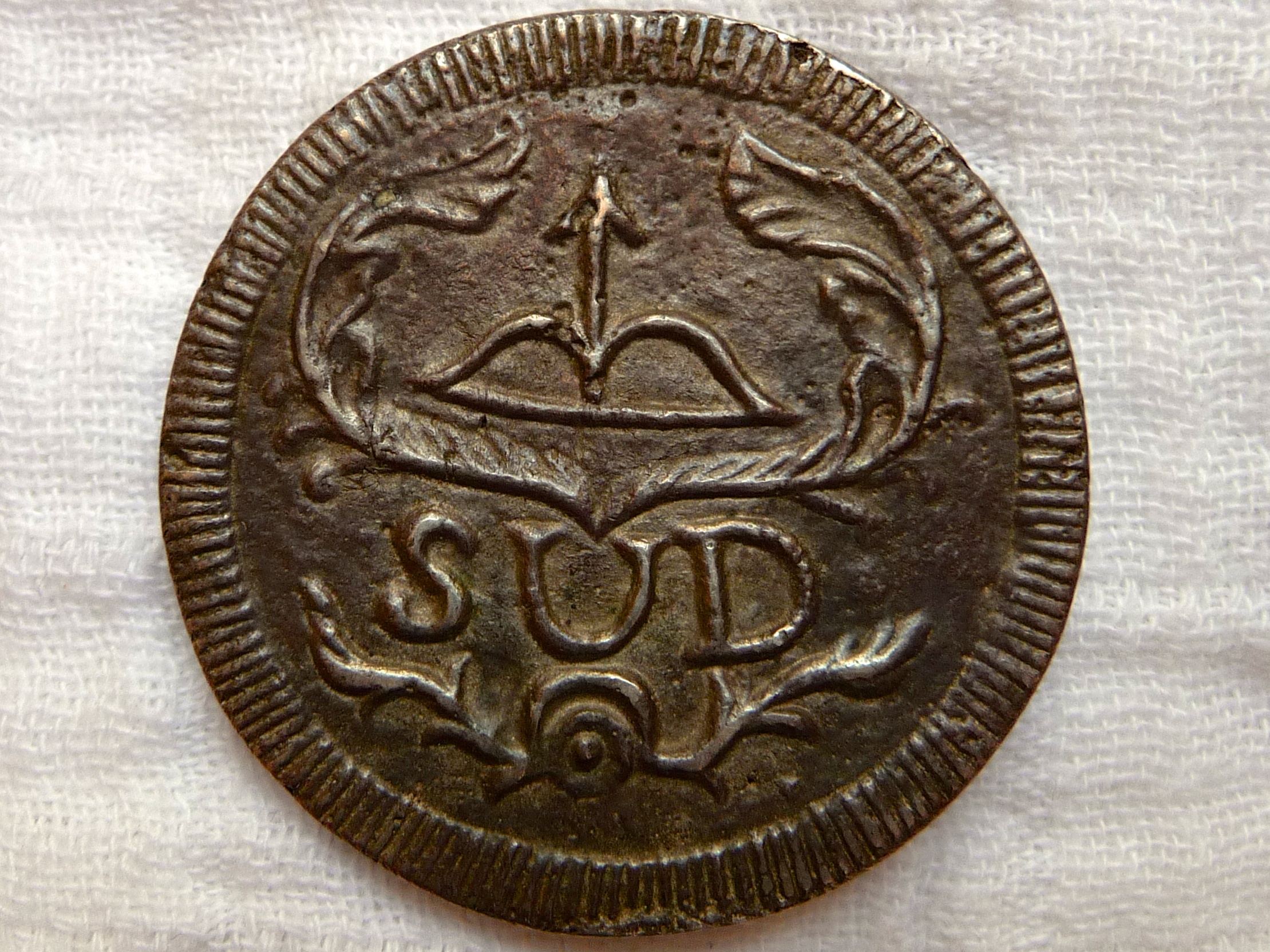 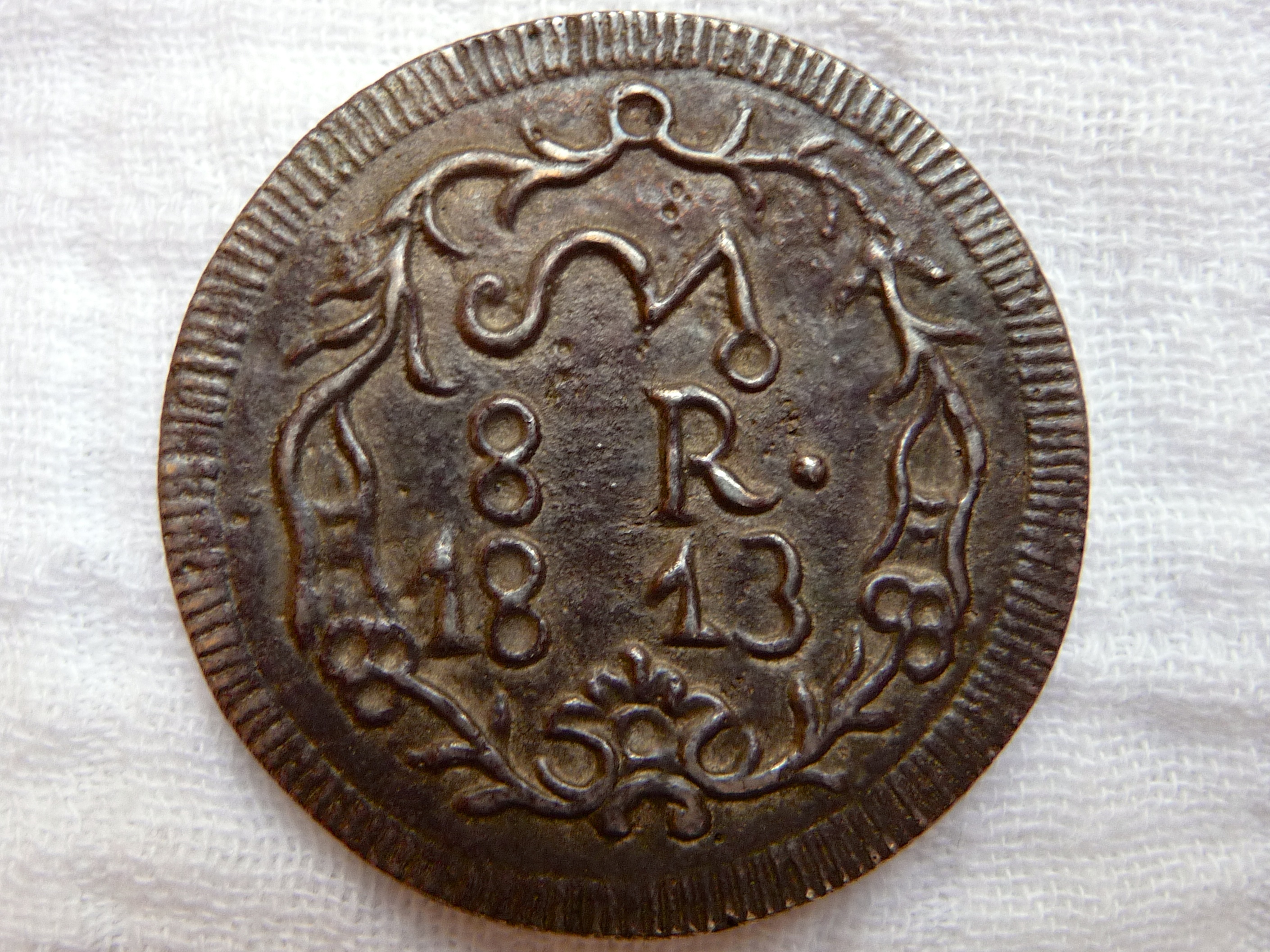 As usual, if you want it for some tests, just tell me - I'm always glad to participate in numismatic history research :) I also have a 1 real silver minor for this type. And a 1/2 real silver, but struck (and debased from what I can see) Edited by MathieuMa
02/04/2014 3:16 pm
|
|
Pillar of the Community
United States
1761 Posts |
Realeswatcher - just some thoughts: Cast and salvaged pieces are EASY some of the times to differentiate based on my earlier studies - At one time I owned at least a dozen of the various El Calzador (spelling?) raw pieces in those flips that verify these pieces as coming from this shipwreck event - the Ag readings were generally 96-99% - so two things are happening here with shipwreck coins IMO - the L. Beck silver surface enrichment effect (ie., silver migrating to the surface and copper leaving the alloy) and with salvage coins the copper has been leaching out steadily over the years - so you are almost left with pure silver in a sense for some pieces in a perfect scenario given enough time and seawater action/corrosion - cast is rarely going to give you this 96%+ Ag surface reading - but again just a 12 piece shipwreck study - but showing promise as a verification tool - v. high Ag values being the signature - I kept one in my collection with the Ag level at 98.6% from three XRF spot analyses (i.e., surface average). A Portrait 2 Reale. Although beyond the scope of this channel IMO. See here anyway realeswatcher: http://www.constantinethegreatcoins..._PROCESS.pdfSilver and copper at room temp. are not soluble to any degree so they form certain microstructures depending on the manufacturing operation and Ag & Cu levels. As I told Bopple the trouble is to have SUD specimens which we think are the good testing standards (i.e., real pieces from this period). So in this case we look at both the composition (XRF) and their microstructure (ie.,a signature specific to a type of manufacturing operation). The later may be difficult since we are dealing with a coining operation in a scenario due to its time period being under non-ideal conditions of emergency coinage and poor coinage quality control from day to day. Realeswatcher - look at Figures 9 (a) & (b) in this paper. Using different testing strategies or multi-testing methods is key for coins like this SUD 8R cast piece. Just need to develop a working data base and see what a small sample of the SUD 8R Cast universe looks like at the microstructure level <BG>. John Lorenzo United States Edited by colonialjohn
02/04/2014 4:10 pm
|
|
Pillar of the Community
United States
1962 Posts |
MathieuMa, nice piece... resizing it and putting into a comparison pic now...
One thing, maybe you realized it and were just using a "play on words" - Yours has an almost chocolate-hued tone... I think, though, that dosmundos only meant "chocolate coins" in the sense of those molded coins like Jews use at Hanukkah... saying that they (the untoned pieces you see regularly) look molded and fake. Am I reading that right?
===========================
John, interesting-looking article study, will review later. Peeked at the microscope closeups you mentioned... finding a physical signature is excellent clear-cut evidence. As you said, the challenge is rounding up enough of them to create a baseline. In lieu of the technology, it would still be nice if some "tells" discernible to the naked eye (and a loupe) to the naked eye could be ascertained.
BTW, one stupid question (maybe I should actually read your paper first :-> )... So the surface enrichment effect... aka copper leeching outward to the surface. If the copper has steadily migrated outward from the core of the coin, yet the (outer) surface readings are coming up 96-99% silver... does that then imply that nearly ALL the copper has come out and that the core must be nearly pure silver by this point?
Can you link again to your paper so I don't have to search it? Thanks.
Edited by realeswatcher
02/04/2014 8:09 pm
|
|
Pillar of the Community
United States
1761 Posts |
In the reference section you will see the L. Beck paper. Its on the Internet - free. If not its on my desktop. johnmenc@optonline.net
Not a short answer but in Beck. Copper clusters form beneath this high silver surface film for a typical 90%Ag/10%Cu alloy. Seawater corrosion is something else ...
E-Mail me for the MNA paper and L. Beck paper. This is anyone reading this ...
Edited by colonialjohn
02/04/2014 9:41 pm
|
|
Valued Member
Germany
194 Posts |
|
|
Pillar of the Community
France
1591 Posts |
Actually, I had a thought about it, but I also wondered about the color. Is it normal for silver to have this deep and dark patina ? I've seen SUD coins looking like this, but I don't remember to have seen other casts (Chihuahua for example) with a similar feature. Hence I was wondering if there was not something to scratch here (or on the other end, if a very clean SUD like the one auctioned on ebay was normal) |
|
Pillar of the Community
United States
1962 Posts |
Thanks for the link/offers to provide, dosmundos & John... started to peruse the Beck paper, will do more later. Quote:...or on the other end, if a very clean SUD like the one auctioned on ebay was normal... Well... note that the ebay piece (of the style which usually pops up, if my casual observation is accurate) shows the same die markers as the Krause-plated 1813... and both show the same markers as the Krause-plated 1814 - about which is stated, "most are considered spurious". Now, in general, common die markers don't automatically mean a piece MUST be fake (these are all casts, those features could appear on originals and any fakes of those originals). If all the 1814 dated pieces are forgeries, they "could" in theory have been produced by replicating a genuine 1813 which perhaps had those markers (which of course could also have spawned similar fakes retaining the 1813 date). Or... the pieces with those markers are ALL fakes and those markers resulted from the process of replicating the original coin. Requires study. Note Mathieu's piece and the NGC piece are from different "dies" (molds). Edited by realeswatcher
02/05/2014 08:00 am
|
|
Pillar of the Community
United States
1962 Posts |
John, what can be used to analyze what's present (aside from the underlying alloy) on the surface, organic or inorganic... some kind of spectrometer or chromatograph? Wondering if looking at the toning scientifically might be a way to confirm that some of these deeply toned pieces indeed have an "old skin" on them, from which you could at least infer that the piece is somewhat "old"...
|
|
Pillar of the Community
United States
1761 Posts |
Realeswatcher I like your idea of testing lower denomination silver SUDS which probably have less of a chance on being counterfeited. Silver in its most oxidized state is BLACK. I do realize that when you polish a silver coin to a shiny new and then hit it with a typical sulfur ointment it does create that unwanted black film (look) on the coin - UNDESIRABLE - however blackness from original toning has never bothered me on silver pieces - to me it means severe environmental exposure - realizing of course this noted exception above ... One thing with Beck - I did cut a 1964 U.S. Kennedy half dollar (90%Ag) and there was no silver enrichment detected on the surface or in the core - it takes time (century or more) and is specimen-dependent. As an example one Sheffield I sold on E-Bay since as you know all my pieces normally come with a full suite XRF analyses - a potential buyer inquired - 94% Ag - you better recalibrate your machine Mister - sent him the L. Beck paper - he apologized profusely - such is life ... <VVBG>. All this is explained of course in the new ANS book on CC8Rs for Portraits now under ANS review/publication (probably early 2015). John Lorenzo United States |
| |
Replies: 15 / Views: 2,415 |
|








 Posted 02/04/2014 08:05 am


