| Author |
 Replies: 17 / Views: 3,452 Replies: 17 / Views: 3,452 |
|
Valued Member
United States
50 Posts |
When looking at the date on this coin, I noticed a strange dot in the top half of the 8. I was hoping someone help me out and tell me what it is and whether or not it adds any value to the coin! Thanks a lot guys! 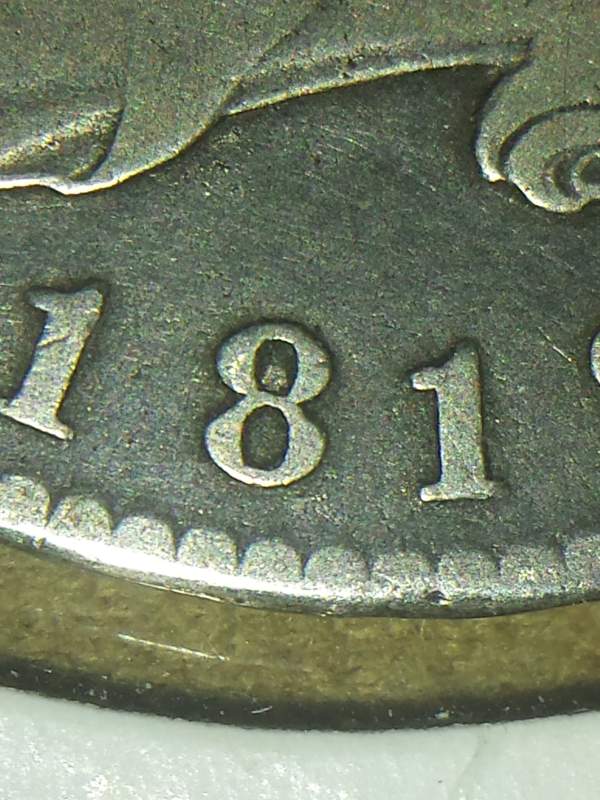 |
|
|
|
Pillar of the Community
United States
4409 Posts |
It could be a die chip  If it is a die chip, I don't think that adds any value, but I could be mistaken. -MV |
|
Valued Member
 United States
50 Posts |
That's what I was thinking too, I am just checking with people more experienced than I am! Thanks!
|
|
Pillar of the Community
United States
6370 Posts |
Looks like a die chip to me. Check to see if that is normal for the variety or if there is another variety that takes the die chip into account.
|
|
Valued Member
United States
50 Posts |
Do you know of any websites that would have the varieties listed?
|
|
Pillar of the Community
United States
6370 Posts |
|
|
Valued Member
United States
50 Posts |
I think you are right about O-106,its hard to tell, but I think that's the only one I saw with that die chip.it said that it was a very scarce variety, would that add any extra value to the coin? Or do varieties of this coin not really change the price too much?
|
|
Pillar of the Community
United States
6370 Posts |
Yes varieties can add value to a coin, depending on the rarity. I have a coin that is questionable in its variety. If it is one variety, it is worth $50, but if it's the other rarer variety, then it is worth at least $1500. So, yes, varieties do have an impact on a coin's volume.
|
|
Pillar of the Community
United States
2540 Posts |
The 'die chip' (if that is what it is, would not add value.
The Overton # (by die marriage) establishes value by rarity.
That said, if it was a LDS (late die state) it could effect the value.
But, this would not.
IMO
|
|
Moderator
 United States
23522 Posts |
The presence or absence of a die chip in the writeup for a given Overton doesn't necessarily prove or disprove its' existence. If you can, please post full-face images of the coin for attribution purposes. O-106 has a die defect over the second 1 and doubling in the 8 which yours does not show; I don't think it's O-106.
|
|
Valued Member
United States
50 Posts |
Thanks for all this information guys! I'm not too familiar with varieties, so any help is appreciated. And ill work on getting some full-face photos up for attribution!
|
|
Valued Member
United States
50 Posts |
Here are the full-faced pictures! 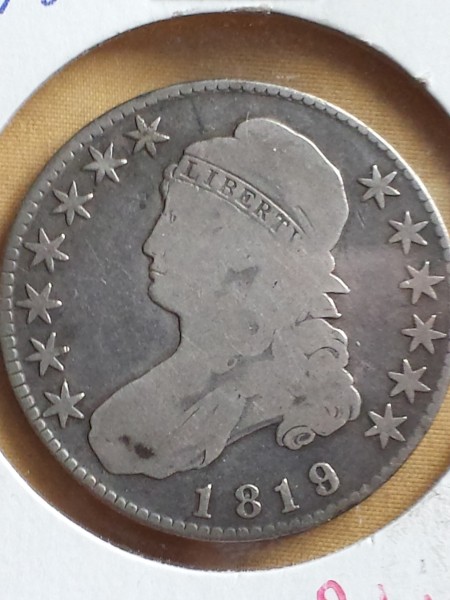 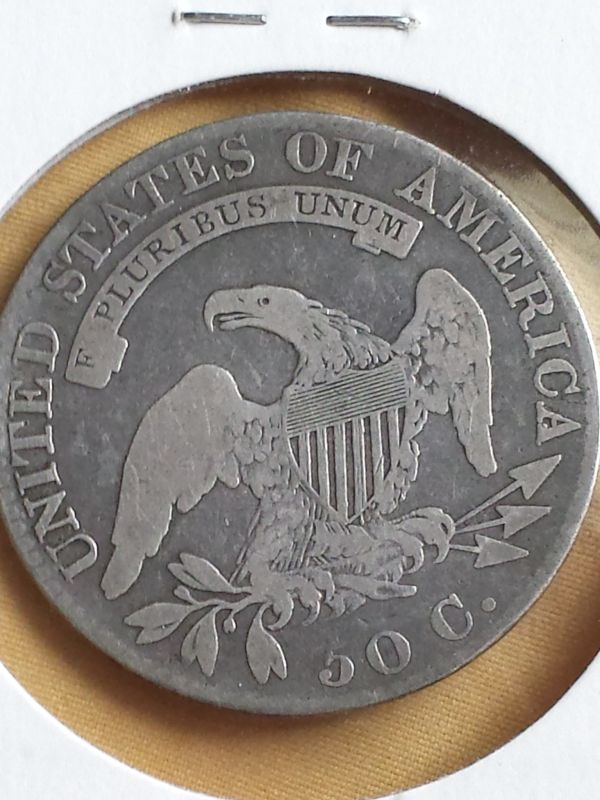 |
|
Pillar of the Community
United States
6370 Posts |
Found it! It is an O-105. R-2
(052) Not Allowed - Auto-Removed .com/CappedBustHalfDollarVarieties/1819varieties.html#.U1F2oie9KSM
|
|
Valued Member
United States
50 Posts |
Thanks for all the help! Is it true that the O-105 isn't really an overdate, but is instead just a die crack in the 9? Just curious!
|
|
Valued Member
United States
50 Posts |
In your honest opinion, would it be worth sending this coin in to be graded and slabbed? The place I got it from had it graded at VG-10. I know its not nearly as rare or valuable as a lot of coins, but It probably still has some value!
|
|
Valued Member
United States
50 Posts |
Ive also noticed that this coin has slightly rotated dies. I tried to measure it, and I may not be 100% accurate, but it is rotated about 30°. I know its nothing major like 90 or 180° but to my knowledge it is above mint tolerance. Is this series known for having rotated dies like this, or us it something more on the scarcer side?
|
| |
Replies: 17 / Views: 3,452 |




 Posted 03/28/2014 11:33 pm





