| Author |
 Replies: 659 / Views: 49,443 Replies: 659 / Views: 49,443 |
|
|
|
Valued Member
 United Kingdom
435 Posts |
Well if you fancy selling this one one day, let me know eh Echizento? Try to catch me when I am feeling flush, lol. I am partial to Salvs reverses on sestertii and that's a nice one. ;-)
Edited by Valecrucis
11/14/2014 8:58 pm
|
|
Pillar of the Community
United States
513 Posts |
I had a few that fit the bill but I'll go with a guy that hasn't been posted yet.  Denarius of Alexander Severus Obverse: IMP C M AVR SEV ALEXAND AVG, laureate and draped bust right, from behind Reverse P M TR P III COS P P, Jupiter standing left, nude but for cloak over arms, thunderbolt in right, long scepter vertical behind in left; Attribution: RIC IV 35, RSC III 249 It's got a scratch on the obverse but it otherwise in really great condition. Alexander was the final emperor of the Severan dynasty. His cousin Elagabus was assassinated by his grandmother in 222 for being really weird (those who remember the excellent thread posted about him a couple weeks ago will appreciate that statement) and that same grandmother (who was also Alexander's grandmother) arranged for him to be elevated to the throne. He was only 14 when he ascended and his mother did a very good job of surrounding him with good advisers. His reign was generally very successful, and despite some losses to the Sassanids the legions handled the threat and it appeared that the empire was going to get solidly on the right track. Then there was trouble in Germania, so Alexander went with the legions to deal with it. He arrived with a depleted army and inexperience at leading one, so he decided (with his mother's advice) to buy some time with diplomacy. The legions did not like this one bit, and they killed him. And with that, the Crisis of the Third Century had begun. |
|
Pillar of the Community
United States
4778 Posts |
I have that same type for Alfonso, Medieval, but the condition is not as good. But for $10 that it cost me I can't complain  |
|
Moderator
 United States
23731 Posts |
Sorry I'm going to hold on to this one for for a while. Medieval I left the Azes for you to post.
|
|
Pillar of the Community
3772 Posts |
Paid even less for mine, bought it as unidentied piece of metal.  But here with the clandestine approval of 'Valecrucis': 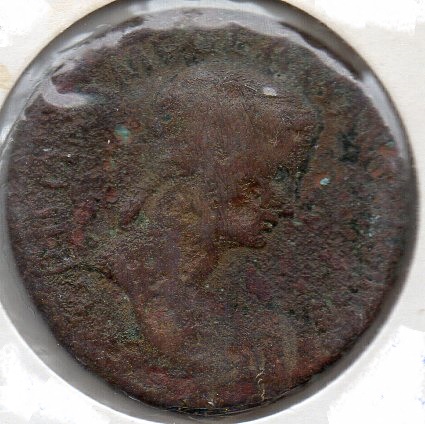 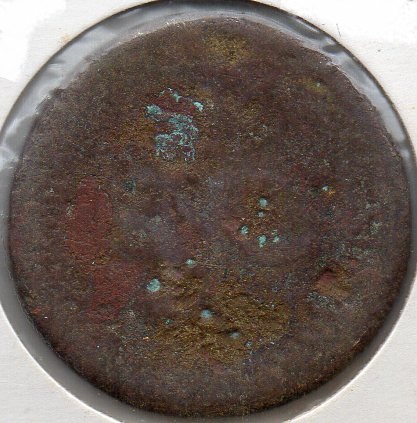 AE Sestertius of Agrippina Senior, minted posthumously in Rome (~AD42) - Sear[ME]#1906 Obverse: AGRIPPINA.M.F.GERMANICI.CEASARIS around bust of Agrippina right Reverse: [TI.CLAVDIVS.C]AESAR.AVG.G[ERM.P.M.TRP.IMP.P.P] around large SC For everyone who wants to know more about this well known woman of the early empire: http://en.wikipedia.org/wiki/Agrippina_the_ElderThe only thing they forgot to mention in that article is that she lived for some time in my home town.  |
|
Valued Member
United Kingdom
435 Posts |
I'm off to bed. It's nearing 3am here. So goodnight to you all. B's tomorrow. My parting offering: SELEUKID KINGS of SYRIA. Antiochos VI Dionysos. 145-142 BC. 23mm, 8.40g Antioch. Obv Radiate head wreathed in ivy r. Rev. BAΣIΛEΩΣ ANTIOXOΥ, EΠIΦANOΥΣ Î"IONΥΣOΥ, elephant standing l., holding torch in trunk; ΣTA above, control mark cornucopia in l. field. Ref. SC 2006, HGC 1043. 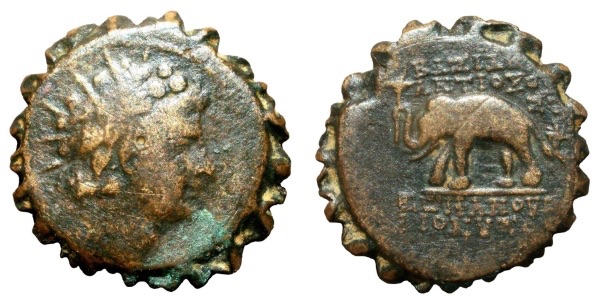 |
|
Pillar of the Community
United States
5155 Posts |
This coin hails from the Kuninda Kingdom, which lay at the foothills of the Himalayas, on what is the modern India/ Nepal border. The ancient Greek historian Ptolemy places the origins of the homeland of the Kuninda where the rivers Sutlej, Yamuna and the Ganges originate. Although unfamiliar to most collectors of ancient coins, the Kuninda Kingdom is mentioned in the famous Indian epic The Mahabharata, where it is said their armies were defeated by the Undefeated Hero Arjuna. The Kuninda Kingdom emerges from obscurity in two distinct series of coins. One minted in the 2nd to 1st century BC and the other around the 2nd century AD shortly before they disappear from the historical record. They struck coins in bronze and silver, while bronze coins are often crude and weakly struck the silver coins are amazingly gorgeous made from highly detailed and cramped dies, conveying an multitude of Buddhist symbolisms. Here I will show my example, dating from the 2nd century BC, a coin struck in the name of King Amoghabhuti. These drachms were struck in the same numismatic model as their Indo-Greek contemporaries. They followed a nearly identical weight standard of about 2.18 grams and 19 millimeter in diameter. Currently there is no catalog that thoroughly covers these coins and an unknown number of variations exist. Although due to hoard evidence, these coin have been found along side the coins of Apollodotus, cementing a solid, equal and peaceful economic exchange. It is thought that coins bearing the name of King Amoghabhuti were struck and circulated long after his death well into the 3rd century AD, and often bare the likeness of the Hindu God Shiva. Unlike most other Indian coins of earlier period this coin was the first of its kind to be made from dies rather than a strip of weighted cut metal and impressed with bankers(?) punchmarks common in the Archaic and Mauryan Periods. This coin was made much like the coins of European influence, yet unlike the circulating Indo-Greek coins these were made by natives in to facilitate ancient trade through out the ancient east. India, Kuninda Kingdom Amoghabhuti c. 2nd cent. BC 17 mm x 2.11 g obverse: Deer standing crowned by two cobras attended by Lakshmi holding lotus flower, ghadiya under deer. Brahmi Legend- Rajanah Kunindasa Amohabhutisa maharajasa. Reverse: Buddhist Stupa surmounted by the Buddhist symbol triratna and surrounded by a Swastika a "Y" symbol and a tree.-Kharoshti legend Rana Kunindasa Amoghabtusia maharajasa. (Great King Amoghabhuti of the Kunindas) ref: MACW 4440-4441, ACC #3 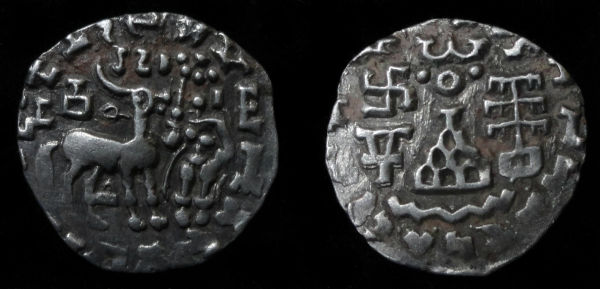 |
|
Moderator
United States
23731 Posts |
Anoob one of my favorite coins in your collection.
|
|
Pillar of the Community
United States
4778 Posts |
Medieval, you may want to take that coin out and check whether or not those green spots are BD.
|
|
Pillar of the Community
United States
5155 Posts |
...and for the Euro-centric collectors... A pleasing coin from the declining Seleucid Empire. This coin was minted under the reign of Antiochus VIII Epiphanes Grypos (the hooked nose). 121-96 BC. The coin features a photo realistic diademed portrait of the King surrounded by a fillet border. The reverse, of exceptional style IMHO, features what some call Zeus, or Zeus Ouranios. Which I believe to be the Titan Uranus, or titan/god of the sky. He features a crescent headdress and in his outstretched hand a star. (really phat). Antiochus VIII 121-96 BC Antioch, Syria AR Tetradrachm 30.5 mm x 16.12 grams struck. 121-113 BC Obverse: Diademed bust of Antiochus VIII right. Reverse: Uranus Standing left arm outstretched holding a star, and scepter crecent headdress IE/A left field, K right, N in Exergue. BASILEWS / ANTIOXOY right EPIPhANOYZ left field. All with wreath. ref:SNG Spaer 2498v, SMA 372 ex. David&Grace Barbobe 9/13 ex. DH Collection 11/13 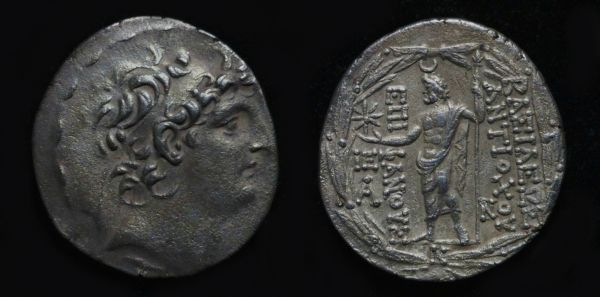 |
|
Pillar of the Community
3772 Posts |
Thanks for your comment 'VisigothKing', I appreciate your concern. Have currently some sort of a chaos, several coins are swimming in olive oil or distilled water. There are a few coins I have to take out of their 2x2 to (re-) treat them, but have also get a new supply of 2x2s. But here also to make 'echizento' happy one of my Azes II coins: 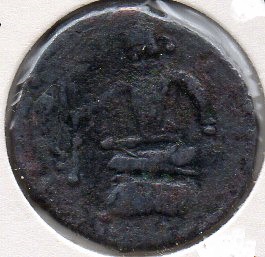 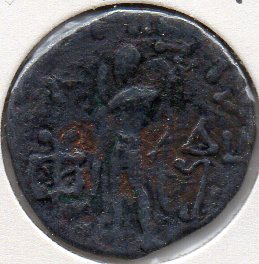 AE Trichalkon (~6.25g) Taxila Sirkap mint, Azes Ii (~35 BC to AD5). Obverse: King seated cross-legged, facing with ...AZOV around Reverse: Hermes standing left with caduceus, sumbols in field and legend around Since we talked recently about this region/realm I abstain from saying more. |
|
Pillar of the Community
United States
5155 Posts |
Dang Medieval thats phat.
|
|
Pillar of the Community
United States
5155 Posts |
Restored Byzantine Empire Andronicus III Palaeologus 1328-1341 AD. AE Trachy Thessalonica mint. 21 mm x 1.06 g obv.St. Demetrius, half-length bust facing, holding spear and shield. Rev.Andronicus standing facing, holding patriarchal cross in each hand; stars to outer left and right. DOC 927-8 var. (stars); SB 2486 var (ditto) etc. Unpublished in the standard references. 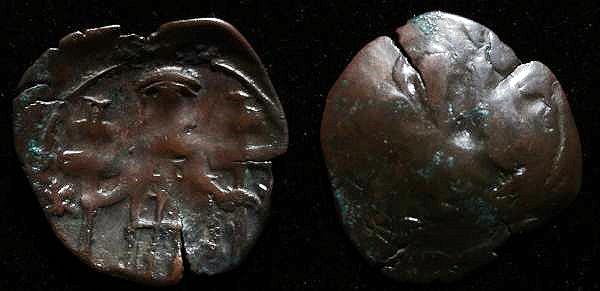 |
|
Pillar of the Community
United States
5010 Posts |
here are a couple A coins that haven't been posted yet..  azilises indo-scythian 60-35 bc o:king on horse, greek legend r: elephant, monogram, kharosthi legend 25x20mm 6g and ...   antialcidas nikephorus indo-greek kingdom 130-90 bc o: zeus (or abe lincoln?, greek legend r:caps of the dioscuri, palm branches, kharosthi legend i see I've already broken the rules.  instead of taking a coin off, I just will not post any more in the "A section". looks like it's wrapping up anyway. hope that is acceptable. if not let me know, and i'll pull my post or delete a coin. nice idea for a thread by the way! Edited by chrsmat71
11/14/2014 11:33 pm
|
|
Pillar of the Community
3772 Posts |
Thanks 'chrsmat71', your post allows me to squeeze one more of the many 'A's in, was a toss up between Alexander Janneus and this one: 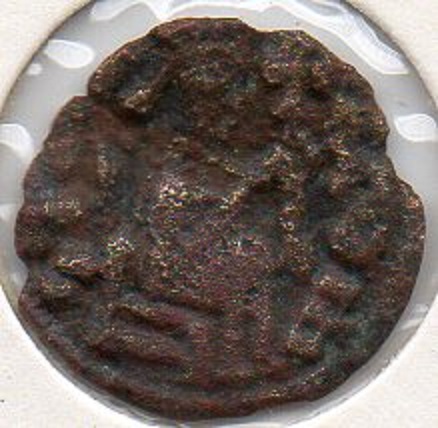 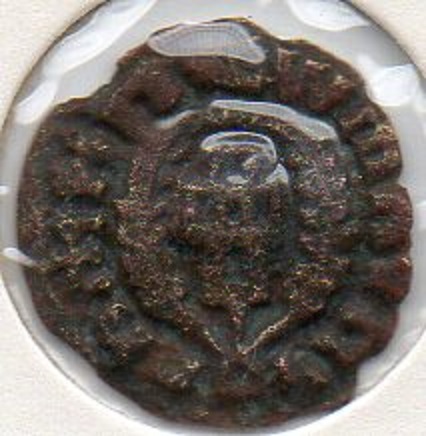 AE coin from King Armah of Axum (~700-730) - Mitchiner#423+ Time is running, so only quick a map where Axum fits in: 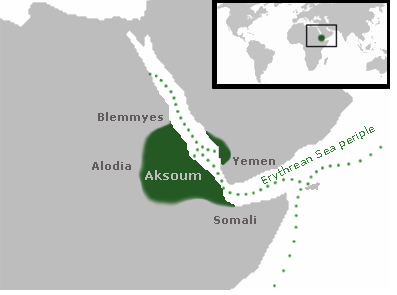 |
| |
Replies: 659 / Views: 49,443 |








 First Page
 Previous Page


 Posted 11/14/2014 8:56 pm


