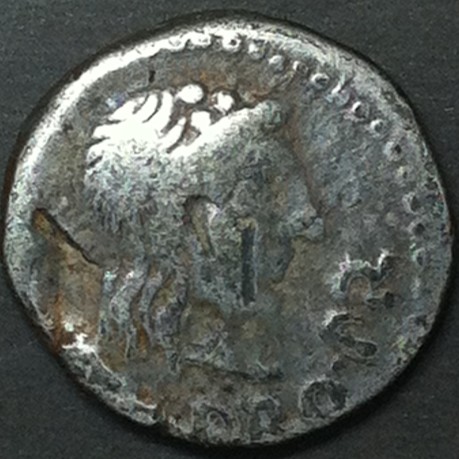
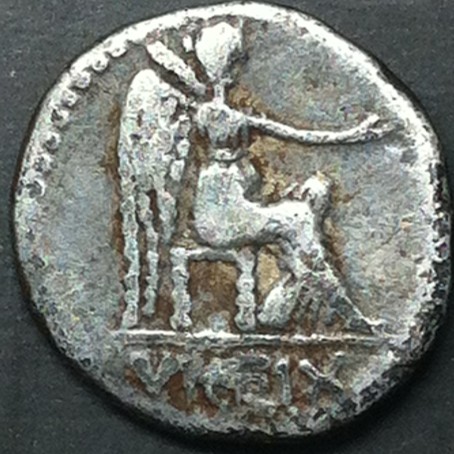
I recently purchased a couple of these coins as I was fascinated by the story behind her.
M. Porcius Cato 70 - 43 BC AR Quinarius 15 mm, 2.1 gm
Head of Liber right crowned with wreath of ivy, M, CATO behind
Victory seated right holding palm and Patera VICTRX in ex. Sear5 #248, Syd597c, Cr343/2b
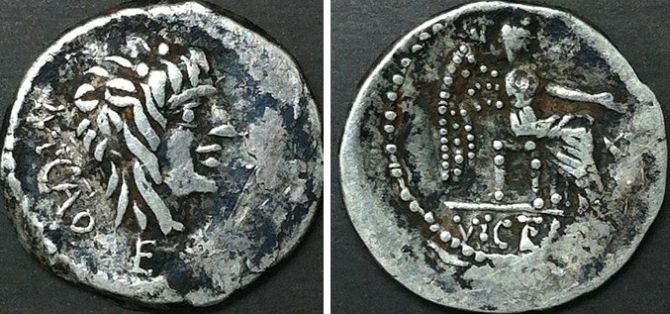
Porcia Catonis was born between 73 BC and 64 BC. She had an affectionate nature, was addicted to philosophy and was full of an understanding courage. Plutarch describes her as being prime of youth and beauty. When she was still very young, her father divorced her mother for adultery.
At a young age she was married first to Marcus Calpurnius Bibulus, her father's political ally. This marriage occurred between 58 BC and 53 BC. With him she may have had a son.
A few years later, Quintus Hortensius desired to make an alliance with Cato and asked for Porcia's hand in marriage. However, Bibulus, who was infatuated with his wife, was unwilling to let her go. Hortensius offered to marry her and then return her to Bibulus once she had given birth to an heir. Such an arrangement was not uncommon at the time. He argued that it was against natural law to keep a girl of Porcia's youth and beauty from producing children for his allies and impractical for her to overproduce for Bibulus. Nonetheless Bibulus refused to divorce her and Cato disliked the idea of marrying his daughter to a man who was four times her age. Instead, Cato divorced his wife, Porcia's stepmother Marcia, and gave HER to Hortensius; he re-married her after Hortensius died.
Bibulus died in 48 BC following defeat, leaving Porcia a widow.
In 46 BC, Cato committed suicide following his defeat in the battle of Thapsus .
Following her father's death, in June 45 BC Brutus, Porcia's first cousin, divorced his wife Claudia Pulchra and married Porcia when she was still very young. The marriage was scandalous as Brutus did not state any reasons for divorce despite having been married to Claudia for many years. Claudia was very popular for being a woman of great virtue, and was the daughter of Appius Claudius Pulcher, who had been Brutus' ally for many years. The divorce was not well received by some including Brutus' mother, Servilia Caepionis.
It appears that Porcia deeply loved Brutus and was utterly devoted to him. She resolved not to inquire into Brutus' secrets before she had made a trial of herself and that she would bid defiance to pain. She and Brutus had a son, who died in 43 BC.
Brutus, along with many other co-conspirators, murdered Caesar in 44 BC. He confided in Porcia of the plot to assassinate Caesar, and some credit her as being the only woman aware of the plot. Some historians believe Porcia might have been involved in the conspiracy itself. Plutarch claims that she happened upon Brutus while he was pondering over what to do about Caesar and asked him what was wrong. When he didn't answer, she suspected that he distrusted her on account of her being a woman, for fear she might reveal something, however unwillingly, under torture. In order to prove herself to him, she secretly inflicted a wound upon her own thigh with a barber's knife to see if she could endure the pain. As a result of the wound, she suffered from violent pains, chills and fever. Some believe that she endured the pain of her untreated wound for at least a day. As soon as she overcame her pain, she returned to Brutus and said:
"You, my husband, though you trusted my spirit that it would not betray you, nevertheless were distrustful of my body, and your feeling was but human. But I found that my body also can keep silence... Therefore fear not, but tell me all you are concealing from me, for neither fire, nor lashes, nor goads will force me to divulge a word; I was not born to that extent a woman. Hence, if you still distrust me, it is better for me to die than to live; otherwise let no one think me longer the daughter of Cato or your wife."
Brutus marvelled when he saw the gash on her thigh and after hearing this he no longer hid anything from her, but felt strengthened himself and related to her the whole plot. Lifting his hands above him, he is said to have prayed that he might succeed in his undertaking and thus show himself a worthy husband. On the day of Caesar's assassination, Porcia was extremely disturbed with anxiety and sent messengers to the Senate to check that Brutus was still alive. She worked herself up to the point whereupon her fainting, her maids feared that she was dying.
When Brutus and the other assassins fled Rome to Athens, it was agreed that Porcia should stay in Italy. Porcia was overcome with grief to part from Brutus,
Porcia's death has been a fixation for many historians and writers. It was believed by a majority of the contemporary historians that Porcia committed suicide in 42 BC, reputedly by swallowing live coals. However modern historians find this tale implausible. (One popular speculation has Porcia taking her life by burning charcoal in an unventilated room and thus succumbing to carbon monoxide poisoning.






 Posted 01/18/2015 10:32 pm