In 2004, the US Mint launched a commemorative program recognizing Thomas Alva Edison and the 125th anniversary of his invention of the light bulb.* As part of the program, the US Mint continued its trend of offering collectors a "special edition" commemorative set in a specially-designed package that featured a coin from the program along with other related collectibles and/or educational content.
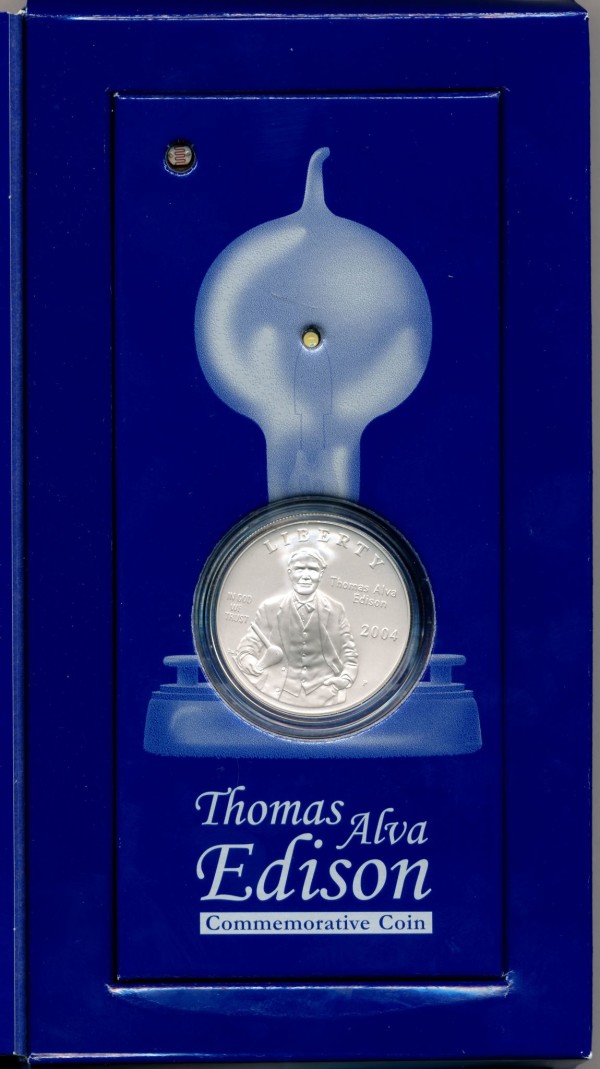
For the Edison program, the featured set was the "Edison Collector's Set." It included an uncirculated version of the Edison silver dollar along with a miniature light bulb that illuminated when the front cover of the set's coin box was opened. In a departure from previous sets produced by the Mint, the Edison Set did not contain additional collectible items such as stamps, currency notes or Bureau of Engraving and Printing (BEP) vignettes. I would suggest, however, that the inclusion of a powered circuit board to control the set's light bulb likely created the Mint's most innovative and novel set of the modern commemorative era.
The Mint opened sales for the Edison silver dollars on February 11, 2004, offering individual proof and uncirculated versions of the coin in standard Mint packaging. During the pre-issue discount period, the proof coin was priced at $33 ($37 later) and the uncirculated version was offered at $31 ($33 later). A total of 500,000 coins were authorized across all options; overall sales totaled 303,205 coins (~60% of the limit) at the program's close on December 29, 2004.
The obverse of the coin features a portrait of Edison in his laboratory in Menlo Park, NJ; he is shown holding an early version of his light bulb. US Mint sculptor-engraver
Donna Weaver is responsible for the design. The reverse, designed by then sculptor-engraver
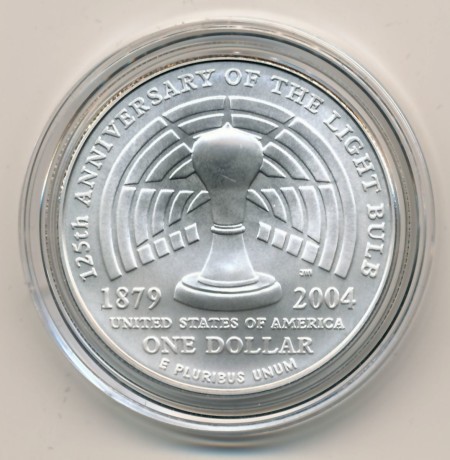
John Mercanti, depicts a circa 1879 Edison light bulb with rays of light emanating from it. The reverse also includes the anniversary dates "1879 - 2004."
Note: On May 19, 2006, Mercanti was promoted to Chief Engraver of the US Mint.The Collector's Set was placed on sale on September 16, 2004 with an issue price of $49. The late-in-the-year release did not significantly hinder sales of the set, however, as 24,370 of the 25,000 available were purchased.
In addition to helping boost overall sales of the coin, the Collector's Set provided a way for the Mint to increase its internal profit for the program. How? The Mint collected $10 in surcharges on each Edison silver dollar sold, whether it was packaged individually or in the set; the surcharge
did not increase for the coins included in the higher-priced Collector's Set. So, as long as the cost of the set's special packaging cost less than $16 (the difference between the selling prices of the Collector's Set and the uncirculated coin in standard packaging), the Mint stood to make additional profit. Incidentally, the same is true for all of the Mint's special edition packaging options.
The overall packaging for the Collector's Set is fairly basic - a glossy, custom-printed cardboard coin box housed in a simple slip case. But the package's simple appearance belies the innovation within.
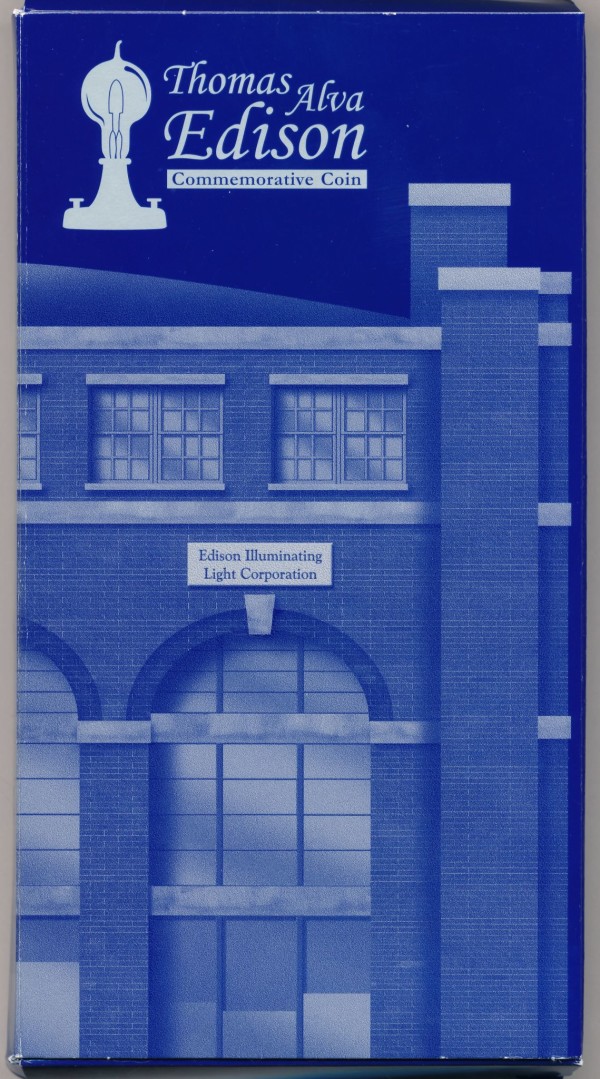
The outer cover of the coin box features an illustration of the west-facing side of Edison's laboratory building in West Orange, NJ; an "Edison Illuminating Light Corporation" sign is seen on the facade. The graphic choices made for the box cover are "interesting" (to say the least) for at least a couple of reasons: 1) Edison developed his light bulb at his Menlo Park, NJ complex in the 1878-80 period not the depicted West Orange facility which was not built until roughly a decade later; 2) the correct name of the company referred to on the sign is "The Edison Illuminating Company of New York" and it was involved with constructing generating stations to produce electrical power rather than making light bulbs.
I'm not sure if the use of the depicted elements was the result of incomplete research by the artist responsible or a decision driven by the fact that the buildings of Edison's Menlo Park complex were less impressive. In either case, I would offer that images more closely associated with Edison's original lab - and the production of Edison's light bulb - would have been far more apropos.
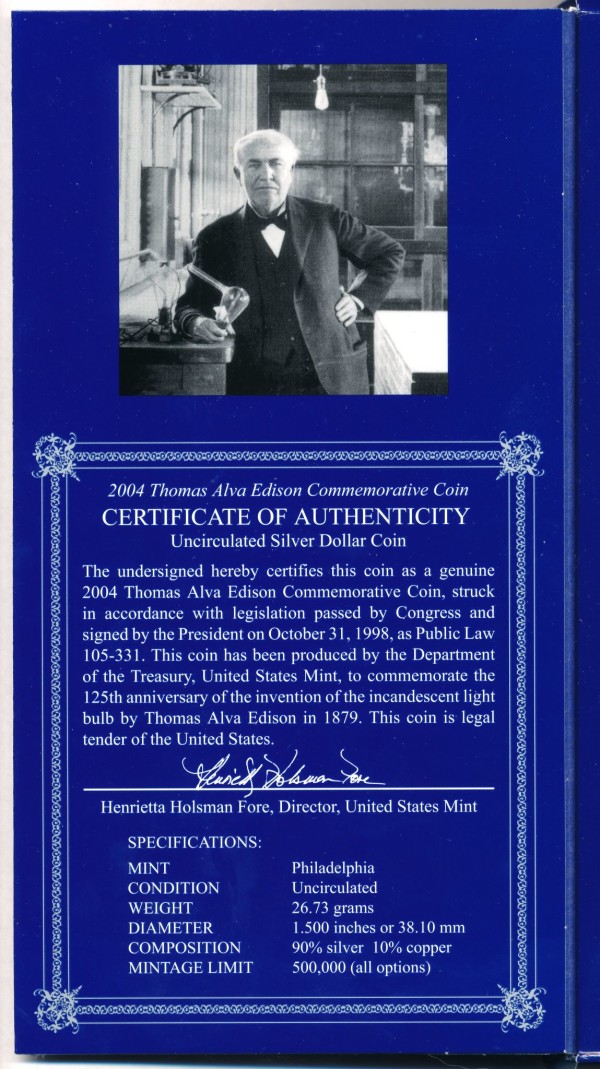
The inside front cover of the package features a picture of Edison at his Menlo Park lab along with the coin's COA. A quick comparison with the coin reveals that the photograph served as the primary reference for
Donna Weaver's obverse design.
An Edison silver dollar is secured in an interior tray that features a background graphic of an early Edison bulb. When fitted with three fresh batteries, opening the box's cover activates the small light bulb at the center of the illustration.
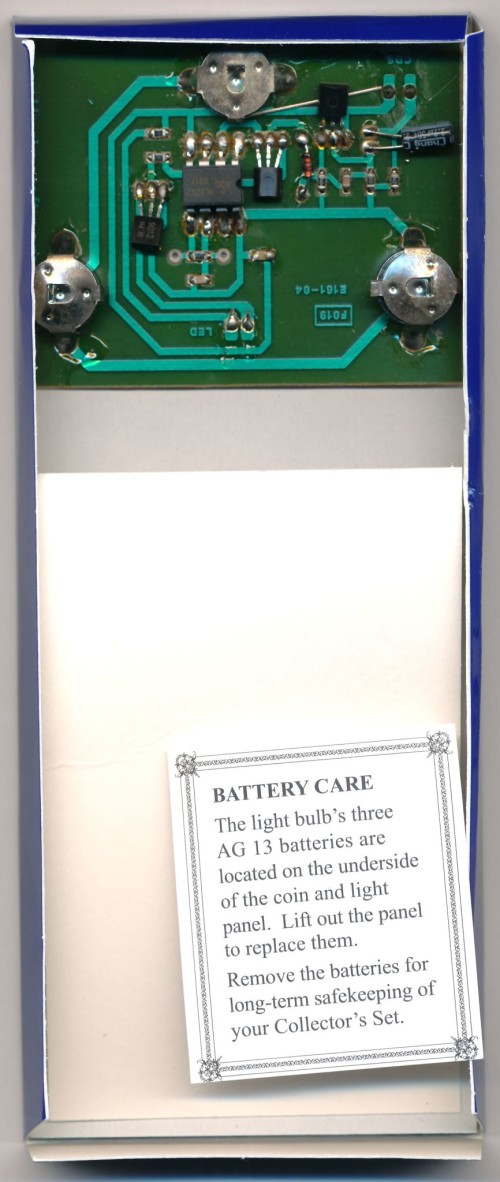
To the underside of the coin tray is secured the printed circuit board that controls the bulb's illumination. It was manufactured by Hankscraft, an electronics design and manufacturing company based in Reedsburg, WI. (The company remains active to this day.) Though simple in design, the powered PC board was quite an innovation for a coin package at the time.
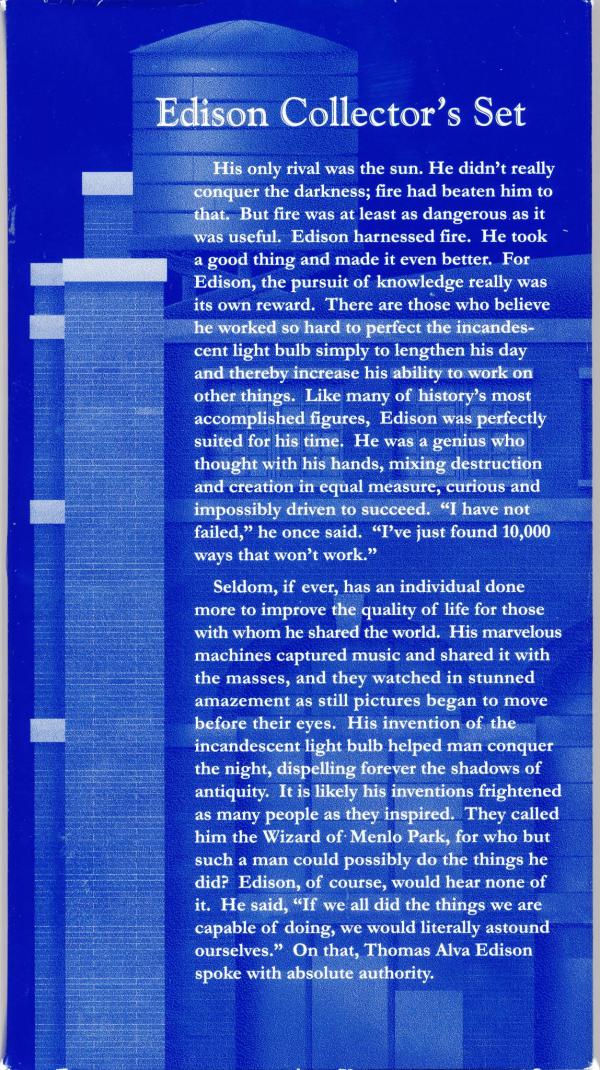
The back cover of the box features a couple of paragraphs about Edison that romanticizes his life, work and inventive genius. IMO, it's too bad that the space was not used to provide a factual listing/summary of some of Edison's many inventions and 1,093 patents. Such an approach would have gone much further in giving the reader a sense of what Edison accomplished and how his work has impacted many aspects of modern life.
So far, the Edison's Collector Set incorporation of technology has proven to be a "one time only" packaging approach for the US Mint, but who knows what the future might bring!
The sets can often be found for their issue price ($49) or less. It's very unlikely that an original set will still have a working light bulb, but a simple replacement of the PC board's batteries should get the set up and running!
Enjoy!
* It is acknowledged that Edison didn't work in a vacuum (no pun intended) while developing his light bulb and that his, and his team's, work built on that of other scientists/engineers/inventors who came before him. That said, Edison did create the first commercially viable incandescent light bulb design and, along with his other work in the field, is undeniably a key figure in the growth and development of electrical lighting and one worthy of commemoration on a US coin.Thomas Alva Edison Silver Dollar - Obverse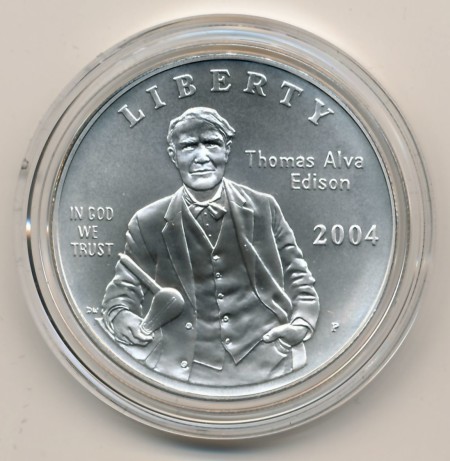 Thomas Alva Edison Silver Dollar - Reverse
 Outer Front Cover of Coin Box
 Inside Front Cover of Coin Box
 Interior Coin Tray
 Underside of Coin Tray Reavealing Printed Circuit Board
 Back Outer Cover of Coin Box
 Read More: Commems Collection







 Posted 02/20/2016 01:57 am


 --->
---> 


 jskala


