| Author |
 Replies: 213 / Views: 19,984 Replies: 213 / Views: 19,984 |
|
|
|
Pillar of the Community
 New Zealand
1679 Posts |
632 REV M1--OBV63
Cheers Don
Vickies cents and GB Farthings nut.
"Old" is a figure of speech and nothing more
|
|
Pillar of the Community
New Zealand
1679 Posts |
Quote:
Would anyone want to point out the diagnostics Doug used to attribute this one The D in DEI and the G in GRATIA also leaf 9 stem Cheers Don
Vickies cents and GB Farthings nut.
"Old" is a figure of speech and nothing more
Edited by fourmack
04/25/2016 5:05 pm
|
|
Pillar of the Community
United States
840 Posts |
Fourmack
Correct on all accounts.
doug
|
|
Valued Member
United States
302 Posts |
Note that reverses L1 and M1 are both single-die groups.
How many of you have a 63+M1? The M1 die is one that I discovered only in the last few years. No. 20 was the last coin in this thread. My preference is for shorter, rather than longer threads. Coin No. 21, then, will start a new thread and will come later tonight or in the morning. It will come in two installments. First will come the obverse, then the reverse later.
Edited by JHax
04/26/2016 12:39 am
|
|
Pillar of the Community
United States
840 Posts |
I currently have but 1 reverse M.
doug
|
|
Valued Member
United States
459 Posts |
|
|
Pillar of the Community
New Zealand
1679 Posts |
ignore wrong
Cheers Don
Vickies cents and GB Farthings nut.
"Old" is a figure of speech and nothing more
Edited by fourmack
04/26/2016 03:07 am
|
|
Pillar of the Community
United States
1101 Posts |
I have 2 of the 632's. The weak vine at loop 10 is one of the things I look for. It's more obvious than the slip on leaf 10, especially when the coins are worn, like my examples. Jim's coin is really stunning!
|
|
Valued Member
United States
302 Posts |
No. 21. This is all you get to work with for now. There will be several questions along the way. Answering a question correctly does not disqualify you from answering the next question if you know it. Question 1: What is the obverse die? 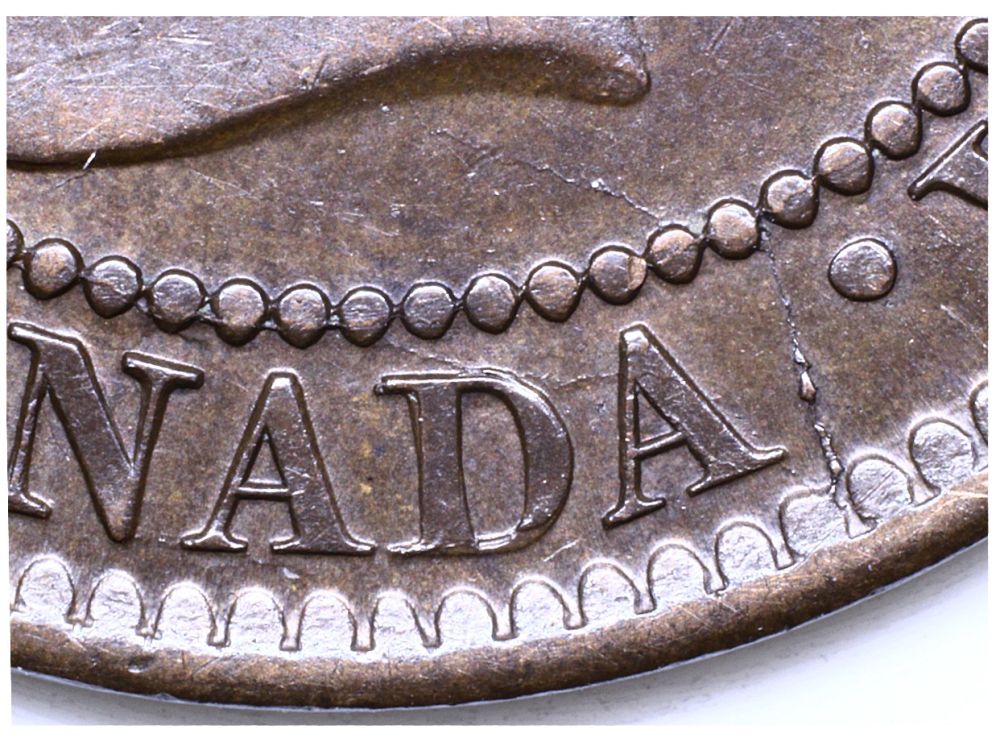 |
|
Valued Member
United States
459 Posts |
|
|
Pillar of the Community
Canada
1275 Posts |
I agree with obverse 65a and as a guess because of the state of the die cracks I'll say paired with reverse P4 with the possibility of it being P4a.
Cheers, Bill
|
|
Valued Member
United States
302 Posts |
Correct, Ed and Bill (who anticipated one of my next questions). More questions:
Question 2: Are there any other possibilities for the reverse?
Question 3: What are the two lines between the beads above the 2nd A in CANADA?
Question 4: What are the two blobs in the radial die crack between the last A in CANADA and the stop?
Edited by JHax
04/26/2016 12:50 pm
|
|
Pillar of the Community
United States
1101 Posts |
I'm going to take a wild guess at question #3. It looks like a series of 4 beads were repunched in the die. Are those lines from between the beads on the bead punch, where they were punched lower and heavier. My first impression was that it was a die crack, but it seems too heavy and consistent for that. You ask some tough questions.
After looking some more, I'm thinking it probably is a die crack, because I don't see those lines in the catalog above CANADA for 65a. I should have looked first and I could have made an educated guess instead of a wild guess.
Edited by Phil310
04/26/2016 3:34 pm
|
|
Pillar of the Community
New Zealand
1679 Posts |
This is where I am lost, so its learning time.
Is the field above the N collapsing, which causes the die cracks in that area?
Cheers Don
Vickies cents and GB Farthings nut.
"Old" is a figure of speech and nothing more
|
|
Pillar of the Community
Canada
3234 Posts |
#3..I would say that a small d/c comes up from the denticle and angles ~30 degrees off to the left of the d/c from "the beads which heads straight up into the beads.."
This small d/c follows up the right interior arm of the "A" and branches off to the left across the top of the "D" and then continues up into the lower part of 4 beads along towards the left..and then a new d/c continues further to the left.
The upper line which connects more to the middle of the beads could possibly be tooling marks..or a connecting line which we often see joining the beads on many cents.
The obverse is breaking up ..and will shortly fail...
.
.
Edited by DEVLEC
04/26/2016 4:51 pm
|
| |
Replies: 213 / Views: 19,984 |








 First Page
 Previous Page


 Posted 04/25/2016 5:04 pm


