With recent discussions here about the possibility of a US commemorative program in 2019 to mark the 50th anniversary of the first manned landing on the moon in July 1969, I thought I would share a few thoughts about the first proposed US commemorative coin with a space flight theme.
The first manned flight of the US space program took place on May 5, 1961. Alan Shepard piloted his
Freedom 7 Mercury capsule on a sub-orbital flight that last just 15 minutes and 22 seconds. About two months later, on July 21, 1961, Virgil "Gus" Grissom piloted
Liberty Bell 7 on the US' second sub-orbital space flight; Grissom's flight lasted 15 minutes and 37 seconds. Both astronauts were widely celebrated at the time for their accomplishments.
The US program took a big step forward on February 20, 1962 when John Glenn, aboard
Friendship 7, became the first American astronaut to circle the earth. Glenn completed three orbits over the course of a flight that lasted 4 hours 55 minutes and 23 seconds. Per NASA records, his flight traveled more than 75,000 miles. As with Shepard and Grissom before him, Glenn was lauded for his accomplishment by the US public.
Less than a month after his flight, Representative Victor Eugene Wickersham (D-OK) introduced a bill calling for "the coinage of 50-cent pieces in commemoration of the first United States manned vehicle orbital flight around the earth."
The bill sought 500,000 silver 50-cent pieces in honor of Glenn's achievement. The proposal did not specify a design for the coin (unlike most commemorative legislation today), and simply stated that the design for the coin was to be "fixed by the Director of the Mint, with the approval of the Secretary of the Treasury and after consultation with the Commission on Fine Arts." The bill also specified that the coins were to feature a "1962" date even if minting of the coin spilled into a subsequent year.
It appears Wickersham intended the coin to be a circulating commemorative as no identification of a sponsor was included in the bill and no provisions for recovery of the cost of making the dies was listed. The public's enthusiasm for America's space program at the time would likely have led to the circulating commemorative being avidly sought and collected (hoarded?).
Wickersham's bill was referred to the Committee on Banking and Currency where it languished, never being reported out for consideration by the full House. A companion bill was introduced in the Senate, but it suffered a similar fate. As a result, there would be no circulating commemorative half dollar honoring Glenn.
As Glenn was alive at the time the coin was proposed (and still is as I write this on May 11, 2016), it would have been interesting to see if any potential designs for the coin would have featured his portrait. Though not illegal*, portraits of living persons on
US coinage had historically been frowned upon, with appearances limited to four commemorative coins that were not intended for general circulation. As this coin was to be a circulating commemorative, a debate over Glenn's image on the coin would likely have ensued and most likely would have been defeated.
* Portraits of living persons on US bonds, securities, notes and postal currency had been made illegal in 1866. Some have interpreted this law as also applying to coinage, but my reading of the legislation suggests that coins were not included. At the time, the US Congress and the US Treasury Department were both more supportive of commemorative medal proposals vs. those for special coins. One can only wonder about "what might have been" if a medal had been proposed.
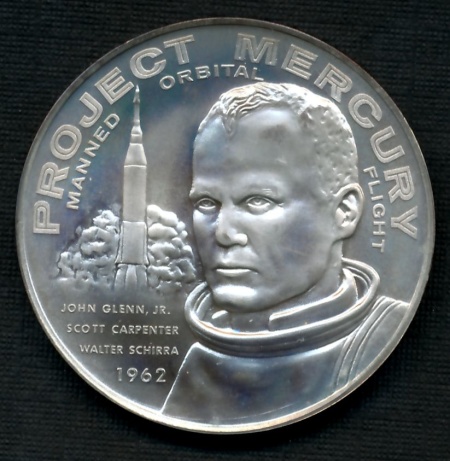
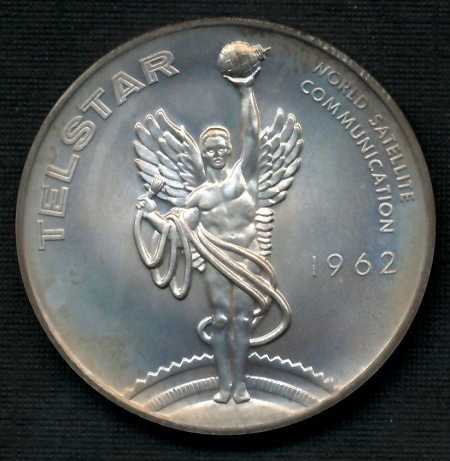
Collectors of the day with an interest in adding a commemorative piece for Glenn's flight were nicely served by a well-designed medal prepared by Bob McNamara and struck by the Heraldic Art Company (which was owned and operated by McNamara). Heraldic issued a silver medal in 1962 to honor Glenn, Project Mercury and the launch of NASA's first Telstar communications satellite in July. The medal is 32mm in diameter, just slightly larger than the 30.6mm diameter of a US half dollar; it was issued as part of Heraldic's special-event "Occasional Series" of medals.
Here are images of the toned example in my collection:
 Note: John Glenn, who would also ride into space aboard the Space Shuttle
 Discovery
in 1998 at age 77, was honored in 2011 along with the crew of Apollo XI (Neil Armstrong, Edwin "Buzz" Aldrin and Michael Collins) with a Congressional Gold Medal. The medal is known as the "New Frontier" medal; bronze duplicates are currently available from the US Mint in 3-inch and 1.5-inch sizes.See it here:
http://catalog.usmint.gov/new-front...al#statmp=noRead More: Commems Collection








 Posted 05/12/2016 09:41 am


