| Author |
 Replies: 59 / Views: 9,924 Replies: 59 / Views: 9,924 |
|
|
|
Bedrock of the Community
United States
17884 Posts |
In the US the term "Monopoly money" has long been used as a general term for notes from many foreign countries for the use of different colors in the notes (Each denomination of currency in a Monopoly game is a different color) rather than the same green and black we used for almost all of our currency from 1862 to the mid 2000's. Now that we are starting to use some color in ours the "monopoly money" term will probably die out.
|
|
Pillar of the Community
Poland
3201 Posts |
I've encountered the Russian 2 kopeks dated 1810 being called "pszczolka" (bee) on Polish auctions twice.
Google gives me two results and thus I don't know how widespread this name is.
|
|
Valued Member
United States
440 Posts |
Slug - This is actually a gold ingot. I owned this slug during the peak of my Territorial Gold interest. This is an 1851 $50 Lettered Edge (LE) Humbert 880. No longer in my collection.  
|
|
Pillar of the Community
Poland
3201 Posts |
Quote:
I've encountered the Russian 2 kopeks dated 1810 being called "pszczolka" (bee) on Polish auctions twice. 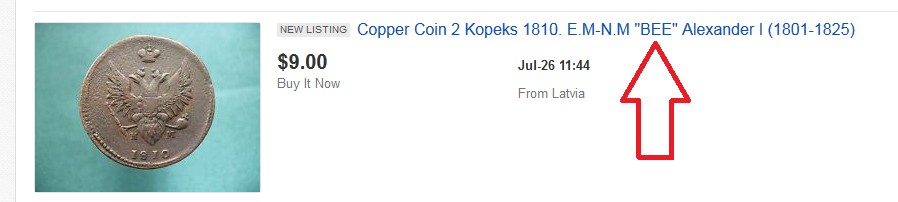 I guess this confirms that such nickname does exist and isn't local either. |
|
Pillar of the Community
United States
6017 Posts |
Just a few from my personal collection... Series 1899 Two Dollar Silver Certificate ("Mini Porthole"): 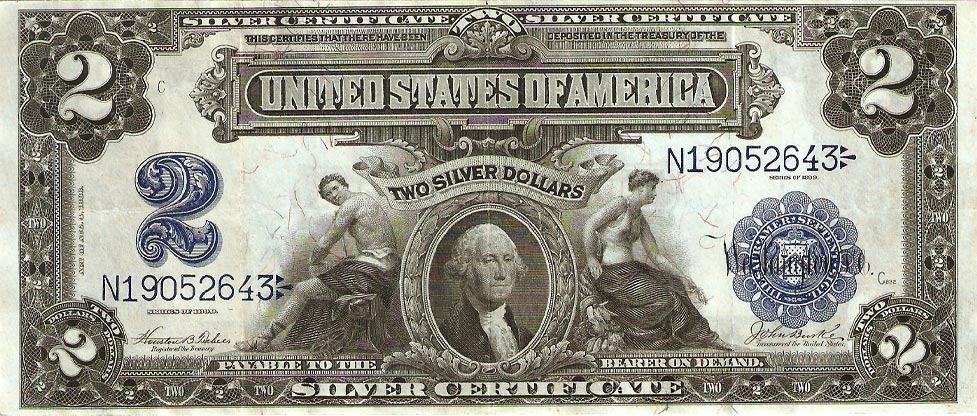  Series 1899 Five Dollar Silver Certificate ("Indian Chief") Series 1899 Five Dollar Silver Certificate ("Indian Chief"): 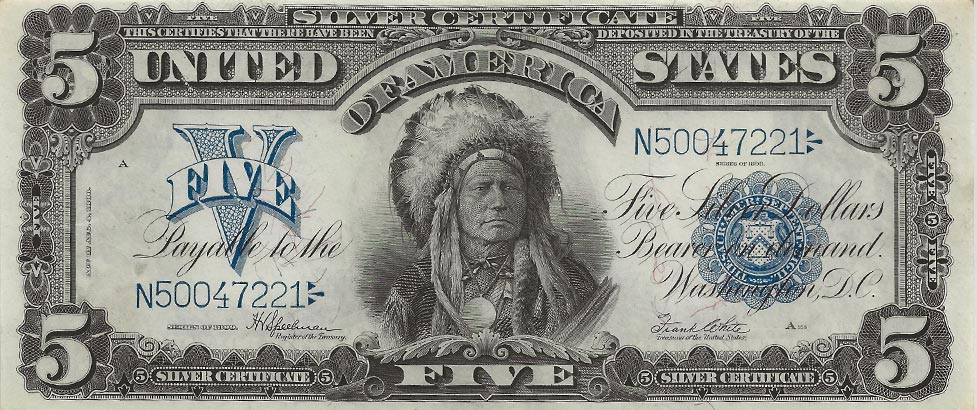  Series 1907 Five Dollar United States Note ("Wood Chopper") Series 1907 Five Dollar United States Note ("Wood Chopper"):   Series 1923 Five Dollar Silver Certificate ("Porthole") Series 1923 Five Dollar Silver Certificate ("Porthole"): 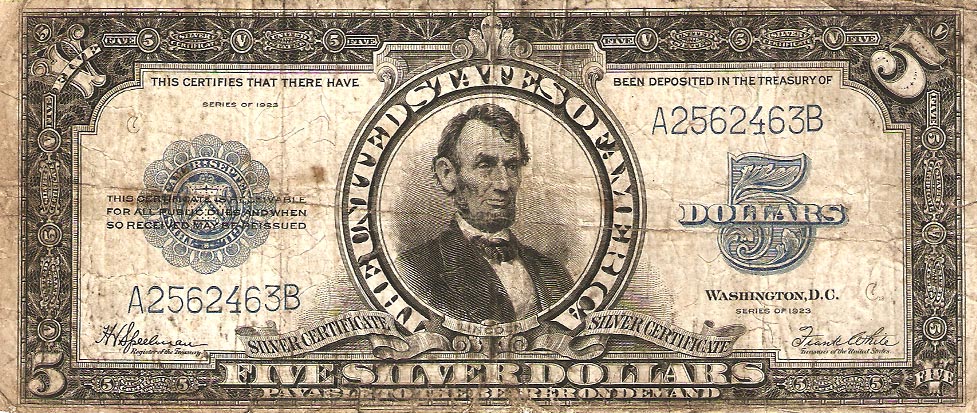  Series 1901 Ten Dollar United States Note ("Bison") Series 1901 Ten Dollar United States Note ("Bison"): 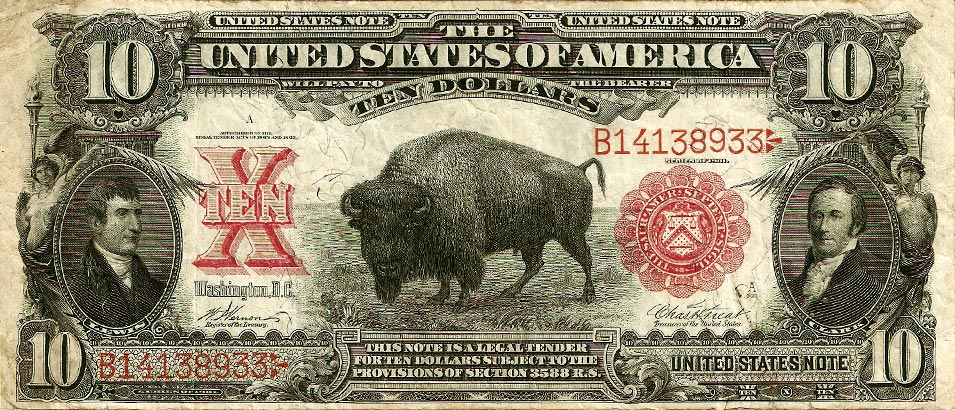  Someday I hope to also own a "Technicolor", a "Tombstone" and a "Pokerchip" note. |
|
Pillar of the Community
Poland
3201 Posts |
Here's another one. Russia 2 kopeks 1811, the successor to the "bee" (posted earlier) is apparently called "teterev" = "black grouse". 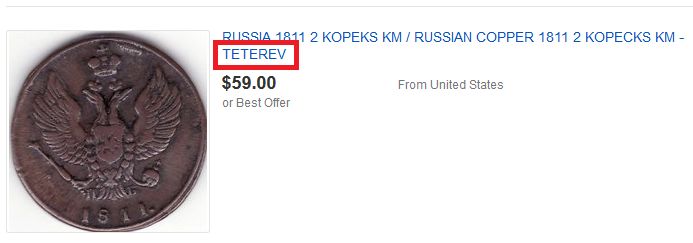 |
|
Pillar of the Community
Poland
3201 Posts |
A whole book on the subject? 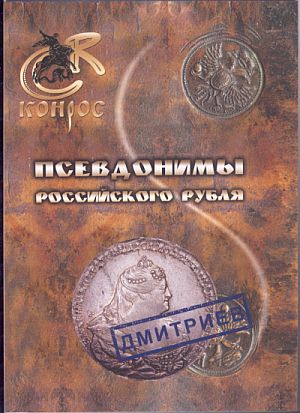 "Pseudonyms of the Russian Rouble". Konros, St. Petersburg, 2013. |
|
Pillar of the Community
Poland
3201 Posts |
Yes, I know, it's been a while... but there still are things to add: "Mlynarki" - any banknotes of the Generalgouvernement (1940 and 1941 series), from the name of the bank director (actually has a Wikipedia entry in Polish) And from a Wikipedia entry in German on the DM: "Groschen" - 10 pfennig* "Sechser" - 5 pfennig* "Indianergeld" - 1 and 2 pfennig "Silberadler" (silver eagle) - 5 DM (1951-74 type) "Heiermann" - any 5 DM (mainly northern Germany, uncertain origin) "Zwickel" - any 2 DM, nowadays used for 2 Euro coins (Bavaria) * I also found this discussion, all in German, regarding what's a "Zehner" - whether it refers to a 10-cent coin or a 10-euro note. Among the replies, one person mentions that "Sechser" and "Groschen" are still used for 5 and 10 cent coins in the Berlin area. |
|
Pillar of the Community
 Norway
1358 Posts |
I recently encountered a whole coin set with a nickname. The bronze 1 and 2 Øre issued in Denmark in the 1960s were never released for circulation, as inflation made the metal more valuable than the face value. The total of the individual coins (4 x 1 Øre, 6 x 2 Øre) were named Hækkerupsæt (Hækkerup Set), after the Danish Minister of Finance who ordered the coins in the first place. I do believe that about 100.000 of these were sold, and much less are complete and uncirculated nowadays.
|
|
Pillar of the Community
United States
8137 Posts |
The Panama 2 1/2 centimos Is commonly known as a "Panama Pill" due to its small size.
|
|
Bedrock of the Community
United Kingdom
18942 Posts |
I listed some nicknames for UK coins on the first page of this thread.
I've been trying to think of other ones.
The final Bank of England pound note to be issued for circulation, bearing the portrait of Isaac Newton and issued from 1978 to 1985, was nicknamed the 'luncheon voucher' as it resembled these vouchers (which were given by some firms to their staff and could be redeemed at certain restaurants).
In Spain, the 5-centimo and 10-centimo coins issued in bronze in the 19th century and later in aluminium (last minted in the 1950s) were called the 'perra chica' and 'perra gorda'. A 5-peseta coin was commonly called 'un duro', and before the Euro was introduced, it was quite usual for market traders to quote prices in 'duros'. The price would not be written up, but if you asked the stallholder, he might say "Diez duros" or "Veinte duros" rather than 50 or 100 pesetas! Also in Spain, the 1,000-peseta banknote, which was coloured green, was commonly called 'un verde' (a green one).
Strangely, when I was on holiday in Costa Rica in 1985, I discovered that the 25-centimo coin there was commonly nicknamed a 'peseta'! Before high inflation and wildly variable exchange rates in the 1970s, it was probably worth about one peseta, and many Costa Ricans have family in Spain so there has always been a lot of contact between this former colony and its erstwhile ruler.
I think the South African silver threepence coin and its short-lived two-and-a-half cent replacement were known as 'tickeys'. Perhaps a SA forum member could confirm this for me? I was in a museum shop in Plettenberg Bay in 2007 and there was a bowl of circulated threepences with a sign saying 'Lucky Tickeys'.
Edited by NumisRob
05/11/2017 1:41 pm
|
|
Bedrock of the Community
United States
10284 Posts |
I don't see "Horse Blanket" Maybe I missed it? It refers to large sized US paper currency. When compared to the newer small sized, they got the nickname probably around 1928 when the changeover took place. I could be wrong about that, but I could just hear somebody saying they would rather handle the new size rather than those big old horse blankets. So here's a handy "Horse Blanket"  Edited by TNG
05/11/2017 1:59 pm
|
|
Pillar of the Community
Poland
3201 Posts |
Apparently this 100 DM note is called 'Roter Hunderter': 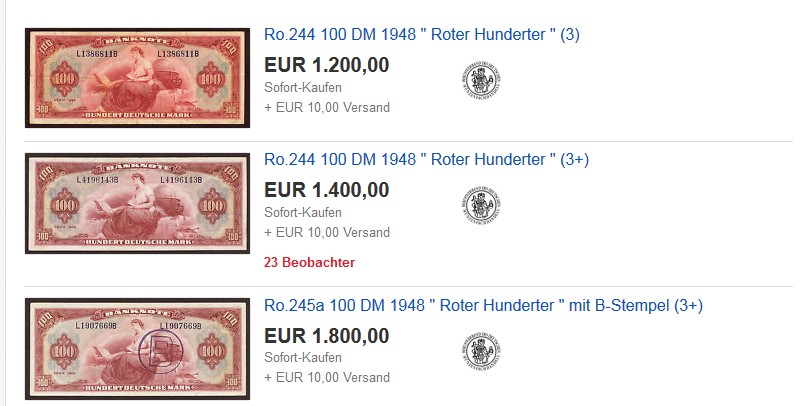 It also is awfully expensive  |
|
Bedrock of the Community
United States
10284 Posts |
I read through here twice, if I missed it mentioned before sorry but they called these " fishscales " Canada 5 cents.  |
| |
Replies: 59 / Views: 9,924 |






 First Page
 Previous Page


 Posted 07/24/2016 06:21 am


