| Author |
 Replies: 139 / Views: 52,493 Replies: 139 / Views: 52,493 |
|
Pillar of the Community
India
1995 Posts |
Bull and horseman coins and their variantsBull and horseman coins of Northwest India constitute a fascinating part of Indian numismatics. These coins are found in profusion and are generally labeled as "bull and horseman coins". But a closer look into them will bring lots of interesting revelations. These coins were prevalent in a very vast area for a very long period. More than thirty rulers have issued coins with bull and horseman or either one from them in the same pattern. The period of issue of such coins can be seen issued from tenth century to the seventeenth. This variety had been issued over Ohind, Sind, Delhi, Ghazni and Kangra regions now falling in three countries, India, Pakistan and Afghanistan. Some rulers issued them with both bull and horseman. Some issued retaining bull and replacing horseman with legends and yet some others retained horseman and replaced bull with legends. Many of them issued different varieties among these three. It is a striking feature of these coins that both bull and horseman are beautifully stylized. Legends can be seen surrounding them in many of them. Bull is always recumbent facing left. Horseman is always holding a spear/flag and horse faces to right invariably. In Kangra issues, the horseman is very crude but the basic pattern is retained. Altogether, this variety of coins is intimidating to numismatics enthusiasts. Here I wish to post some different Bull/horseman coins and variants, of a few rulers belonging to Ohind, Sind, Ghazni, Delhi and Kangra. Alexander Cunningham in his work "Coins of Medieval India" and A.S.Smith in "The Coins in Indian Museum at Calcutta" have given somewhat clear description of Kangra coins. So their views are generally followed in Kangra coin details and datings. I am unable to conclusively date a few of them though. This is not an exhaustive list of such issues or rulers either. There are several more like Prithviraj, Sallakshanapala, Spalapatideva etc who have similar issues. Typographically, they can be arranged into three varieties. 1. Bull and Horseman coins 2. Horseman replaced by legend 3. Bull replaced by legend Bull and horseman coins can be subdivided into those with Bull side obverse and those with Horseman side obverse. Many rulers have issued coins falling into different varieties. Jalal ud din Mingburnu, Qubacha, Sultanan Razia are a few among them. Chronologically, they spread over more than eight centuries form middle of eighth century to first quarter of seventeenth century. Spalapati coins and Samanta deva coins are considered to have originated between AD. 750 and 900. These coins show wide variation in the stylization of both the sides but there is consistency between coins of the same region to a very good extent save for a few crude ones from Delhi. Kangra coins look monotonous on the horseman reverse, but the obverse gives the name of the ruler very clearly. Average weight of these coins also remains around 2.8-3.8gms. But why there are many rulers who retained the legend "Samanta deva" is obscure. And some varieties have been wrongly attributed, like Chahata deva to Muhammad bin Sam. Bull and Horseman coins-with Bull side obverse Mahipala-AD.1103-1128He was a Tomara ruler of Delhi. The City of Delhi was founded by Tomars in the first half of eighth century. They were subordinates to Kanauj in the beginning and later became independent. Chauhans took over the land from them in twelfth century. In 1043, Mahipal captured Thaneswar, Nagarkot and Hansi. He is said to have contributed a lot to development of Delhi. There is an area called "Mahipalpur" near the Indira Gandhi International airport in Delhi. 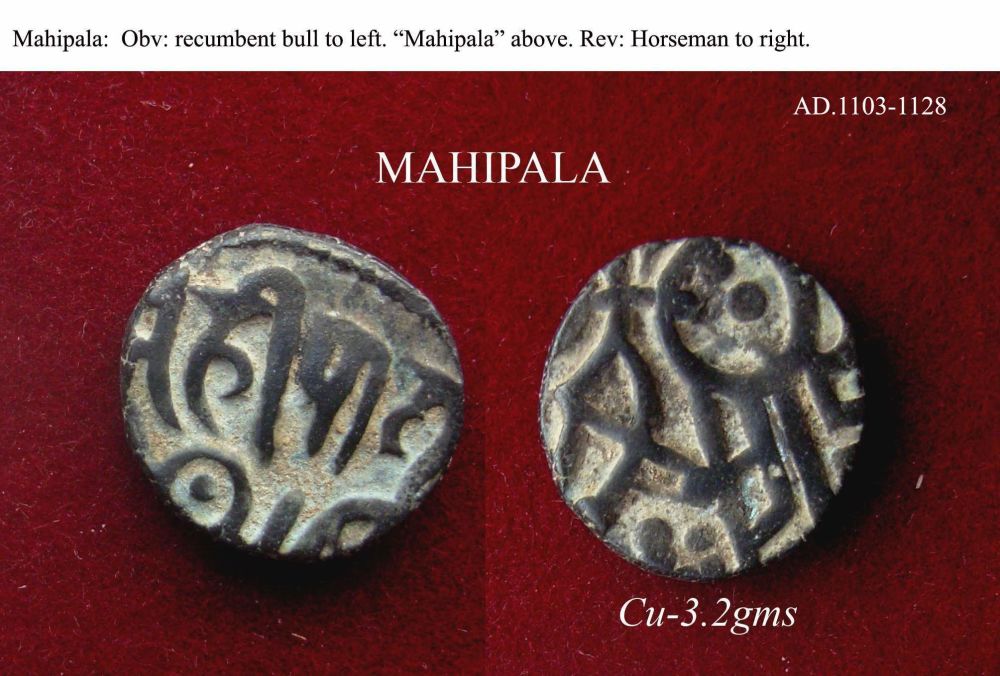 The name of the ruler is written "Mahipala" in Sarada script.Please find illustration.  *** Moved by Staff moved to a more appropriate forum. *** *** Moved by Staff moved to a more appropriate forum. ***
|
|
|
|
Pillar of the Community
 India
1995 Posts |
Muhammad bin Sam-1193-1206Mu'izz ad-Din Muhammad was born in 1149 in the Ghor region of what is now present day Afghanistan. He reigned over a territory spanning over parts of modern-day Afghanistan, Bangladesh, Iran, India, Pakistan, Tajikistan, and Turkmenistan. He ruled along with his brother Ghiyath ad-Din Muhammad from 1173 to 1202, and as the supreme ruler of the Ghurid Empire from 1202 to 1206. In 1186, Mu'izz, along with Ghiyath, ended the Ghaznavid dynasty after having captured Lahore and executed the Ghaznavid ruler Khusrau-Malik. In 1206, Mu'izz left all the affairs in India in hands of his slave Qutb ud-Din Aibak.On his return, he was assassinated on 15th March 1206.  Ruler's name-Muhammad Sama in Nagari script 
|
|
Pillar of the Community
India
1995 Posts |
Iltutmash-1210-35Qutb-ud-din Aibak died in 1206 in a Polo accident in his capital Lahore. Aram Shah acceded to the throne in Lahore in 1211 assisted by some nobles. When Iltutmish claimed the throne in Delhi, Aram Shah marched towards Delhi but was slain in battle at Bagh-i-Jud. In 1215-1216, Yildiz moved towards Punjab and captured Lahore from Qubacha and laid claim to the throne of Delhi. ltutmish defeated Yildiz at Tarain. By 1220, Jalal ud din Mingburnu fled to the Punjab and captured Lahore and much of the Punjab. Iltutmash marched towards Lahore. Mingburnu retreated from Lahore and moved towards Sind and inflicted heavy defeat on Qabacha. He plundered Sindh and northern Gujarat and returned to Persia in 1224. Iltutmash captured Sind and Multan defeating Qubacha who committed suicide drowning in Indus river after his defeat. He ruled as a persistent invader of surrounding kingdoms until his death in 1235.  Ruler's name-Suritana Sri Samasadina Ruler's name-Suritana Sri Samasadina
|
|
Pillar of the Community
India
1995 Posts |
Nasir ud din Qubacha-1206-28Qubacha was a slave under Muhammad bin Sam just as Iltutmash and Taj ud din Yildiz were. After the death of his master, he came to rule Sind. But when Iltutmash came to rule in Delhi, the picture took a different turn. Qubacha was in conflict with Yildiz and Iltutmash. In 1924, Jalal ud din Mingburnu inflicted a devastating defeat to Qubacha. Iltutmash used this opportunity to invade Sind in 1228. Qubacha tried to flee but failed. He either committed suicide or accidentally drowed in the Indus river.  R uler's name - "Sri Kubacha" above recumbent bull. Sree Hamira above horseman on the reverse. 
|
|
Moderator
 United States
34476 Posts |
@drnsreedhar, outlining the letters in the legends is very helpful for those of us who are firmly mono-lingual!
"If you climb a good tree, you get a push."
-----Ghanaian proverb
"The danger we all now face is distinguishing between what is authentic and what is performed."
-----King Adz
|
|
Pillar of the Community
India
1995 Posts |
Mingburnu-1220-24He was the last ruler of the Khwarezmian empire. His empire was a vast area now belonging to Iran, Uzbekistan, partly to Kazakhstan and partly to Turkmenistan. Jalal ud din fled to India with Chengiz Khan following him at his heels in AD.1220. He was denied refuge at Delhi by Iltutmash. He captured Lahore and some land around. When Iltutmash marched to Lahore in 1224, Mingburnu left and attacked Sind, defeating Nazir ud din Qubacha and then retreated to Persia. 
Name of ruler-Jalal ud d(eena) in Sarada script.
|
|
Pillar of the Community
India
1995 Posts |
@spence :) Thank you for the remark. I shall try to outline as many as I can.Please raise questions in case you need explanations.
|
|
Pillar of the Community
India
1995 Posts |
Rukn ud din firoz-1235-36At the time of death,Delhi Sultan Iltutmash had nominated his daughter Razia to the throne. But the nobles who resented it saboutaged it and took Rukn ud din, her brother to the throne. But he proved worthless and was he was eventually murdered in November 1236. 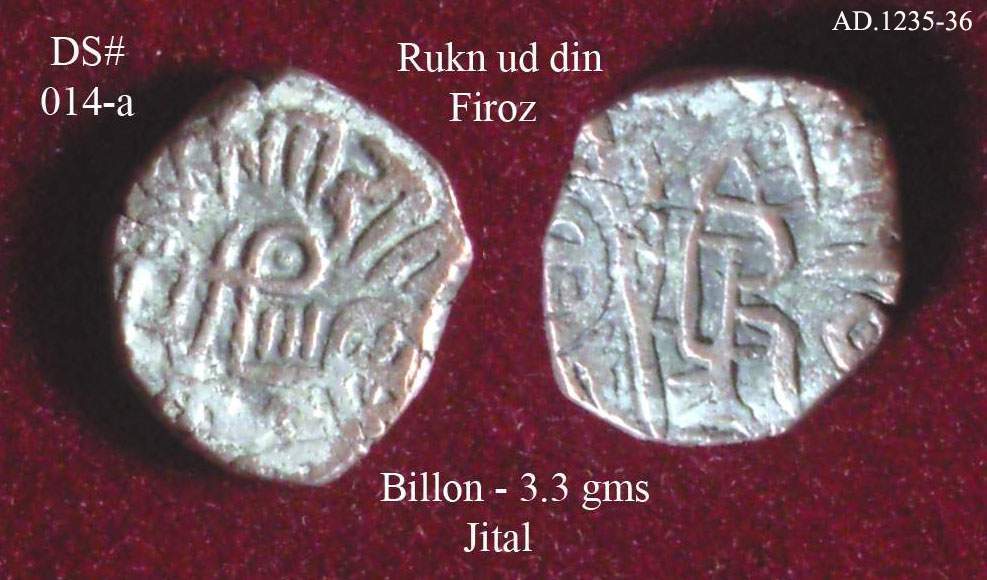 Name of ruler - "Ruknaadeena" above recumbent bull to left Name of ruler - "Ruknaadeena" above recumbent bull to left
Edited by drnsreedhar
08/22/2016 1:10 pm
|
|
Pillar of the Community
India
1995 Posts |
Saif ud din Hasan Qurlugh-1239-46He was ruler of Sind for about a decade. He was was reigning in Ghazna and moved to Sind in about 1239. Nothing much is known about him. He had issued bull-horseman and legend-horseman type coins. 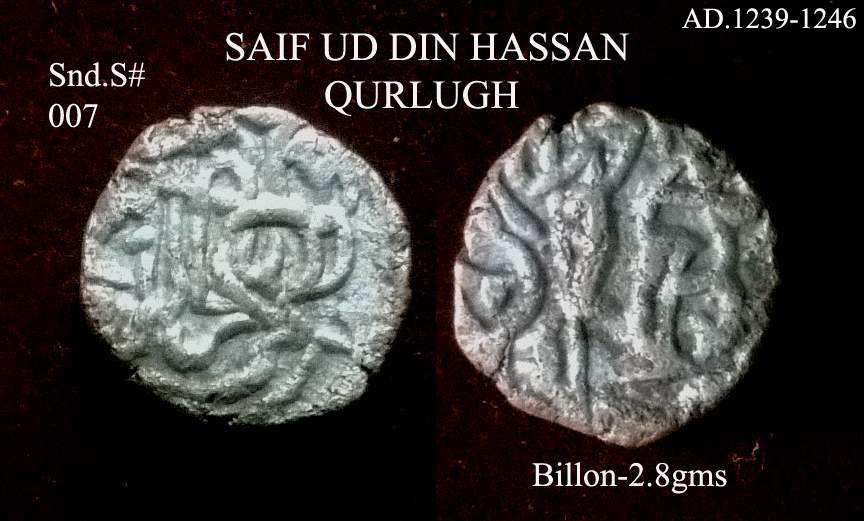 Ruler's name - "Kurlak" Ruler's name - "Kurlak"
|
|
Pillar of the Community
India
1995 Posts |
Muiz ud din Bahram-1240-42He was Delhi Sultan and brother to Sultana Razia(1236-1240). A plot was raised against Razia during her reign. She was captured and imprisoned by Altunia the Governor of Bhatinda. She and Altunia got married later and planned to return to Delhi. But Muiz ud din had plans to the throne of Delhi. He defeated Altunia and Razia and put them to death in 1240. But he became unpopular and was murdered by his own army in 1242.  Ruler's name - "Sri Mu aza deen" above recumbent bull to left. Ruler's name - "Sri Mu aza deen" above recumbent bull to left. 
|
|
Pillar of the Community
India
1995 Posts |
Ala ud din Masud (1242-1246)Ala ud din Masud was chosen to rule Delhi after Muiz ud din Bahram was killed in AD.1242. He was son of Rukn ud din Firoz (AD.1235-36) who was brother of Sultana Razia. He was lost to luxurious living that ended up in his replacement in AD.1246 with Nazir ud din Mahmud. 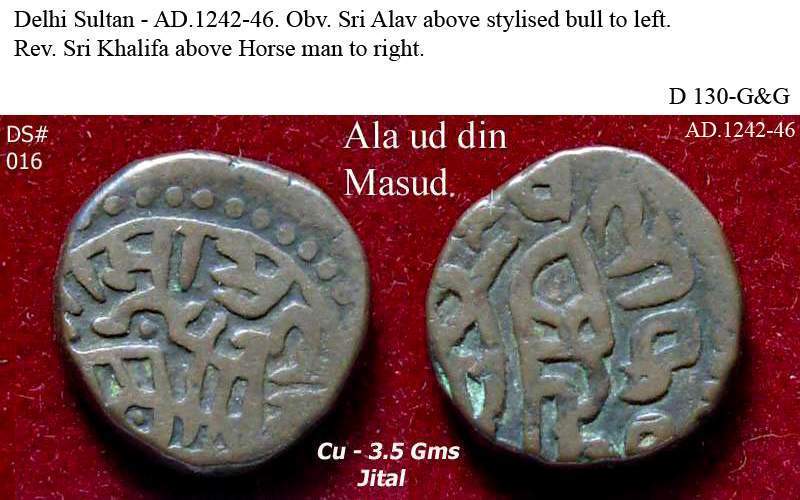 Ruler'a name - "Alav" above recumbent bull to left. Ruler'a name - "Alav" above recumbent bull to left.
|
|
Pillar of the Community
India
1995 Posts |
Samant devaCoins bearing the legend "Samant deva" are the biggest puzzle in Indian coins. Lots of coins bearing this legend on one side and the name of another ruler on the other are often come across. So this must have been a title used by them. But there are a few with "Samant deva" on the bull side with no legend that can be read on the other also. 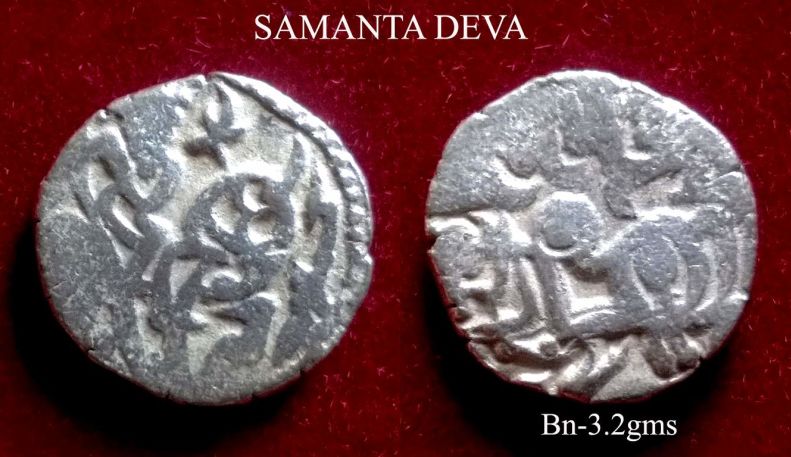 legend :"Samant deva" above recumbent bull to left. legend :"Samant deva" above recumbent bull to left.
|
|
Pillar of the Community
India
1995 Posts |
Bull and Horseman coins- with horseman side obverseMadanapala deva-1145-67He ruled Delhi between 1145 and 1167. (A.S Smith places him slightly before at about 1080-1115). His father Chandradeva is said to have acquired suzerainty over Kanauj.  
|
|
Pillar of the Community
United States
3499 Posts |
drnsreedhar- Wonderful post about some very interesting coins! Thank you very much.
|
|
Pillar of the Community
India
1995 Posts |
@Archraz:) Thank you very much.
|
|
Pillar of the Community
India
1995 Posts |
Someswara deva-1169-79He belongs to the Chauhan rulers of Delhi. A.S.Smith also places his period to approximately 1170-75. His son Prithviraj is famous in history for his gallantry. 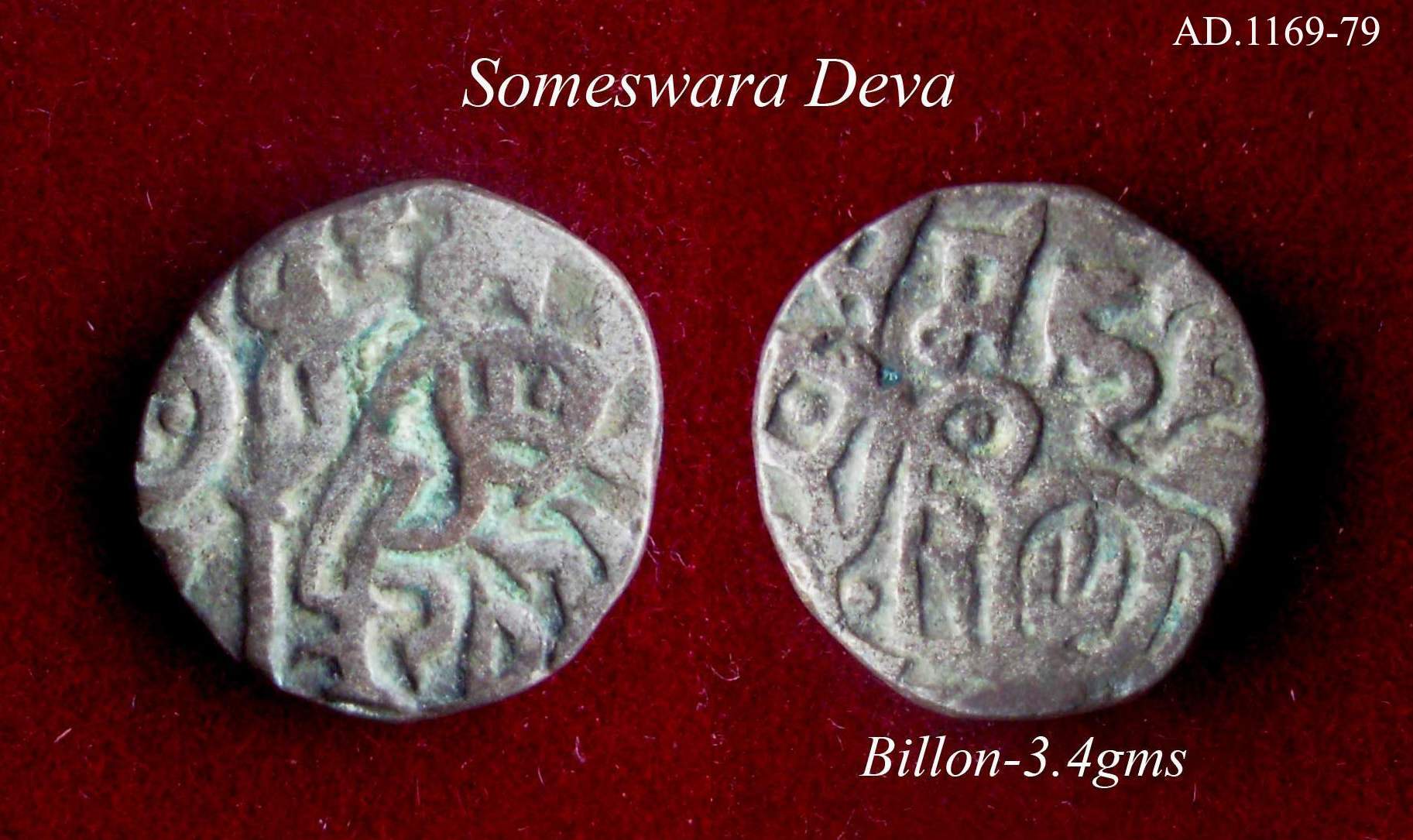 Ruler's name-"Some(swara)deva" above the horseman to right. Ruler's name-"Some(swara)deva" above the horseman to right."So" is written to the left of the horseman and the rest to its right. 
|
| |
Replies: 139 / Views: 52,493 |










 Posted 08/21/2016 11:50 am


