

Coin Community Family of Web Sites
Specializing in Modern Numismatics Shop for APMEX Bullion on eBay!300,000 items to help build your collection! Vancouvers #1 Coin and Paper Money Dealer Coin, Banknote and Medal Collectors's Online Mall Royal Canadian Mint products, Canadian, Polish, American, and world coins and banknotes. Shop CCF Members on eBay!


Username:
Password:
Save Password
Forgot your Password?


This page may contain links that result in small commissions to keep this free site up and running.

Welcome Guest! Registering and/or logging in will remove the anchor (bottom) ads. It's Free!

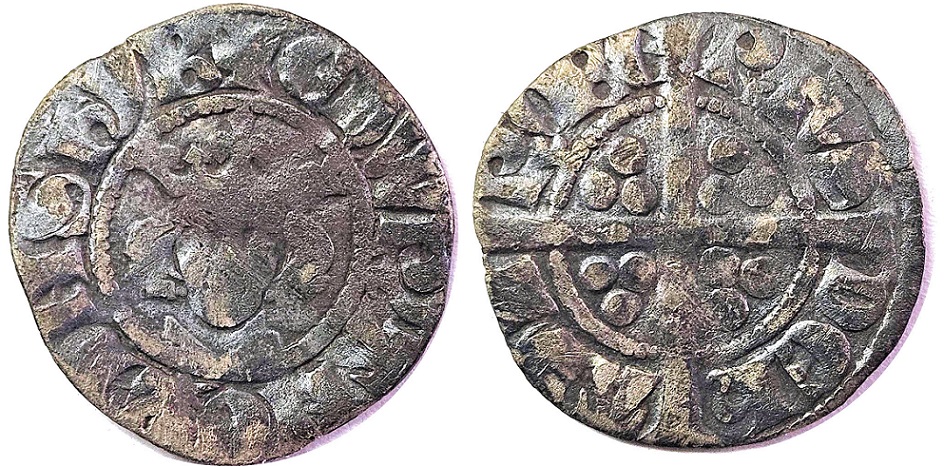
Edward I, Bury St Edmunds Penny, Robert De Hadeleie

To participate in the forum you must log in or register.
Author Previous TopicReplies: 4 / Views: 824Next Topic  
Pillar of the Community
Bacchus2's Avatar
United Kingdom
2868 Posts
 Posted 05/29/2025  1:24 pm Show Profile   Bookmark this topic Add Bacchus2 to your friends list Get a Link to this Message Number of Subscribers
Back in 1279 Edward I changed the style of the coinage to the long cross penny. There were multiple mints working in England at the time, though London and Canterbury were the two main ones. One of the provincial mints was Bury St Edmund, a settlement to the north east of London in the county of Norfolk.

As part of the recoinage the names of the moneyers were removed and the town/city name was used instead.

All that is for this one instance in Bury St Edmunds where Robert De Hadeleie, continued to issue coins in his name.

Apparently the dies were approved in London and send on a "one in / one" out basis where an obverse die and two reverses were sent and only when the broken or worn ones were returned were a new set issued.

Scholarly work for this series suggests that there were 20 obverse dies used during the period (1279-1296) though this particular coin seems to be Type 3d which places it at 1280-1281. It is, however not certain just what, if any, were struck after 1284.

It's not a rare coin, but it's not exactly a run-or-the-mill one either. I can't seem to locate it's reference on Numista.
This is the link to the Edward 3d entry - (https://en.numista.com/catalogue/pieces52366.html) but obviously this Robert De Hadeleie ossue is quite distinctive and should have a separate category. Maybe I just can't search for it correctly.

The reverse legend reads ROBERTVS DE HADL'


Edward-I,-Bury-St-Edmunds-Penny,-Robert-De-Hadeleie
Edited by Bacchus2
05/29/2025 1:28 pm
Pillar of the Community
Learn More...
tdziemia's Avatar
United States
7933 Posts
 Posted 05/29/2025  2:28 pm  Show Profile   Bookmark this reply Add tdziemia to your friends list Get a Link to this Reply
Very interesting numismatic history.

As for the Numista angle ... It looks like the Numista listing has a line in the date table for Bury St. Edmunds (Sp#1417) as one of several mints that struck this type, but you are right that the Numista description says the reverse has the mint name (not mint name or moneyer's name).


Moderator
Learn More...
jbuck's Avatar
United States
187446 Posts
Valued Member
United States
216 Posts
 Posted 05/30/2025  11:35 pm  Show Profile   Bookmark this reply Add samoth to your friends list Get a Link to this Reply
These are really difficult to attribute for a non-specialist, and even more so for worn examples.

I disagree with 3d. There are only six options, so my thinking (as a non-specialist) is:
- Two-piece wedge drapery eliminates 3c
- Your example appears to have a late S, eliminating 3d
- 3g & 4a are possible
- Hair seems to eliminate 4b, but the diagnostic on the crown isn't visible
- Central fleur & barred A eliminates 4c

I can't tell where in the transition from 3g to 4a & its subclasses your coin is, so this is a far as I could go.

References: North, Spink, Wren
Pillar of the Community
Bacchus2's Avatar
United Kingdom
2868 Posts
 Posted 05/31/2025  06:20 am  Show Profile   Bookmark this reply Add Bacchus2 to your friends list Get a Link to this Reply
Thanks samoth for the correction to the Type. I'm certainly not a specialist on these and the coin is unfortunately worn in the centre of the obverse. It's an interesting little snapshot into history though.
  Previous TopicReplies: 4 / Views: 824Next Topic  

To participate in the forum you must log in or register.


Disclaimer: While a tremendous amount of effort goes into ensuring the accuracy of the information contained in this site, Coin Community assumes no liability for errors. Copyright 2005 - 2026 Coin Community Family- all rights reserved worldwide. Use of any images or content on this website without prior written permission of Coin Community or the original lender is strictly prohibited.
Contact Us  |  Advertise Here  |  Privacy Policy / Terms of Use

Coin Community Forum © 2005 - 2026 Coin Community Forums
It took 0.25 seconds to rattle this change. Forums