| Author |
 Replies: 19 / Views: 3,441 Replies: 19 / Views: 3,441 |
|
Pillar of the Community
United States
1101 Posts |
This is my latest St. George token. It has some nice die cracks on both sides. It is coin orientation. This is the nicest condition of the 6 I have so far. Can you help me with the Courteau variety and how this one would grade. I'm still getting familiar with them. I'm liking them more all the time!  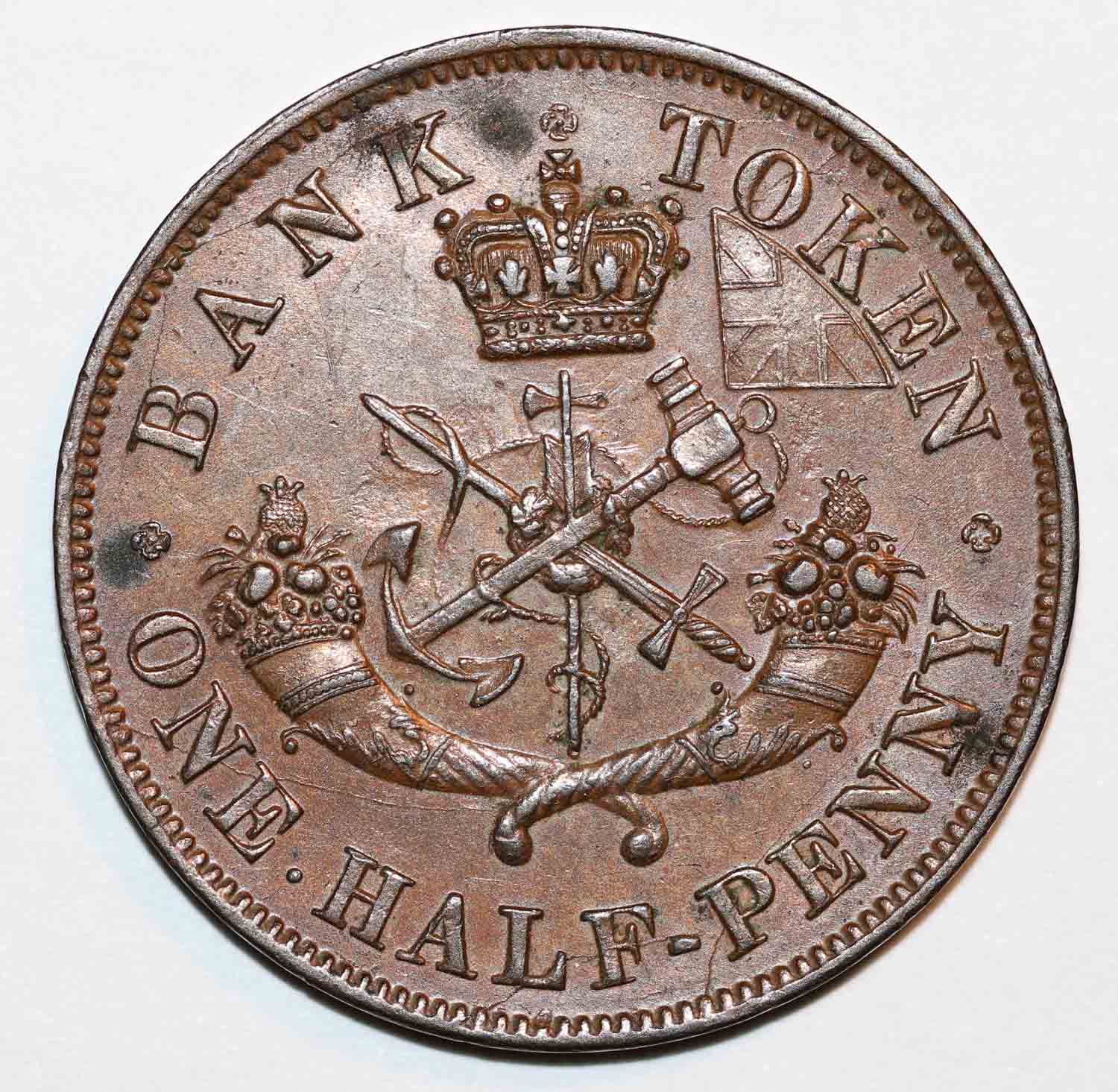 |
|
|
|
Rest in Peace
United States
17900 Posts |
I've always liked this type. Nice original.
|
|
Pillar of the Community
United States
840 Posts |
Phil,
Great token. AU 55.
Will attribute when I have more time.
Take care.
doug
|
|
Pillar of the Community
United States
840 Posts |
Phil,
I will need to know the die-axis.
doug
|
|
Pillar of the Community
Canada
955 Posts |
Edited by Canacoins
01/22/2017 02:09 am
|
|
Pillar of the Community
Canada
638 Posts |
Wow very nice photos and coin Phil310! Also looks like nice doubling  MG |
|
Pillar of the Community
 United States
1101 Posts |
Thanks Doug. It is coin alignment, like U.S. coins. ( So, Heaton mint, I guess )
Thanks MG. I noticed the doubling too. It's pretty bold.
|
|
Pillar of the Community
Canada
3234 Posts |
Very sweet example Phil..
I think that there are safe ways to carefully remove the green and protect that nice token.
|
|
Pillar of the Community
Canada
2786 Posts |
Nice token - and stunning photos (if you don't mind me asking - what set up are you using?)
A challenging series to grade for sure. My initial thoughts were XF40 cleaned as there are a couple of spots showing wear that keep me from saying AU.
But then there are other elements that should also be typically worn - that are not. Could that be a weak strike due to the extensive cracking of the dies?
|
|
Valued Member
Canada
343 Posts |
Nice looking coin - great photos as well.
|
|
Pillar of the Community
United States
1101 Posts |
Thanks DEVLEC. Do you have any advice on ways to remove the green stuff?
Wade, I use a Canon digital camera with a macro lens mounted on a floor tripod over the edge of my desk.
I have the room lighting on, but no other spot lighting, and I also use the camera flash with the camera on macro setting.
I get pretty good detail, but don't get real accurate color. Viper has given me some tips I'm going to try to
get some better color results. I love his photos.
I think all the die cracks could account for weakness of strike in areas of the token. Good observation.
|
|
Pillar of the Community
United States
840 Posts |
Phil, This is Courteau variety 80 having a rarity factor of 5 on a scale of 1-10.
Below is a cut and paste of my notes of this variety.
Forgive the alignment. Something happened in the conversion process.
80 R-5 Coinage Die Axis.
Obverse Characteristics:
A round Knob is to the Dagger Hilt.
The upper outline of the left Wing of the Dragon shews well.
The Legend is Perfect.
The Date is Perfect.
The numeral 2 is close to the numeral 5.
The left-end of the numeral 2 is on-line betwixt the Denticles.
The left-side of the numeral 2 is nearer the Denticles.
Note - This variety is easily confused with variety 87.
An imaginary line from the right-side extremities of the numeral 2 (the upper right corner of the vertical of the base, and the apogee), extends to the right-side of the Stand of the left Upright of the initial H in the abbreviation below the ground.
The Man's left Foot is Perfect.
Two Lines are below the Man's right Arm. The upper is slightly longer; the terminal of the lower appears cloven.
The left Bridle Rein is missing.
Two bold horizontal Lines are below the left Wing of the Dragon.
The Belly of the Horse is double-cut.
Some specimens are found exhibiting Shift-Entry doubling.
Found with or without Die-Clash marks about the left Wing of the Dragon.
Terminal die states exhibit markings (diagonal lines) above the left Wing of the Dragon. At present, the author is unable to positively ascertain the corresponding reverse designs elements mimicked by the Die-Clash.
A Lump is below the left Hoof of the Horse.
Using considerable imagination, this appears as a globular mass below the left Hoof of the Horse, which is on-line with the right Upright of the N in CANADA.
Note - This lump is not readily discernable on even high-grade specimens. Dependent upon the lighting and angle of view, this mass chamaeleons in shape and size.
From perfect and broken dies.
A Die-Crack is to the B in BANK
This curved Die-Crack is from the left-section of the Denticle above the right-side of the B in BANK, extending to the centre of the top of the right-side of the same letter.
Latter die states have the Die-Crack exiting the left end of the base of the same letter and entering the tip of the left ground and running along the inside of the underside of the slope of the underside of the ground, exiting the mid-section of the right-side of the same slope and continuing though the upper left corner of the numeral 1, exiting slightly below the upper right corner of the same letter, and continuing through the upper left shoulder of the numeral 8, and exiting to the vertical of the numeral 5.
A Die-Crack is to the F in OF.
This straight diagonal Die-Crack is from betwixt the Denticles above the right-side of the F in OF, extending through the mid-point of the upper Arm of the same letter, running close to the right-side of the Upright of the same letter, exiting the left-side of the Stand of the same letter, and extending to the upper-section of the 3rd Mantle Fold. The Die-Crack exits the mid-section of the curve of the 5th Mantle Fold, and extends to the apex of the Tail of the Horse. The Die-Crack exits slightly below the apogee of the upper outer curve of the Tail, and gracefully arcs through the field, entering the centre curve of the same Tail slightly above the apogee, and exits the lower section of the same Tail and exits to the Upright of the B in BANK.
Note - At present, the author is unsure whether the Die-Crack to the B in BANK (previously discussed) and the Die-Crack to the F in OF (recently discussed) are two independent Die-Cracks which intersect, or one continuous Die-Crack.
A Die-Crack is to the R in UPPER.
This bent Die-Crack is from the left-side of the Denticle above the right-side of the R in UPPER, running diagonally rightward, and turning abruptly downward, through the right edge of the curve of the same letter, extending through the lower Leg of the same letter, and extending into the field, and curving to the lower Lip of the Snout of the Horse.
A Die-Crack is to the 3rd A in CANADA.
This Die-Crack is from the centre of the Denticle above the left Leg of the 3rd A in CANADA, extending to the upper left-corner of the same letter.
A Die-Crack is to the numeral 1.
This is the terminal state of the Die-Crack to the B in BANK (previously discussed).
Reverse Characteristics: Basically the same as varieties 78 and 79, but having additional
Die-Cracks.
The Anchor Ring is Perfect.
The Anchor Rope ends with a Dot and a small line.
The Battle Axe has a hole.
Four Dots are betwixt the Feather and Anchor Shaft.
The Legend is Perfect.
The outline of the Union Jack is nearly Perfect and strongly struck.
The section of Union Jack betwixt the K and E in TOKEN is wide and abruptly narrows to normal width.
On higher grade specimens, a faint remnant of doubling is detectable at the terminal of the Union Jack.
Only the upper section of the frame of the St. Andrew's Cross frame shews below the E in TOKEN.
The upper section of the St. Andrew's Cross frame merges with the outline of the Union Jack on-line with the mid-section of the E in TOKEN.
The inner ornamental Balls are not connected to the Cornucopia.
Some ensamples are found having Die-Clash marks about the Battle Axe Head.
From perfect and broken Dies.
A Die-Crack is to the P in PENNY. The same as variety 79.
This diagonal Die-Crack is from right-section of the Denticle below the centre of the Hyphen, extending to the left-side of the Upright of the P in PENNY, on-line with the horizontal of the same letter transversing the same upright and hollow, exiting the shoulder of the same letter, and arching above the EN in the same word, and exiting to the top of the left upright of the 2nd N in the same word.
Note - This Die-Crack and the next to be discussed intersect each other near the left-side of the Upright of the P. The Die-Cracks do not merge together, but intersect.
A Die-Crack is to the L and F in HALF.
This long Die-Crack is from the lower right-side of the Denticle below the right Leg of the A in HALF, extending through the upper section of the Denticle to the immediate right, extending through the base of the L in the same word, on-line with the right-side of the Upright of the same letter, exiting near the top of the right-side vertical of the right-side of the base of the same letter, continuing through the mid-section and Cross Bar of the F in the same word, continuing across the top of the hyphen, curving downward and intersecting the Die-Crack to the P in PENNY (previously discussed) and exiting to the lower section of the left-side of the Upright of the same letter, slightly below the Die-Crack from the P.
Note - Early die states only shew the section of the Die-Crack betwixt the hyphen and the vertical of the F.
Note - This Die-Crack and the previous intersect each other near the left-side of the Upright of the P. The Die-Cracks do not merge together, but intersect.
A Die-Crack is to the T in TOKEN.
This straight Die-Crack from the field below the denticle to the immediate right of the Upper Rosette, and exiting to the upper left corner of the T in TOKEN, exiting the upper right corner of the same letter, and exiting to the denticle above the left-side of the O in the same word.
A Die-Crack is to the O in TOKEN.
This diagonal Die-Crack from left section of the Denticle above the outer right-side of the O in TOKEN, extending to the upper right-side of the same O. The Die-Crack continues in an irregular bending fashion through the mid section of the same letter, exiting the lower left-side of the same letter, and continuing through the tip of the Shield, and continuing through the lower section of the upper right-side Jewel of the Crown, and exiting to the right shoulder of the Crown.
Note - This Die-Crack was not mentioned by Doctor Courteau.
A Die-Crack is to the O in TOKEN. (Another).
This diagonal forked Die-Crack is from the centre of the Denticle betwixt the O and K in TOKEN. This is from a latter die-state of specimens already sewing the previous discussed Die-Crack. Midway to the same vicinity of the juncture of the previous Die-Crack with the same O, this Die-Crack forks. The right branch extends to the left-side of the Serif of the K in the same word, and continues through the tops of the E and N of the same word.
The main branch continues in a curving fashion to the same area of impact as the previously discussed Die-Crack. This second Die-Crack passes atop the previous Die-Crack, and extends in an irregular bending fashion through the mid-section of the same letter. This section of the Die-Cracks runs above and parallel to the previous Die-Crack. This Die-Crack exits the lower left-side of the O (above the previously mentioned Die-Crack), and continues through the right-side of the Stand of the T in the same word, through the mid-section of the inner upper Crown Jewel, and finally disappearing at the right-side column of Pearls of the Crown.
Note - This Die-Crack was not mentioned by Doctor Courteau.
A Die-Crack is to the N and E in ONE.
This diagonal Die-Crack is from the base of the right-side of the Denticle betwixt the O and N in ONE, passing through the upper left corner of the Denticle to the immediate right, and extending through the right-side of the Stand of the N in the same word, continuing through the lower section of the diagonal of the same letter, exiting the mid-section of the right-side of the right Upright of the same letter, and extending through the upper section of the E in the same word, and extending through the field to the vertex of the left Cornucopia and the Handle of the right Cornucopia.
Note - This Die-Crack was not mentioned by Doctor Courteau.
A Die-Crack is to the B in BANK.
This long Die-Crack is from the left-side of the Denticle below the left Rosette, extending through the top of the B in BANK, and exiting to the left-side of the Denticle above the A in the same word.
Note - This Die-Crack was not mentioned by Doctor Courteau.
A Die-Crack is to the N and K in BANK.
This long curving Die-Crack is through the Denticle above the A in BANK, extending through the Serifs of the N and K in the same word, exiting to the centre of the Denticle to the immediate left of the upper Rosette.
Note - This Die-Crack was not mentioned by Doctor Courteau.
Thus:
80 A Die-Crack is to the P in PENNY.
80A Die-Cracks as above, plus a Die-Crack is to the N and E in ONE.
Die-Cracks as above, plus a Die-Crack is to the 3rd A in CANADA.
80B Die-Cracks as above, plus a Die-Crack is to the L and F in HALF.
80C Die-Cracks as above, plus a Die-Crack is to the B in BANK (reverse).
Die-Cracks as above, plus a Die-Crack is to the F in OF.
80D Die-Cracks as above, plus multiple Die-Cracks are to the O in TOKEN.
Die-Cracks as above, plus a Die-Crack is to the B in BANK (obverse).
Die-Cracks as above, plus a Die-Crack is to the N and K in BANK (reverse).
Die-Cracks as above, plus a Die-Crack is to the R in UPPER.
Die-Cracks as above, plus a Die-Crack is to the T in TOKEN.
Note - Many Die-Cracks were not mentioned by Doctor Courteau.
This is the Die-Crack progression.
|
|
Pillar of the Community
United States
840 Posts |
Wade
Initially I was at a solid AU 50, but the fields are rather clean of bag marks and
the colour appears good.
Most of the clutter is attributed to being die-cracks, or clash marks, not misusage.
Likewise with some of the depressions. These are not attributed to rust. I suspect
a faulty planchet.
I opted to be liberal at AU 55; I will not squabble at AU 50.
And this is from the terminal die-state of this variety.
This may attribute to some of the softness to the strike.
doug
|
|
Pillar of the Community
New Zealand
1679 Posts |
Cheers Don
Vickies cents and GB Farthings nut.
"Old" is a figure of speech and nothing more
|
|
Pillar of the Community
Canada
3234 Posts |
Quote:
Thanks DEVLEC. Do you have any advice on ways to remove the green stuff?
Yes Phil..I hope that it works..PM sent.. |
|
Pillar of the Community
United States
1101 Posts |
Thanks Doug! Your work in describing the die cracks and other features of this variety is really amazing! What's even more amazing is to think you have such a description for all the other varieties also.
Since this is the terminal state, it's fun to read your descriptions and look at the corresponding crack on the photos. I can even see the lump below the left hoof of the horse! It is indeed a "globular mass".
Thanks Don and DEVLEC.
|
| |
Replies: 19 / Views: 3,441 |




 Posted 01/21/2017 10:14 pm





