I've previously posted about the 1936 Albany Charter half dollar here (
Original Post) and here (
Ephemera Follow-Up).
I thought I'd revisit those posts with a short supplement that discusses a lesser-know aspect of the coin and its intended purpose.
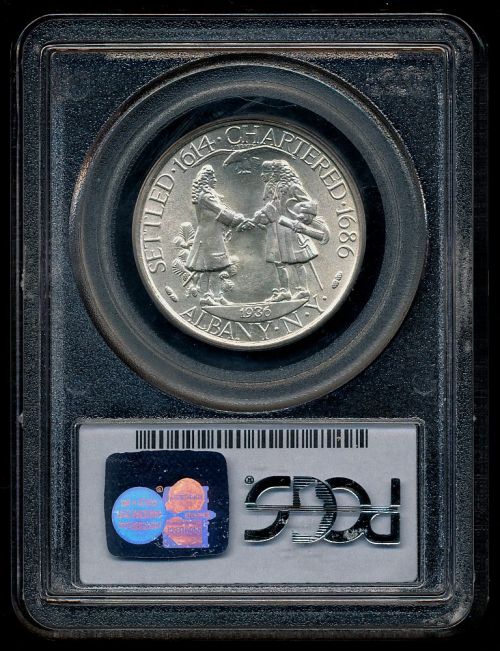
The 1936 Albany half dollar marked the 250th anniversary of the granting to Albany of a city charter by Thomas Dongan, the Governor of the Province of New York. A stylized depiction of the ceremony is found on the reverse of the coin with Dongan on the left and Peter Schuyler and Robert Livingston to the right (viewer's perspective).
Read More: Commems CollectionThe city marked its historic anniversary with four days of commemorative events, beginning on July 19, 1936 and running through July 22nd. New York Governor Herbert H. Lehman officially opened the city's celebrations from the steps of the State Capitol on July 20th with a speech that recounted the history of Albany and called for a present-day continuation of the same spirit of "tolerance and understanding and sympathy" as was shown by the area's early pioneers.
The overall celebration included parades, church services, athletic contests, formal dinners and, of course, the obligatory speeches by politicians and VIPs. Contemporary accounts of the festivities report a parade with 200 floats and 10,000+ marchers; a crowd of over 300,000 was expected to line Albany's streets to view the parade. A newly-written history of Albany was also published to support the anniversary.
As with other US commemorative coins before and since, the Albany half dollar was intended as a fundraising tool to help pay for the city's celebrations. The half dollar was a bit atypical, however, in that it was not sponsored by a private organization; it was sponsored by the city of Albany.
The coin's authorizing legislation directed the mayor of Albany to form a committee - of no less than three members - to oversee the sale and distribution of the coins and to manage the funds derived as a result. The legislation also mandated that the funds raised by the committee via the coin "shall be used by it in defraying the expenses incident and appropriate to the commemoration of such event."
Well, after taking care of all its anniversary celebration expenses and reconciling its books, the committee found that it had $4,063.49 left over in its coin fund. At that point, a dilemma arose. The committee was only authorized to spend the coin funds on the costs related to the city's anniversary celebration, with no such expenses to be paid it was not clear what could be done with the remaining money.
Rather than "invent" an expense to exhaust the funds, Albany Mayor Erastus Corning decided to ask Congress for an amendment to its original coin bill that would allow the funds to be transferred to the general fund of the city.
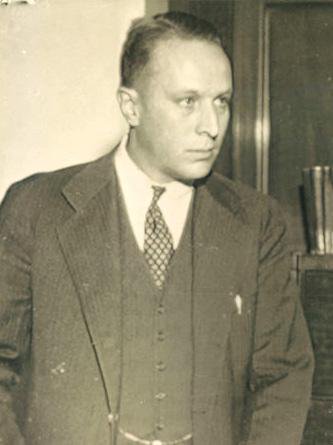
Erastus Corning circa 1943
Quick Sidebar: Corning was elected mayor in November 1941 at the age of 32. He took office on January 2, 1942 and continued to serves as mayor until he died on May 28, 1983 - he was re-elected 10 times and served more than 41 years!In March and April of 1943, bills were introduced in the House and Senate, respectively, "To provide that the unexpected proceeds from the sale of 50-cent pieces coined in commemoration of the two hundred and fiftieth anniversary of the founding of the city of Albany, New York, may be paid into the general funds of such city."
The US Treasury was consulted about the bill and its proposed alternate distribution of commemorative coinage funds and, after due consideration, reported that "it had no interest" in the funds and thus had no objection to the bill. As a result, the Senate Committee on Banking and Currency - the Senate committee that reviewed all coin-related legislation - recommended that the bill be approved.
The bill was brought to a vote in the full Senate and passed. The House, however, did not bring its version of the bill, or the Senate's version, up for a vote. As a result, the bill died with the adjournment of the 78th Congress.
The same bills were re-introduced in the House and Senate in 1946, during the 79th Congress. The Senate version of the bill was once again passed and, this time, the House also took action. It laid its version of the bill on the table and approved the Senate version; the bills were identical.
The bill was soon signed by President Harry S. Truman and became Public Law 79-653 on August 7, 1946. With Truman's signature, the City of Albany became $4,000 richer! I wonder if they did anything in particular with the funds?
With all of the mishandling, favoritism and outright corruption that was part of the US commemorative coin scene throughout the 1930s, the handling of the Albany half dollar stands out as an example of how to do things the "right" way.
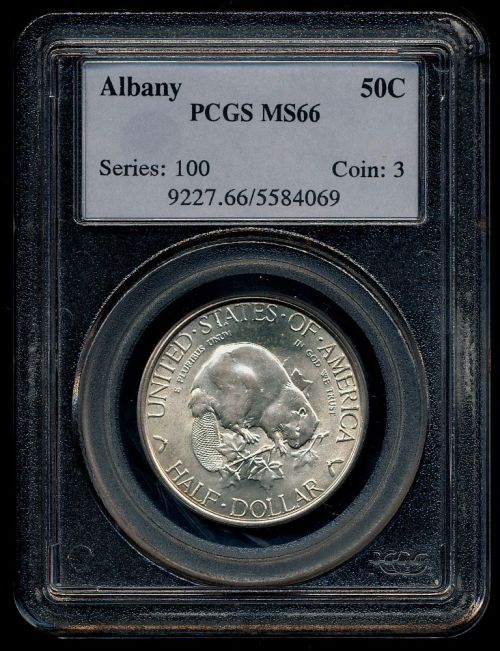
Following are images of the Albany in my collection.







 Posted 04/25/2017 7:54 pm





